
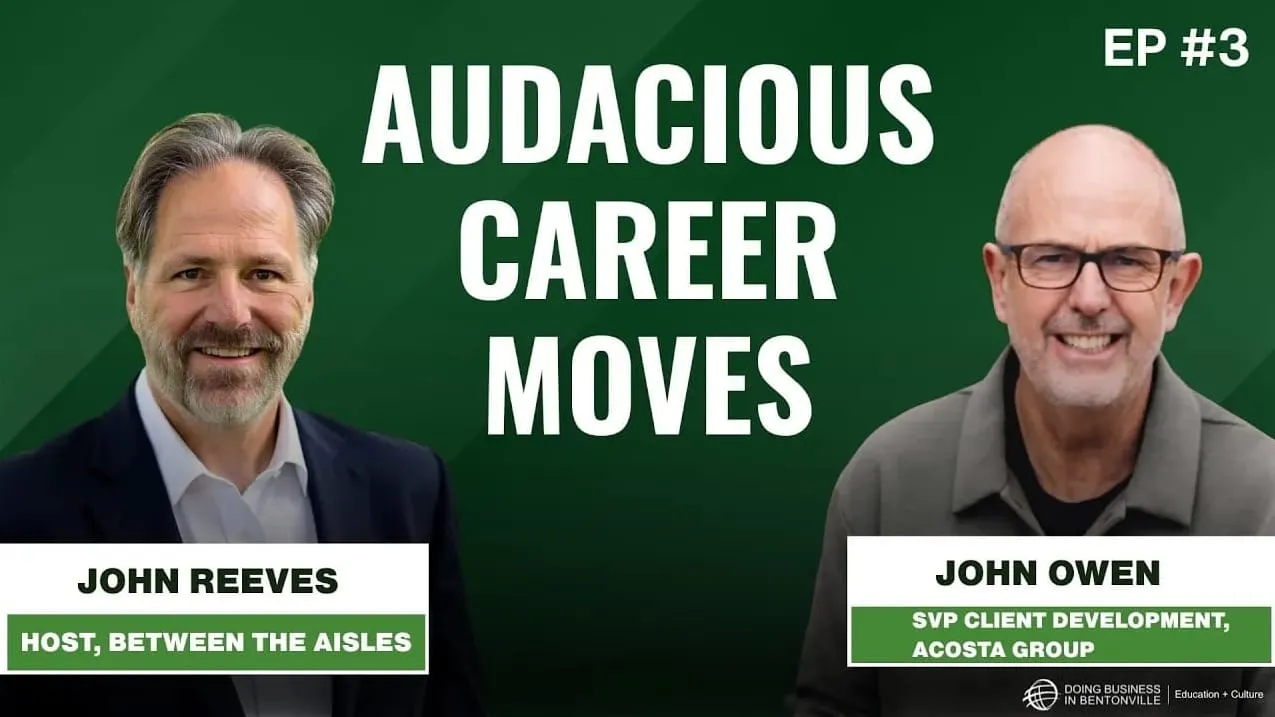
Corporate strategy looks clean on a slide deck, but the actual execution of a business plan is entirely determined by human behavior. Many companies waste millions trying to force an established operational blueprint onto a completely different market without assessing local realities. We sit down with John Owen, Senior Vice President of Headquarter Client Development for Walmart at Acosta Group, who shares how a series of proactive, unscripted decisions shaped a highly diverse international retail career.
We get into what it was actually like to report directly to retail titans like Tom Coughlin and Bill Fields during Walmart’s hyper-growth era of the 1990s. John walks us through the tactical friction of category management deployment in Mexico City, the financial lessons of managing a corporate profit and loss statement, and the strategic missteps of trying to replicate American retail culture inside Germany. We also break down the high stakes of competing directly against future Walmart CEO Doug McMillon during a intense period of market share rivalry with Kmart.
The harder part of corporate leadership isn't analyzing data; it's maintaining absolute organizational clarity when a business scales to millions of customers. John highlights the hidden operational risks of managing cash flow in independent business ventures and the friction of returning to a massive organization after nearly two decades away. True leadership requires constant, repetitive reinforcement of foundational principles rather than relying on standard corporate perks or superficial engagement programs.
If you care about corporate leadership, international retail execution, and data-driven category management, you’ll get a lot from this conversation. Please subscribe to the channel and share this video with another professional looking to build a sustainable career in the consumer packaged goods industry. What is the single most critical leadership lesson you have learned from a professional mentor that still guides your day-to-day decisions? Let us know in the comments below.
More About this Episode
The Blueprint of Scale: What Twenty Years Across Global Retail Taught Me About Corporate DNA
When we look at the landscape of modern commerce, we often fall into the trap of analyzing business through a clinical lens. We study capital allocation models, geographic expansion strategies, supply chain optimization metrics, and sophisticated data-sharing frameworks. Yet, after spending decades navigating the shifting tides of retail across four continents, I have come to realize a fundamental truth that defies standard spreadsheet analysis. Culture eats strategy for breakfast every single day.
You can deploy an exceptional, airtight strategy within an organization possessing a toxic or indifferent culture, and the machinery will eventually grind to a halt. Conversely, you can take an average strategy, place it in the hands of a high-functioning, deeply aligned culture, and that organization will consistently find a way to win. A thriving organizational DNA means that people show up to work feeling deeply invested. They unlock discretionary effort, identify hidden market opportunities, and actively protect the core mission of the enterprise because they feel personally respected and empowered.
True organizational strength does not manifest through corporate happy hours or superficial perks. It crystallizes when leadership establishes clear expectations, provides tangible pathways for upward mobility, and preserves the absolute clarity of the core mission through relentless reinforcement.
The Audacity of Initiative: Engineering Your Own Milestones
Early in my professional life, I learned that the world operates on a simple premise: the market owes you absolutely nothing. If you want to accelerate your development, you must learn to recognize subtle windows of opportunity and possess the raw audacity to act upon them, regardless of how intimidating the corporate hierarchy might seem.
My journey inside the foundational ecosystem of American retail began in the early 1990s within the internal audit department of Walmart. It was a rigorous, trial-by-fire environment. We would pile into a Pontiac Grand Am at 6:00 on a Monday morning, driving ten hours or more to remote locations, living on a strict fifteen dollars a day for food. It was an exhaustive introduction to operational realities, but it provided a pristine view of how a massive organization functioned at the store level.
The pivotal moment of my early career materialized during an all-hands audit assembly led by Paul Carter, who served as the Chief Financial Officer at the time. He asked the newcomers to stand up and introduce themselves. Given my background, having grown up in South Africa and completed high school in Australia before playing collegiate tennis in the United States, my accent naturally stood out. Upon hearing my introduction, Paul Carter offered a casual, offhand remark: "Come see me in six months and tell me something about European retailing."
In a corporate environment, it is incredibly easy to mistake a polite executive pleasantry for a genuine directive. Most people would have let that moment slide. But I chose to take him entirely at his word.
Because email and the internet were in their absolute infancy, I immediately called my father in the United Kingdom, instructing him to physical-mail me every corporate annual report, retail trade publication, and financial analysis he could get his hands on. I spent my Sundays writing detailed comparative analyses of international retail models. Exactly six months to the day, I walked down to Executive Row, carried a bound report into the CFO office, and presented it to a visibly stunned Paul Carter. He had completely forgotten the exchange, but the sheer initiative spoke volumes. Within a week, I was moved out of internal audit and promoted into Corporate Treasury.
Taking ownership of your career trajectory requires this precise blend of initiative and execution. Years later, I observed a parallel dynamic when working under Tom Owen, who was managing Walmart specialized operating groups, pharmacy, optical, jewelry, and automotive centers. While working in treasury, I was tasked with developing an entirely new financial model to allocate store accident costs fairly, ensuring that locations with excellent safety records weren't unfairly penalized by a flat, company-wide distribution. To implement the model, I needed buy-in from the highest levels of operations.
Instead of hiding behind layers of corporate bureaucracy, I explicitly targeted Tom Owen at the conclusion of a massive Saturday morning meeting. I intercepted him right outside the main auditorium, standing over a gray trash can, and pitched the financial restructuring logic directly to him. He was a larger-than-life, intensely charismatic figure who could terrify underprepared executives with a single look. Yet, instead of dismissing the audacity of a young executive, he recognized the underlying value of the initiative. Less than two weeks later, he bypassed traditional corporate channels, offered a massive compensation adjustment that sent the traditional finance department into a tailspin, and brought me on as his dedicated finance director for the specialty divisions.
Leadership by Investment: The Human Capital Metric
When an organization scales into an international titan, maintaining the human element becomes its greatest operational vulnerability. True leaders do not scale through the imposition of ego; they scale by aggressively investing in the generation that will eventually replace them.
Tom Owen exemplified this philosophy through unconventional, highly impactful methods of cultural alignment. I remember a Friday afternoon in 1993 when he asked about my weekend plans. I mentioned that my wife and I had just finished constructing our first home, which was plagued with severe drainage issues, and that I had twenty tons of red clay dirt sitting in the driveway waiting to be moved. He asked if I possessed a tractor or a box blade. Being a city kid from South Africa, I candidly admitted I had no idea what a box blade even was.
At 8:00 the following morning, a Saturday morning when senior executives were traditionally required to be commanding corporate strategy sessions, Tom Owen backed his personal truck and tractor trailer into my driveway. He didn't delegate the task, and he didn't seek corporate recognition. He spent hours working alongside a junior employee to level the landscape, intentionally building a profound sense of personal loyalty that no corporate compensation package could ever replicate.
He understood that operational excellence is fundamentally driven by mutual respect. He reinforced this daily focus through symbolic gestures that carried deep operational meaning. He famously distributed standard Timex Iron Man watches to his direct reports at a time when stock options and executive bonuses were making many of them wealthy. His rationale was brilliantly clear: "You guys now make good money, but your customers do not. I want you to wear this watch to work every single day so that every time you look down at your wrist, you are explicitly reminded of exactly who you serve."
This relentless focus on the consumer was mirrored by Bill Fields, the Executive Vice President of Merchandising, for whom I later served as Chief Financial Officer of Walmart US operations. Bill Fields was a towering operational force who managed the domestic profit and loss statement with absolute granularity. My role required me to manually compile data matrix infrastructure feeds into custom financial models, ensuring a precise snapshot of the domestic P&L was sitting on his desk by 6:05 every morning.
If the technology pipelines lagged, I would track him down to the corporate break rooms where legacy retail leaders debated market movements over coffee and tobacco smoke. It was an environment characterized by early mornings, intense operational accountability, and an unyielding commitment to parsing consumer behavior down to the single penny.
The Pitfalls of Global Adaptation: The Friction of Corporate Friction
As domestic markets mature, the pressure to replicate corporate success internationally becomes an organizational imperative. However, cross-border expansion introduces severe cultural friction points that can easily derail even the most sophisticated retail enterprises.
In 1997, I was deployed as a General Merchandise Manager to Mexico City to help oversee the integration and acceleration of a massive joint-venture partnership with Cifra, the largest retail conglomerate in Mexico. The assignment was designed to inject American hypermarket operational discipline into an ecosystem comprised of twenty-four early Supercenters, multiple Sam's Clubs, clothing retail chains, and restaurant properties.
Our core mandate was to introduce the foundational doctrine of Everyday Low Price (EDLP) and structured category management into a retail market that had historically operated under entirely different principles. The domestic Mexican market was profoundly reliant on high-velocity high-low promotional circulars, frequently discounting entire inventory categories by forty to fifty percent to aggregate foot traffic.
When our expatriate leadership team arbitrarily dismantled those promotional structures to force a pure American EDLP model, consumer traffic plummeted instantly. The local consumer base did not trust the long-term value proposition of smoothed pricing; they demanded the psychological validation of the immediate, massive promotional event.
Simultaneously, we encountered severe friction regarding operational labor structures. The Mexican retail ecosystem utilized thousands of supplier-funded promotional workers who entered retail stores daily to stock, merchandise, and organize specific brand footprints. From a sterile balance-sheet perspective, this looked like free labor. In an effort to assert total operational control and standardize store layouts, international leadership dictated the elimination of this system, expecting in-house associates to pick up the slack. The immediate result was a catastrophic degradation of on-shelf availability and a sharp drop in overall sales velocity. We had to quickly pivot, modify our rigid assumptions, and carefully blend corporate ideals with the ingrained cultural realities of the local market. Today, that division thrives with over four hundred Supercenters because we eventually learned to adapt the corporate DNA to the local landscape rather than forcing a total institutional rewrite.
The consequences of failing to respect this delicate balance became starkly apparent during my subsequent deployment to Germany. Following the acquisition of the Wertkauf hypermarket chain, corporate leadership initially intended to spend two years quietly absorbing the nuances of German consumer behavior and European supply chain structures.
However, that strategic patience disintegrated within ninety days. Leadership abruptly ordered an aggressive, top-down implementation of pure EDLP frameworks and American corporate protocols. The German consumer base, highly protective of localized retail patterns and deeply skeptical of foreign corporate interventions, reacted with cold indifference. The regional workforce resisted the sudden imposition of standardized American cultural practices. This aggressive attempt to copy-paste corporate DNA onto an incompatible cultural framework resulted in massive capital destruction, ultimately forcing a complete withdrawal from the German market.
Micro Space Mechanics: Elevating the Store of the Community
Upon returning to domestic operations, Tom Owen handed me a conceptual challenge that we eventually mapped out on the back of a paper napkin in a local tavern, a strategic initiative that we formally christened Store of the Community.
As a national retail footprint expands from central geographic corridors to opposite coastlines, the structural efficacy of the single corporate prototype completely breaks down. A standard merchandise assortment that maximizes capital efficiency in a rural Midwestern community will fail miserably if forced into Oceanside, California, or Delray Beach, Florida.
The Store of the Community framework applied macro category management principles directly to spatial allocation modeling. We began analyzing local demographic realities with intense precision. If data profiles indicated that seventy percent of the population surrounding our Delray Beach location consisted of retirees over the age of seventy, it was a logical failure to deploy a standard suburban product matrix.
We completely re-engineered the spatial landscape. We expanded the physical footprint of the pharmacy and health-related fields, downscaling categories like infant care and youth athletic goods. Conversely, in a coastal, military-adjacent family hub like Oceanside, the spatial matrix flipped entirely toward high-velocity consumables, juvenile products, and recreational items.
By applying these macro adjustments to department sizes, category depths, and item-level assortments, we transformed the retail floor from a rigid corporate monoculture into a highly fluid, localized marketplace. This analytical framework remains an absolute cornerstone of modern consumer packaged goods strategy. Today, when advising enterprises on navigating major retail line reviews, I continually emphasize that an item's right to distribution is entirely dependent on localized relevance. If you can leverage data platforms to handle the complex analytical heavy lifting for the corporate buyer, explicitly demonstrating why an assortment shift aligns perfectly with local consumer demographics, you secure a sustainable marketplace advantage.
Market Friction and the Illusion of Data Dominance
The volatility of corporate competition was driven home to me in 2000, when I transitioned from Bentonville to assume the role of Senior Vice President of Hardlines for Kmart, which at the time stood as a major domestic competitor. It was an era of fierce, hyper-aggressive market share warfare.
My immediate peer across the competitive line was Doug McMillon, who was managing the hardlines portfolio for Walmart. The competitive environment was so intense that my corporate headshot was mounted directly onto a physical bullseye target on the back of his office door. We fought relentlessly over single percentage points of domestic market share, shifting massive volumes in toy and seasonal categories through cutthroat pricing and aggressive supply chain maneuvering. Although Kmart subsequent financial restructurings and eventual bankruptcy rewrote the history of that era, the experience provided an invaluable lesson in the sheer velocity of market discipline.
Following that turbulent period, I stepped completely outside the protective umbrella of massive corporate ecosystems to launch a chain of twenty-three convenience stores and a dedicated fuel logistics company in South Dakota alongside close partners. Managing a mid-sized, independent enterprise is an incredibly grounding experience that every corporate executive should undergo. In a massive corporation, you are insulated by pre-built cultural momentum and specialized internal departments. In an independent, entrepreneurial environment, you are directly exposed to the brutal realities of daily cash flow mechanics.
I remember my corporate peers laughing about our revenue metrics, noting that their single-category return volumes eclipsed our entire annual corporate revenue. My response was always grounded in operational reality: "When you sit in a massive corporate buying seat, you don't actually understand where cash flow originates. You understand how to pull levers that drive top-line numbers through a register, but you are completely insulated from the true velocity of capital."
Running an independent business means that when a controller fails to execute ethically, you step in and personally manage the bank reconciliations for twelve months. You quickly learn the terrifying mechanics of fuel asset pricing. When the wholesale price of fuel escalates rapidly, your liquid cash reserves are instantly drained into the ground to maintain physical inventory tanks, and you do not realize those returns until macro pricing moves downward. It was a masterclass in capital liquidity, operational agility, and the raw realities of business survival.
This foundational understanding of data asymmetry later guided my work at Nielsen, where I managed the global Walmart data relationship. In the early 2000s, Walmart had famously elected to hide its point-of-sale data pipelines from major tracking firms, effectively shielding the meteoric rise of its Supercenter division from competitive surveillance. My core mandate was to systematically demonstrate to executive leadership that the strategic blindness caused by this data isolation far outweighed the perceived competitive protection.
We had to continuously unearth specific market anomalies to illustrate what they were missing. For instance, we leveraged specialized household panel data to show that Dollar General had quietly engineered a highly customized package size for Tide laundry detergent. This targeted volume play was aggressively peeling market share away from Walmart in a critical, high-velocity category, a structural shift that corporate merchants were completely blind to because they were insulated from broader market data sharing.
Showing how specific blind spots compromised their category dominance eventually convinced leadership to re-engage with industry-wide point-of-sale data frameworks. It proved that access to granular consumer data is an absolute prerequisite for maintaining market leadership.
The Preservation of Corporate Identity Through Clarity
Returning to the halls of Walmart domestic headquarters nineteen years after my initial departure provided a fascinating, highly unique perspective on corporate transformation. When Doug McMillon welcomed me back to help lead store layout and architectural design during the onset of the pandemic, he offered a candid piece of advice: "I am warning you right now, the culture has changed."
When you remain embedded within an organization during its multi-decade expansion, your perception of cultural drift is naturally obscured. It is the corporate equivalent of gaining a single pound of physical weight every year for twenty years; the day-to-day transition is entirely imperceptible. But if you step completely outside the ecosystem and return two decades later, the immediate impact is equivalent to waking up twenty pounds heavier overnight. You perceive the structural transformation instantly.
The lean, fiercely entrepreneurial retail machine of the 1990s had inevitably evolved into a highly complex, matrix-driven global enterprise. Where a single operational executive once held absolute, clear accountability for an institutional outcome, responsibility was now distributed across multi-layered corporate committees and cross-functional matrix teams. The mandatory Saturday morning meetings that once served as the central furnace for cultural alignment, operational visibility, and raw executive development had naturally been scaled back by the realities of a global workforce.
Yet, this evolution highlights the single greatest challenge facing any mature enterprise: the intentional preservation of institutional clarity. The legendary CEOs of early retail history did not maintain organizational alignment through complex corporate manifestos. They achieved it through the deliberate, unyielding repetition of fundamental principles.
David Glass, who masterfully guided Walmart through its most explosive era of physical growth in the 1990s, was an absolute master of this discipline. I remember attending my first Friday morning executive review as a young finance director, waiting with intense anticipation for the Chief Executive Officer to deliver a profound, highly complex strategic doctrine to the assembled leadership team.
Instead, David Glass took the microphone and delivered a series of incredibly basic, plain-spoken mandates: "We must focus heavily on driving structural costs out of our supply chain. We must take exceptional care of the individual customer. We must ensure our stores are accurately assorted for the local communities."
I carefully noted his comments. The following week, he stepped up to the microphone and delivered the exact same message, using nearly identical phrasing. He repeated this cycle week after week, month after month. Initially, my youthful perspective mistook this for a lack of strategic variation. But then, the brilliant simplicity of his leadership model became crystal clear.
He understood that in a rapidly scaling organization adding tens of thousands of new associates every single year, cultural dilution is an existential threat. He knew that the moment a chief executive stops repeating the core mission, the lower tiers of the organization completely lose their operational compass. He prioritized absolute institutional clarity above all else.
True corporate culture is not a static set of values printed on a corporate plaque; it is a living, breathing operational framework that requires constant nurturing, fierce protection, and relentless reinforcement. It is the ultimate foundation of sustainable market dominance. Communicate clearly, protect your people, understand your consumer down to the local shelf level, and never lose sight of the foundational principles that earned you the right to serve them in the first place.