
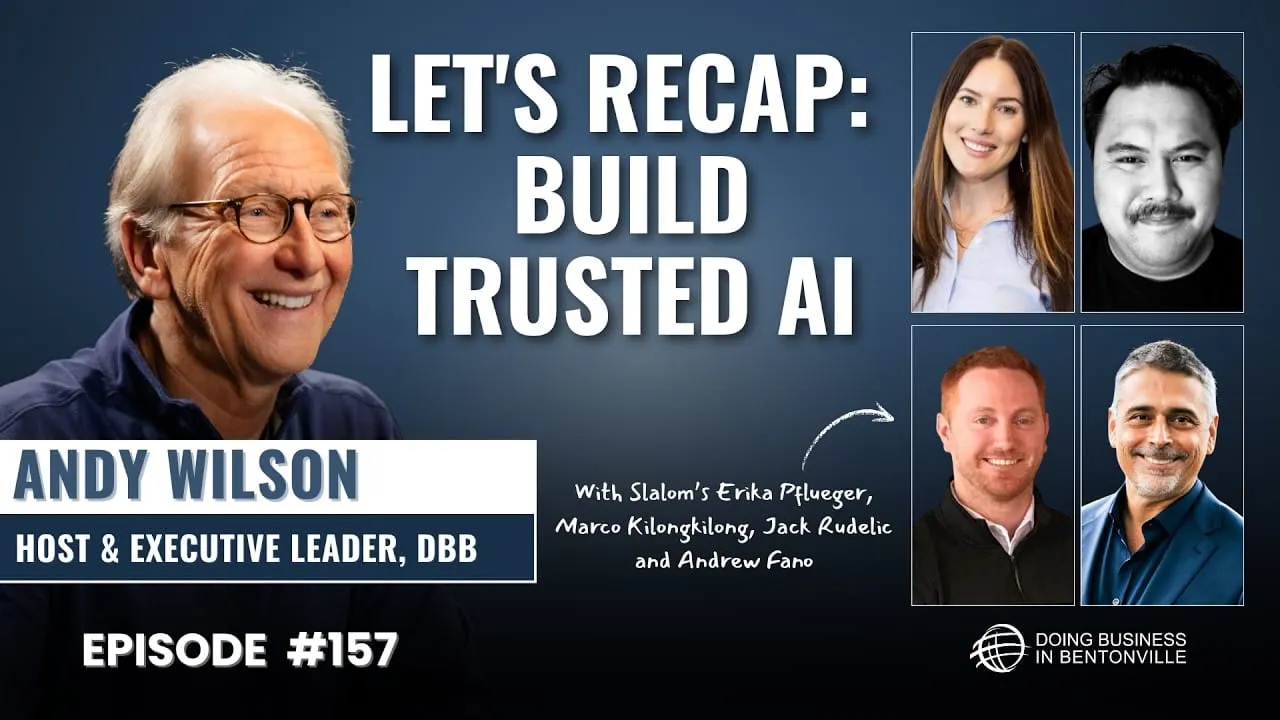
Unmonitored automation is a massive enterprise risk that will quietly destroy consumer trust if left unchecked. With eighty percent of retailers actively expanding their artificial intelligence capabilities this year, establishing clear guardrails separates the companies scaling efficiently from those facing catastrophic system failures. In this episode, we sit down with Andrew, Jack, Erica, and Marco from Slalom to unpack how modern enterprises are integrating generative AI, establishing operational governance, and driving real business outcomes.
We get into the mechanics of taking complex technology from a back-of-the-napkin concept to a fully productionized system within heavily regulated industries. The discussion highlights concrete tactics for shifting product development left to build high-fidelity roadmaps, empowering citizen developers across organizations, and safely connecting LLMs to enterprise data sources to eliminate manual workflows. The Slalom team's key insight is that effective AI integration isn't about adding another tool to an employee's daily routine; it's about removing manual work so teams can focus on high-level problem-solving and creative execution.
Deploying cutting-edge tech means confronting the hard operational hurdles of legal ambiguity, data privacy compliance, and internal pushback. Most pilot programs never make it to production simply because organizations lack the due diligence frameworks required to manage the risk of autonomous systems. You will walk away from this conversation with a practical mindset shift around AI governance as a collaborative team sport, learning how to structure clear lines of human accountability, deploy robust compliance controls, and prevent expensive software from sitting unused due to poor workforce adoption.
If you care about enterprise AI governance, operational efficiency, and building a high-trust digital retail ecosystem, you’ll get a lot from this. Please subscribe to the channel and share this episode with other industry leaders who are navigating digital transformation in their own organizations. What is the biggest manual workflow in your daily operations that you are ready to eliminate with automation?
More About this Episode
How Generative AI and Robust Governance Are Transforming Retail and Enterprise Productivity
The retail and corporate landscape is experiencing a profound shift driven by generative artificial intelligence, transforming how organizations handle everything from back-office logistics to customer-facing shopping experiences. Across major business hubs and retail centers globally, boardroom conversations are no longer about whether to adopt artificial intelligence, but how to deploy it rapidly without breaking existing systems or losing consumer trust. While the promise of automated workflows and intelligent virtual assistants is immense, the difference between a successful enterprise transformation and a stalled proof of concept ultimately comes down to strategy, culture, and governance. To truly harness emerging technologies, organizations must move beyond the hype and focus on eliminating manual friction, empowering employees, and establishing ethical guardrails that protect the business.
Unlocking Domain Knowledge and Eliminating Data Bottlenecks
Every modern corporation sits on mountains of data. Decades of transactional records, supply chain metrics, customer behavioral profiles, and proprietary domain knowledge live within complex enterprise systems. Yet, for many employees, extracting fast, actionable answers from this vast sea of information remains a daily bottleneck. The business relies on speed, whether a logistics manager is trying to optimize a delivery route or a human resources specialist is navigating employee benefit inquiries. When data is siloed across disparate platforms, decision-making slows down, creating inefficiencies that ripple across the entire supply chain.
Generative artificial intelligence and large language models act as the connective tissue between these siloed databases and the people who need answers. By securely attaching intelligent models to existing enterprise architecture, companies can process and synthesize massive volumes of information at speeds no human team could ever match. In practical terms, this means a logistics coordinator can instantly model routing parameters to avoid weather disruptions, or a retail store associate can query an internal assistant to check inventory levels and product specifications in real time.
The true power of enterprise AI lies not in replacing human judgment, but in accelerating the retrieval of critical insights. When employees spend less time hunting for data across cumbersome software interfaces, they can dedicate their energy to strategic problem-solving, creative product development, and direct client engagement.
Why AI Initiatives Stall Before Reaching Production
Despite the clear operational benefits, a startling number of enterprise artificial intelligence initiatives never make it out of the testing phase. Industry studies, including comprehensive research from institutions like MIT, consistently show a high failure rate for corporate AI projects. It is common to see organizations develop dozens of promising proof-of-concept models, only to leave them sitting in a development sandbox, never deployed to active production.
Two primary missteps drive this stagnation: tool bloat and a lack of foundational governance.
First, when organizations initially experiment with artificial intelligence, they often attempt to introduce entirely new standalone tools to their workforce. However, employees who are already accustomed to specific operational routines rarely want another application to log into or manage. When technology leadership focuses on adding tools rather than solving workflows, adoption rates plummet. The most effective deployments do not ask teams to change how they work; instead, they integrate silently into existing software ecosystems to remove manual, repetitive tasks. When artificial intelligence operates in the background to automate data entry, draft documentation, or generate preliminary analysis, it becomes an indispensable asset rather than an intrusive burden.
Second, many companies move too quickly during the development phase without building the necessary compliance and security infrastructure. As projects approach deployment, executive leadership, legal teams, and compliance officers suddenly realize the potential risks. Without clear oversight, leaders become understandably nervous about releasing autonomous models that could crash critical systems, hallucinate incorrect data, or violate complex privacy regulations. Consequently, expensive, highly capable projects are indefinitely shelved because the organization lacked the confidence to deploy them safely.
The Three Pillars of Responsible AI Governance
Trust is the foundational currency of modern business. Consumers will only engage with digital shopping assistants, and employees will only rely on automated internal systems, as long as they trust the accuracy and security of the underlying technology. Once an organization loses trust through a data breach, algorithmic bias, or a regulatory violation, rebuilding that credibility is an uphill battle. Therefore, establishing robust artificial intelligence governance is not merely a legal checkbox; it is a critical business imperative.
When evaluating the ethical and legal implications of emerging technologies, business leaders must remember one fundamental rule: you cannot blame artificial intelligence when something goes wrong. Human accountability must remain at the center of every automated process. To achieve responsible innovation without stifling speed, organizations must operationalize governance across three interconnected pillars: people, tools, and processes.
- People: Governance must be treated as a collaborative, cross-functional team sport. This involves establishing clear roles for first-line operators whose hands are on the keyboard, due diligence teams spanning legal, compliance, privacy, and IT security, and independent internal auditors who verify ongoing adherence to company standards.
- Tools: Every piece of technology in the development pipeline must be rigorously audited. Organizations must understand exactly how language models ingest proprietary data, where that information is stored, and how the models generate new outputs. Preventing data leakage requires technical guardrails that restrict unauthorized access to sensitive HR files, financial records, or consumer profiles.
- Processes: Companies must define hard ethical lines that they refuse to cross. This involves establishing transparent operational controls that prioritize explainability, ensuring that when an algorithm makes a recommendation, the business can explain the logic behind it. Whether automating appeals processing in heavily regulated healthcare environments or managing personalized retail promotions, clear procedural frameworks keep regulators satisfied and customers protected.
Accelerating Product Development and Shifting Left
When organizations combine clear governance with targeted, high-impact use cases, the return on investment can be transformative. Nowhere is this more evident than in the product development lifecycle within retail and consumer packaged goods.
Traditionally, taking a new product or digital feature from an initial concept to a consumer-facing launch is a lengthy, linear process. Product managers write detailed business requirements, software engineers translate those specs into code, quality assurance teams conduct rigorous testing, and marketing teams prepare launch strategies. Delays at any single stage can push back delivery timelines by months.
By thoughtfully injecting artificial intelligence into this development pipeline, companies are achieving what industry leaders call "shifting left," moving critical tasks, validation, and execution much earlier in the timeline. For example, software engineers can leverage secure coding assistants to automate routine architectural boilerplate, allowing them to focus on complex software design. Product managers can utilize generative models to analyze customer feedback and instantly generate high-fidelity product roadmaps or comprehensive buyer requirements.
The operational result is profound. Modern engineering and product teams utilizing these strategies are consistently delivering complex initiatives on schedule or ahead of deadlines. More importantly, they are expanding the scope of their minimum viable products, packing more valuable features into initial launches without needing to increase departmental headcount or inflate project budgets.
The Citizen Developer Explosion and the Future of Work
Looking beyond immediate operational efficiencies, the democratization of artificial intelligence is fundamentally changing who gets to innovate within a corporation. Historically, building custom software, designing automated workflows, or creating sophisticated data analytics dashboards required specialized technical degrees and advanced coding proficiency. This technical barrier to entry created a natural bottleneck, forcing business units to wait in line for IT department resources.
Modern generative tools are dismantling these barriers, sparking an explosion of "citizen developers" across enterprise departments. Supply chain managers, retail buyers, human resources coordinators, and marketing specialists are now empowered to build their own tailored applications and automated workflows using natural language prompts. When the mechanics of creation are simplified, the creative potential of an entire workforce is unlocked. An employee who identifies a repetitive inefficiency in their daily routine no longer has to submit a ticketing request; they can safely build an automated solution themselves within company-approved guardrails.
This surge in workforce productivity is fueling broader discussions about the future of corporate labor and work-life balance. As enterprise systems absorb the burden of mundane, repetitive tasks, individual employee output increases dramatically. Across global markets, business strategists and technology leaders are observing that these compounded efficiency gains could soon make shorter workweeks a realistic standard. When software can handle routine analysis, administrative reporting, and preliminary content generation, employees can accomplish five days of strategic, high-value work in significantly less time, driving superior business outcomes while reducing burnout.
Aligning Culture and Strategy for Lasting Transformation
The integration of artificial intelligence into the corporate fabric is undeniably disruptive, but disruption does not have to mean chaos. Technology alone is never a silver bullet. The most sophisticated algorithms in the world will fail if they are dropped into an environment characterized by organizational silos, fear of change, or adversarial relationships between technical teams and business stakeholders.
True digital transformation occurs when modern technology is paired with a fiercely human corporate culture. When leadership invests in comprehensive employee training, transparent communication, and thoughtful change management, workers stop viewing automation as a threat to their livelihoods and start viewing it as an empowering tool. Organizations that win in the modern retail and enterprise arena are those that treat governance as a foundation for innovation rather than a roadblock, ensuring that every technological step forward is grounded in human accountability, operational excellence, and unwavering consumer trust. By fostering an environment where people and emerging technologies work in harmony, businesses can navigate industry disruption with confidence and build sustainable competitive advantages for the future.