
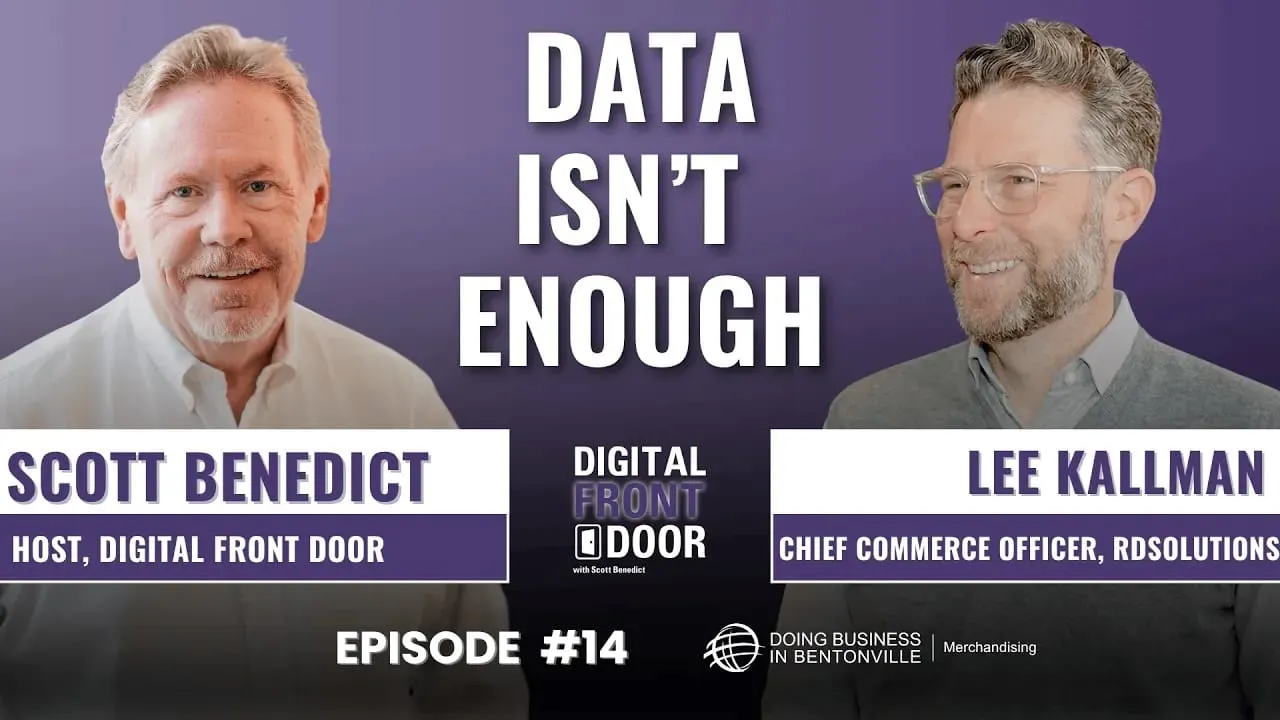
Retail is drowning in data and still missing the moment to act. Scott Benedict sits down with Lee Kallman, Chief Commercial Officer at RD Solutions, to unpack what changed in retail analytics over the last decade and why “access to everything” can create more confusion than clarity if teams cannot operationalize it.
We get specific about where value actually shows up: competitive intelligence that improves pricing and assortment, better item matching and data governance that makes comparisons trustworthy, and a stronger understanding of who the shopper’s real competitors are when baskets get split across multiple retailers. Lee also shares how brands can walk into buyer meetings with marketplace intelligence that goes beyond “here’s my product,” using category context, promotions, and even ratings and reviews to build a sharper collaboration.
Private label and omnichannel retail add new pressure. We dig into the data behind store brand trial, why small price gaps can drive switching, and how quality perception changes the playbook for national brands and challenger brands alike. Then we tackle omnichannel integration, loyalty identity, and the messy realities of third-party platforms like Instacart and other marketplaces where pricing, promotions, and MAP policies can drift away from a retailer’s intent.
Finally, we look ahead at AI in retail, real-time decisioning, and what has to change operationally to keep up, from legacy systems to electronic shelf tags and faster store execution. If you care about retail data analytics, omnichannel strategy, pricing strategy, and turning insight into action, this one will sharpen your thinking. Subscribe, share with a teammate, and leave a review, then tell us: what is the hardest part of making data actionable in your organization?
More About this Episode
The Evolution of Retail Data: From Insights to Execution
In the rapidly shifting landscape of modern retail, we are witnessing a fundamental transformation in how information dictates success. For those of us who have spent decades navigating the aisles and the digital storefronts, the conversation around data has shifted from a luxury of large corporations to the very lifeblood of every merchandising decision. It is no longer enough to simply possess data; the true competitive advantage lies in the velocity of that data and the ability to bridge the gap between having an insight and taking a meaningful action in the aisle.
The last decade has brought about a revolution in accessibility. Ten years ago, the concept of comprehensive grocery e-commerce was essentially nonexistent. Most of our competitive intelligence was gathered through boots on the ground, field teams manually auditing prices and assortments in physical stores. Organizations relied on complex sampling methodologies to guess what was happening in the broader market. Today, the internet has democratized that access. We have moved from a scarcity of information to an absolute deluge. However, this accessibility creates a new challenge: many organizations are still trying to fit massive, high-velocity web data into the rigid, slow-moving analytical boxes they built for the brick and mortar world of 2014.
The Science of Actionable Analytics
One of the most persistent frustrations for any merchant is the accumulation of data that leads to "trivial pursuit" knowledge rather than execution. Information without action only leads to organizational anxiety. The gap between collecting a data point and executing a price change or an assortment adjustment is where many retailers lose their edge.
Bridging this gap requires a commitment to the unsexy foundational work: data management and governance. As private label brands expand and e-commerce platforms omit standard identifiers like UPCs, the task of comparing "like for like" items becomes increasingly subjective. Retailers and brands must develop sophisticated frameworks to ensure they are comparing the right products across different pack sizes and channels.
The leaders in this space are moving toward operationalizing analytics in real time. We are seeing breakthroughs where third-party signals and first-party data are combined to identify "phantom inventory" or out-of-stock issues almost instantly. In a legacy environment, identifying a problem and getting a person into a store to fix it might take three to five weeks. In that timeframe, the shopper has already moved on to a competitor. The goal now is a 72-hour window, identifying the issue and resolving it before the revenue loss becomes significant.
The Private Label Paradigm Shift
Perhaps the most visible impact of data-driven decision-making is the meteoric rise and evolution of private labels. We are seeing a significant shift in consumer perception, fueled by both the pandemic-era supply chain disruptions and recent inflationary pressures. Recent studies indicate that 86% of US shoppers have tried or switched to private label items, and more importantly, 64% now perceive these store brands to be of equal or better quality than national brands.
Retailers are no longer using private labels just as a low-price entry point to improve margins. Instead, they are using marketplace intelligence to identify "white space" left by large CPG companies that have grown too big to be nimble. Data allows retailers to insert premium, upmarket private brands like Walmart’s Better Goods, that challenge national brands on innovation and quality rather than just price. This forces national brands to move away from simply "selling" a product and toward providing actual category insights to maintain their shelf space.
Navigating the Omnichannel Reality
The modern consumer does not think in terms of "channels." They don't wake up and decide to be an "omnichannel shopper"; they simply go shopping. While 90% of consumers now shop across both physical and digital platforms, often spending 1.5 times more than single-channel shoppers, retailers are still struggling with internal silos.
Often, the digital team, the pricing team, and the merchandising team operate as separate entities with separate goals. This lack of integration leads to brand inconsistency. We see this clearly in the "Instacart Dilemma." Early in the pandemic, many retailers rushed to third-party delivery services to solve their e-commerce needs, only to realize they had surrendered control of their brand. When a retailer’s prices are 20% higher on a third-party app than in-store, the consumer doesn't blame the app; they blame the retailer.
The future of retail depends on connecting the online and offline persona of the shopper. Whether through loyalty programs or credit card data, the objective is to create a holistic view of the customer journey. This allows for personalized promotions and a more cohesive brand promise, regardless of where the transaction occurs.
Overcoming Legacy Limiters
As we look toward the future, the integration of Artificial Intelligence and predictive modeling is inevitable, but we must first address the physical limiters. Many retailers are still operating on legacy systems, including access databases and "green screen" terminals that cannot handle the speed of modern retail.
Another major hurdle is the physical labor of the "price tag." Even with the best AI-driven pricing strategy, you still need a human to walk to a shelf and change a piece of paper. This is why the adoption of electronic shelf tags is reaching an ROI tipping point. When the cost of the technology drops and the cost of labor rises, the ability to execute overnight price changes becomes a reality. This doesn't mean we will see "surge pricing" like an Uber ride, consumers would never accept the price of milk changing between the shelf and the register, but it does mean a much more fluid and responsive marketplace.
Building a Data-Driven Culture
Ultimately, the shift toward a data-driven culture is a human challenge as much as a technological one. For merchants who have spent decades relying on "gut feel," handing over decision-making to an algorithm is a difficult transition. However, the most successful teams are those that understand context.
Data is a tool, not a replacement for merchant expertise. The winners in the next era of retail will be those who can leverage data for visibility and velocity, ensuring that every insight results in a better experience for the shopper. We are moving toward a retail environment where information is the primary driver of value, and the speed at which we turn that information into action will define the leaders of the industry.
Strategic Keywords for Retail Analytics Optimization
To ensure this content reaches the right audience of retail executives, merchants, and brand managers, it is essential to focus on the following high-value terms:
- Retail Data Analytics: The overarching framework for using information to drive business outcomes.
- Actionable Insights: The process of moving beyond observation to execution in the retail environment.
- Omnichannel Strategy: Integrating physical and digital touchpoints to create a seamless customer experience.
- Private Label Trends: Understanding the shift in consumer loyalty toward store brands and premium private labels.
- Competitive Intelligence: Using web and in-store data to monitor marketplace pricing and assortment.
- Retail Execution: The physical implementation of data-driven decisions at the store level.
- Predictive Modeling: Using historical trends to forecast future consumer behavior and inventory needs.
- Electronic Shelf Labels (ESL): The technology enabling real-time or high-frequency pricing updates.
- Data Governance: The foundational management of data to ensure accuracy across various retail platforms.
- CPG Brand Management: How national brands must adapt to the rising influence of data-driven retail partnerships.
By focusing on these core pillars: accessibility, actionability, and cultural integration, retailers can move past the noise of the data revolution and start seeing real performance improvements on the bottom line. The digital front door is always open, but it is the data behind that door that determines who stays in business.