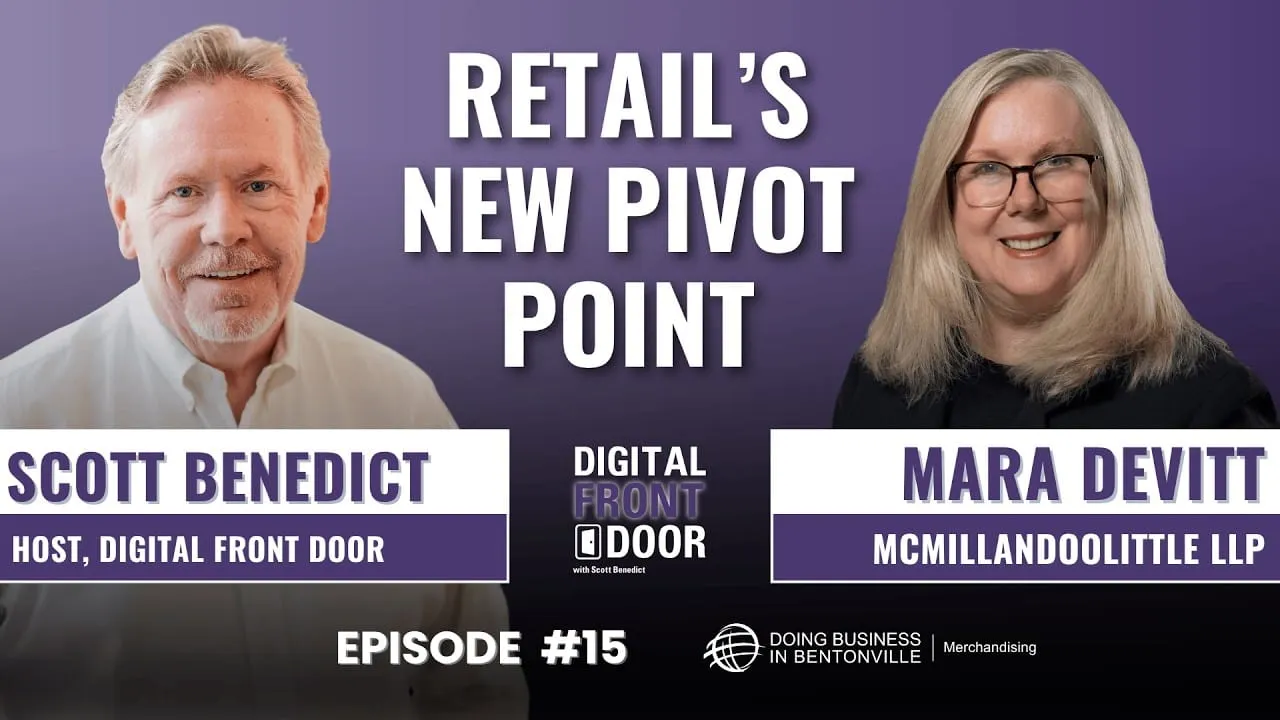
Retail is changing in a way that feels bigger than the usual trend cycle. Agentic AI is arriving fast, automation is accelerating, and shoppers are raising the bar on convenience, values, and experience all at the same time. I sit down with Mara Devitt, senior partner at McMillanDoolittle and a leader in retail strategy and innovation, to unpack what the newly released Retail Innovations 21 report reveals about where retail is headed next.
We walk through how the report is built from more than a hundred global nominations and why the best retail ideas are not confined to the United States. Mara breaks down the three themes that rise to the top this year: Better World, Easy Journeys, and Engaging Destinations. You will hear practical examples of sustainability in retail that is truly embedded in the business model, including Droppie in the Netherlands turning recycling into a rewarded storefront experience, an inclusion training program in Italy, and Rebread in Poland upcycling unsold bread into new products.
From there we dig into AI in retail that actually reduces friction. We cover H and M’s connected fitting rooms using RFID and AI to improve conversion and service, plus an AI-powered supermarket concept in Singapore designed to lower cognitive load and make shopping simpler. We also tackle what agentic commerce means when AI starts to sit between the shopper and the product decision, including why structured product attributes and clean machine-readable data become essential, and how retail media may evolve beyond classic ad placement.
If you want a clear set of leadership priorities for the year ahead, we close with three actions to start now: rethink AI for growth, embed purpose into the brand, and modernize the store fleet with the right “store of the future” components. Subscribe for more, share this with a retail leader on your team, and leave a review with the one retail innovation you think will matter most next.
More About this Episode
The retail landscape is currently undergoing a period of profound structural change. While evolution is a constant in our industry, the current moment feels like a definitive pivot point. We are witnessing the convergence of agentic AI, rapid automation, and a fundamental shift in consumer expectations. Success in this new era requires more than just operational excellence; it demands imagination, innovation, and the courage to rethink traditional models.
In the latest edition of the Retail Innovations report, produced in partnership with the Ebeltoft Group, we analyzed over one hundred global retail concepts to identify the themes shaping the future of commerce. Three distinct pillars emerged: the pursuit of a Better World, the creation of Easy Journeys, and the development of Engaging Destinations. These themes highlight a shift where retail is no longer just about selling products and services. It is about reducing the cognitive load on consumers, creating authentic emotional connections, and delivering on the values that matter most to them.
Embedding Sustainability into the Business Model
One of the most significant shifts we are seeing globally is the move from sustainability as a marketing theme to sustainability as a core business driver. Leading retailers are no longer just "doing green things"; they are weaving social and environmental impact into the very fabric of their operations. This is the essence of the Better World theme.
A standout example of this is Dropy, a concept out of the Netherlands that effectively turns recycling into a retail experience. For many consumers, recycling is a hassle involving sorting, storage, and inconvenient drop-off points. Dropy has solved this by creating engaging, convenient storefronts where people can bring items that are traditionally difficult to recycle, such as apparel and consumer electronics. By rewarding users instantly via an app, they have transformed a chore into a seamless part of the consumer journey.
In Poland, a concept called Rebred is tackling food waste through biochemistry. They take unsold bread from local bakeries and grocery stores and repurpose it into beauty products, protein-enhanced beverages, and even kombucha. This is a sophisticated example of the circular economy in action. Meanwhile, in Italy, Decathlon has implemented a specialized inclusion training program. By using app-based training and mentorship to help individuals with cognitive disabilities enter the workforce, they aren't just filling labor gaps; they are enriching their corporate culture and the lives of their associates.
The lesson for merchants is clear: sustainability and inclusivity should be embedded in how you source, how you design products, and how you support your labor models. It is about being more thoughtful regarding the products we select and finding ways to extend the lifecycle of everything we sell.
Leveraging AI to Create Easy Journeys
The conversation around Artificial Intelligence has shifted from "where are you using it?" to "how is it removing friction?" The goal of technology in the retail space should be to lower the cognitive load on the shopper. We want to make it so the customer's head doesn't have to work so hard to find what they need.
H&M in Sweden is a prime example of using technology to solve a specific physical pain point: the fitting room. Often, the fitting room is where conversion dies because the customer feels isolated from the rest of the assortment. By using a combination of RFID and AI, H&M created connected fitting rooms. When a customer brings an item in, the system recognizes it and suggests complementary pieces. If the customer wants to try a different size or a suggested item, they can request it through a screen, and an associate brings it directly to them. This enhances the brand experience by providing high-touch service powered by invisible tech.
In Singapore, FairPrice has launched an AI-powered supermarket that utilizes smart carts and AI assistants to simplify navigation. In a digitally mature market like Singapore, these innovations are essential for meeting the expectations of a savvy consumer base. As we look toward the near future, the rise of agentic commerce will take this even further. We are moving toward a world where AI agents will sit between the consumer and the product decision. For retailers and merchants, this means that providing structured, rich, and machine-readable product attributes is no longer optional. If an AI agent cannot "read" your product, that product effectively does not exist for the shopper using that agent.
Physical Stores as Engaging Destinations
For years, we have talked about the need for stores to become experiential. However, the latest global data shows that "nice stores" are now merely table stakes. To truly stand out, a physical location must become an engaging destination. We have identified three characteristics that distinguish these locations: they provide a reason to visit beyond a transaction, they foster an emotional connection, and they function as a complete brand world.
Consider Area 15 in Las Vegas. It is a destination that blends nightlife, entertainment, and immersive retail into a constantly evolving environment. It draws people away from their screens and into a physical space because it offers something digital cannot replicate. Similarly, the beauty flagship Mecca integrates education and professional services so deeply into the retail environment that the purchase becomes a byproduct of the experience.
In New York, the French brand Printemps has created an outpost in the Financial District that serves as a cultural immersion. The associates are historians of the location as much as they are salespeople. When a customer walks in, they aren't just looking at clothes; they are learning about the heritage of French fashion. This type of engagement generates demand rather than just fulfilling it. It builds memories and brand loyalty that sustain the business long after the customer leaves the store.
Translating Global Insights for Local Markets
As we look at these global breakthroughs, it is vital to avoid the "copy-paste" trap. A mistake many North American retailers make is seeing a successful format in Japan or South Africa and trying to replicate it exactly without understanding the underlying insight.
Innovation is often a response to a specific local friction. For example, high levels of automation in Japanese retail are frequently a response to acute labor shortages. The logistics platforms emerging in South Africa are often solving for access inequality. When evaluating these global best practices, we must ask: What problem is this solving in its home market, and what is the equivalent friction in our own?
We certainly have our own versions of labor challenges and access inequality in North America. The key is to translate the insight into a solution that fits our unique regulatory environments and consumer expectations. We don't need to replicate the format; we need to solve the same fundamental problems with equal creativity.
Leadership Priorities for the Future
To navigate this landscape, retail leaders should focus on three immediate priorities. First, rethink your AI strategy. Move beyond internal efficiencies and start asking how AI can enable growth and reduce customer friction. Ensure your data is ready for the era of agentic commerce.
Second, get serious about purpose. Younger consumers are increasingly making purchasing decisions based on values. Embedding a "Better World" philosophy into your business model is no longer a luxury; it is a requirement for long-term relevance.
Finally, rethink the physical store fleet. You do not have to reinvent every single store overnight, but you must identify which components of the "store of the future" can be integrated into your existing assets today. Whether it is through connected fitting rooms or more immersive brand storytelling, the goal is to maximize the value of your real estate by making it a place people actually want to be.
The pace of change in retail is faster than ever, but so is the opportunity for those willing to innovate. By looking beyond our own borders and focusing on the core themes of sustainability, ease, and engagement, we can build a retail future that is both profitable and meaningful.