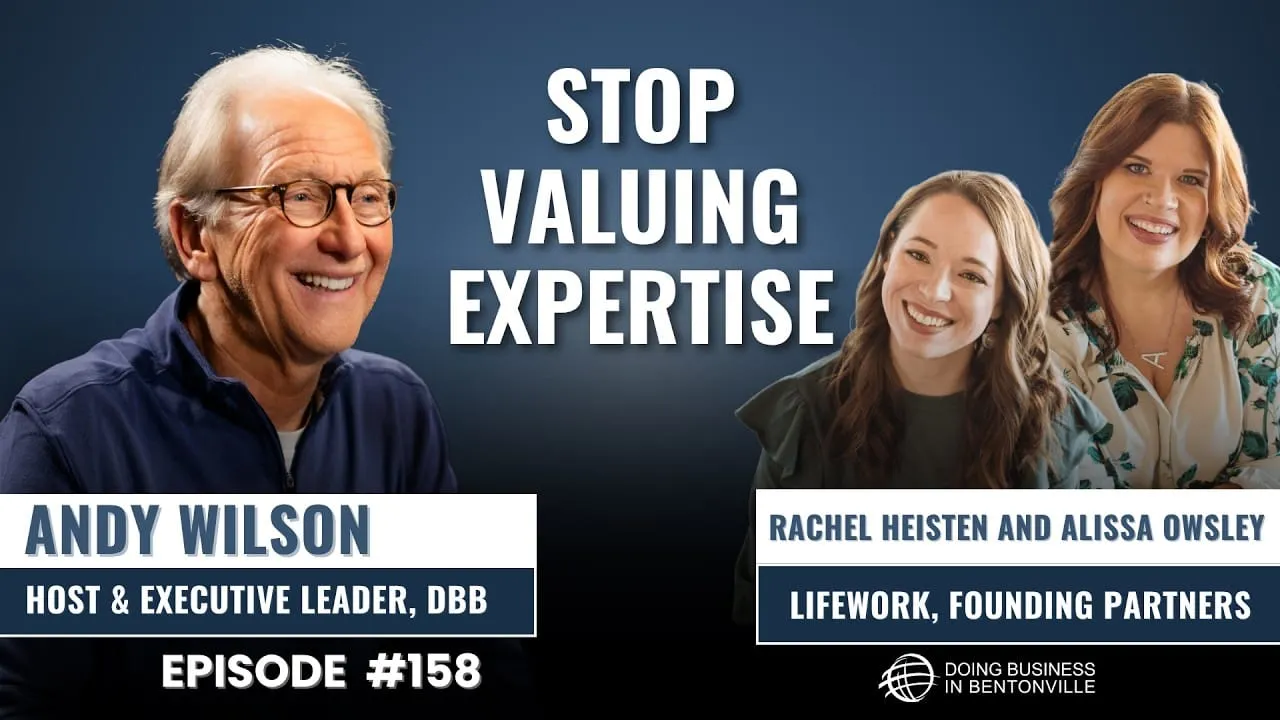
Relying solely on technical expertise in leadership is a trap that destroys team momentum. As automation and AI rapidly handle the analytical work, the future value of a leader relies entirely on their capacity to cultivate human skills and adaptability. Rachel Heisten and Alissa Owsley from Life Work Talent sit down with us to explain how to stop fixing every problem and start leveraging curiosity to build dynamic organizations.
We get into the mechanics of the functional expert trap, the systemic shift from static headcount to dynamic skill count, and how to effectively navigate experience bias in the workplace. The conversation reveals a profound shift in mindset, establishing that true development requires intentional discomfort and that prioritizing genuine interest over deprivation curiosity is the actual foundation for behavioral change.
The hardest part of stepping into a higher role isn't learning a new system, it is the difficult, often ego-bruising process of unlearning the need to always be the person with the answers. We look at the very real friction that happens in succession planning when executives treat it like a simple administrative checklist instead of an ever-evolving, complex human problem. You will walk away with a clear perspective on how to stop hiring to fill current seats and start assessing for the cognitive flexibility required to meet future strategies.
If you care about future-proofing your leadership, building adaptive teams, and navigating succession planning, you’ll get a lot from this. Please make sure to subscribe to the channel and share this episode with anyone currently stepping into a new management position. What is the hardest professional habit or perspective you have had to unlearn in your own career?
More About this Episode
The Future of Leadership: Shifting from Functional Expertise to Human Skills
When we look at the rapidly evolving landscape of modern business, it becomes abundantly clear that the traditional models of leadership are fundamentally changing. For decades, the corporate ladder was climbed by those who possessed the most technical knowledge. If you were the best at your specific job, you were eventually promoted to manage the people doing that job. However, the modern marketplace demands a completely different approach. Today, true organizational growth relies heavily on human skills, emotional intelligence, and a deeply rooted sense of curiosity.
Navigating the shift from technical proficiency to leadership excellence requires a high degree of intentional discomfort. Growth does not happen in a state of absolute certainty. When you are making major strategic decisions, a certain level of unease is actually a positive indicator. It means you are engaging in deep, critical thinking rather than relying on autopilot. To truly excel in the future of work, leaders must learn to escape what many call the functional expert trap.
Escaping the Functional Expert Trap
The functional expert trap occurs when individuals are promoted into positions of leadership solely because they are exceptional at solving specific, technical problems. They have built their careers, and often their professional identities, around being the person with all the answers. People come to them for solutions, and providing those solutions creates a cycle of validation.
However, as a professional moves into higher levels of leadership, the nature of the problems they face changes drastically. The challenges are no longer purely technical. They are complex human and organizational problems. At this level, teams do not necessarily need a manager to step in and fix their technical issues. They need a leader who can see them, hear them, and empower them to solve problems independently.
To break free from this trap, leaders must shift their focus from providing immediate answers to asking the right questions. The antidote to the uncertainty of leadership is curiosity. When leaders operate with intellectual humility, they acknowledge that their technical experience might actually create a bias that hinders progress. Letting go of this experience bias allows a leader to guide their team through inquiry rather than directive commands. It builds a culture where team members feel valued for their contributions rather than micromanaged by an overzealous expert.
The Art of Unlearning and Shifting Perspectives
One of the most challenging aspects of modern leadership development is the concept of unlearning. We often focus entirely on acquiring new information, but true development requires us to dismantle outdated beliefs. When professionals anchor their personal value in being right all the time, they create a rigid mindset that resists innovation.
The absolute hardest habit for any professional to unlearn is their reliance on their own perspective. Human nature dictates that we filter every piece of data, every interaction, and every challenge through our own established belief systems. We draw conclusions and make assumptions based on selective data that confirms what we already think we know.
To combat this, leaders must actively work to change their perspectives by unlearning the need to be the smartest person in the room. This requires a dedicated effort to be genuinely curious about the perspectives of others. You cannot just pick a specific topic and decide to unlearn it overnight. Instead, you must train your brain to ask better questions and seek out differing viewpoints constantly. By actively practicing cognitive flexibility in everyday interactions, you prepare your mind to unlearn deep seated habits when it truly matters.
Understanding Deprivation Curiosity versus Genuine Interest
When we discuss curiosity in the workplace, it is vital to distinguish between deprivation curiosity and genuine interest. We live in an era where information is available in microseconds. If you forget how long to cook chicken in an air fryer, you look it up on your phone. You satisfy a temporary deficit of information, get a quick hit of dopamine, and move on without committing the information to long term memory. This is deprivation curiosity. It is the urgent need to find an answer simply to eliminate a knowledge gap.
Genuine interest operates on a completely different level. Consider a scenario where a manager struggles to teach an employee how to use pivot tables in spreadsheet software. Despite training sessions and courses, the employee simply cannot grasp the concept. Yet, this same employee goes home, watches online tutorials, and successfully rebuilds the engine block of a car. The difference is not a lack of learning capacity. The difference is a lack of genuine interest.
When leaders rely solely on deprivation curiosity, they only seek enough information from their teams to move chess pieces around a board. They want quick status updates and bottom line figures. Leaders who operate with genuine interest care about the humanity of their team members. They want to know what motivates them, what their perspectives are, and what drives their behavior. This deep, authentic interest is the foundation for creating lasting behavioral change and fostering a highly engaged workforce.
Prioritizing Skill Count Over Headcount
As businesses grow and scale, they often fall into the habit of measuring their workforce purely by headcount. Counting bodies in seats is an easy metric, but it is a highly flawed way to build a dynamic organization. The most forward thinking companies are abandoning traditional headcount models in favor of dynamic skill count strategies.
When you rely on headcount, you make massive assumptions about the abilities of the people in those roles. No two employees are exactly alike. Over time, roles often morph and shift to accommodate the specific, unique skills of the individual currently sitting in that seat. This creates a Frankenstein role. An employee might be naturally gifted at a random assortment of tasks, so those tasks are grouped together into their job description. When that person eventually leaves, the organization panics trying to find a replacement who possesses that exact same random assortment of skills.
To avoid this, businesses must build their organizational structure based on future strategy rather than current configurations. You have to look at what the business will need eighteen months or three years from now, completely erasing the current individuals from the equation. By identifying the necessary skills of the future and comparing them against the skills currently available in your workforce, you can create targeted development plans. Assessing human skills is undoubtedly more difficult than counting employees, but it results in a vastly more adaptable and resilient workforce.
The AI Revolution and the Premium on Human Skills
The transition toward skill based organizational design is being rapidly accelerated by the rise of artificial intelligence. AI is fundamentally changing how we work, particularly in roles that involve heavy data analysis, entry level professional tasks, and routine administrative duties. As AI takes over the complicated, technical functions of the workplace, the skills that cannot be automated will skyrocket in value.
This puts an unprecedented premium on human skills. An algorithm cannot replicate genuine curiosity. A machine learning model cannot motivate a discouraged team, win over the hearts and minds of a workforce, or navigate complex emotional conflicts. Because AI will inevitably serve as the ultimate technical expert, human leaders will no longer be able to hide behind their technical proficiency to mask their leadership gaps.
This technological shift should completely revolutionize recruiting strategies. Instead of hiring strictly for technical credentials and job history, companies must prioritize candidates who demonstrate high levels of critical thinking, adaptability, and curiosity.
Consider a scenario where a company needs to hire instructional designers. Traditionally, they would look for candidates with specific degrees and years of direct experience using particular software. However, if a candidate currently working in a completely unrelated role like a receptionist demonstrates a fierce desire to learn and exceptional critical thinking abilities, they might actually be the better hire. Technical software can be taught, especially with the assistance of AI tools. You cannot easily teach the intrinsic drive to solve problems creatively. When leaders focus on hiring and developing holistic human skills, they future proof their organizations against technological disruption.
Reimagining Succession Planning as a Living Strategy
All of these concepts converge perfectly when we look at how organizations handle succession planning. Far too many companies treat succession planning as a simple checklist or a static matrix completed once a year by the human resources department. They treat it as a complicated problem that just needs a rigid mathematical solution.
In reality, succession planning is a highly complex, constantly evolving human challenge. There are countless variables, shifting dependencies, and personal life changes that make a static plan obsolete almost as soon as it is written. Therefore, succession planning must be treated as a long game. It should be a living, breathing strategy that is constantly revisited and adjusted.
Furthermore, the person currently holding a leadership position should not have absolute control over choosing their successor. While their input is valuable, they often suffer from the bias of looking for someone who mirrors their exact skill set and working style. Succession decisions must be aligned with the future strategic needs of the role, not the historical footprint of the current leader.
Most importantly, succession planning should not be a secondary thought for executive leadership. It must be a primary responsibility. An executive should spend a significant portion of their time actively developing the talent beneath them to ensure the long term sustainability of the organization. True leadership performance should be measured not just by quarterly profits, but by the strength and readiness of the leaders they are cultivating.
The business landscape will only continue to grow more complex. By leaning away from technical certainty and leaning heavily into human curiosity, continuous unlearning, and dynamic skill development, leaders can build organizations that are not just prepared for the future, but actively shaping it.