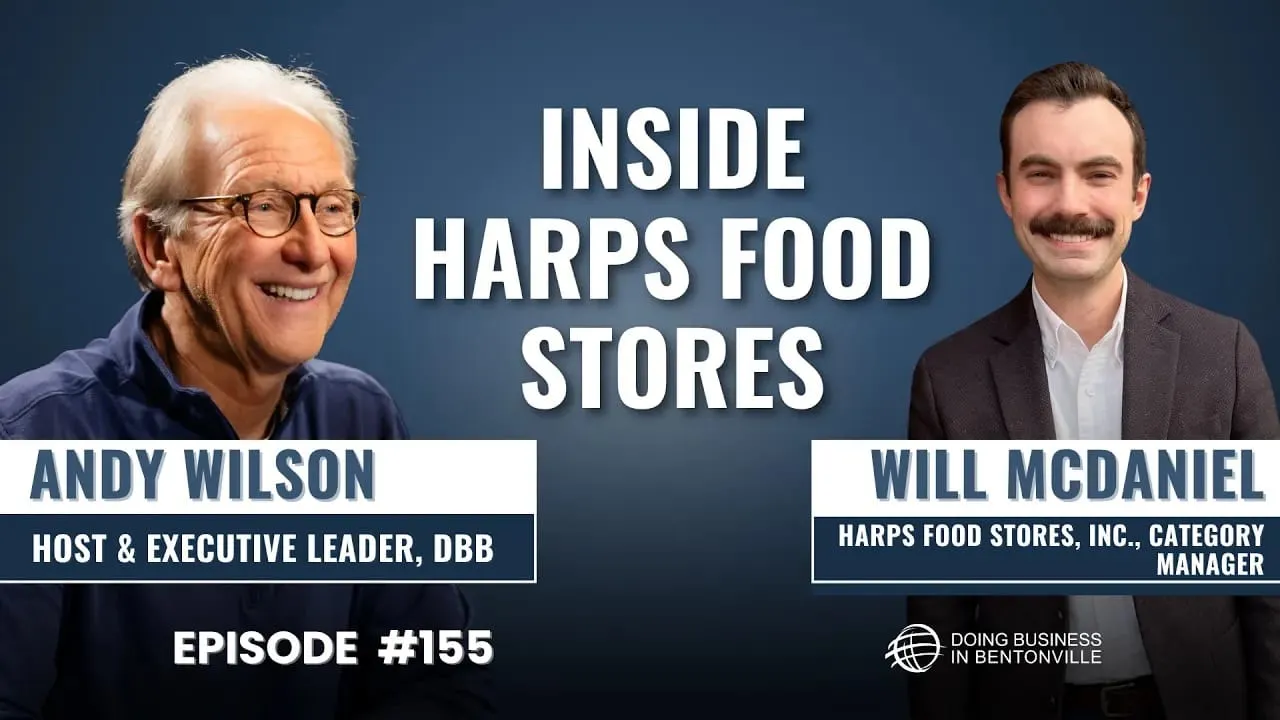
Competing against retail giants can quickly become a race to the bottom if a company treats its workforce like replaceable numbers instead of true partners. With retail margins shrinking and industry consolidation accelerating across the country, building a resilient, scalable company culture is more critical than ever for independent operators. Today, we sit down with Will McDaniel of Harps Food Stores to break down how a 178-store regional grocer thrives right in the epicenter of the world's largest retail ecosystem.
We get into the operational mechanics of Harps' 100% Employee Stock Ownership Plan (ESOP), leveraging Associated Wholesale Grocers (AWG) for distribution scale, and automating cycle counts with AI to free up floor staff for customer service. We also explore their omni-channel loyalty strategy through the My Hometown Rewards app and how they differentiate their brand by dominating perimeter departments with fresh meat and seafood programs. The secret sauce behind their sustained rocket-ship growth is their "empowered to satisfy" philosophy, where giving every department manager visibility over their own P&L transforms daily wage workers into long-term equity holders.
Operating a regional grocery chain on razor-thin margins requires rigorous supply chain discipline, constant technological adaptation, and navigation of the complex logistics of multi-generational business acquisitions. You will walk away from this conversation with a practical framework for building genuine employee buy-in, streamlining store-level inventory logistics, and scaling an independent retail footprint without losing your core identity or customer trust.
If you care about retail leadership, sustainable employee ownership models, and strategic regional growth, you’ll get a lot from this. Please make sure to subscribe to the channel and share this episode with someone who needs to hear it. What is the most effective incentive you have seen for turning traditional employees into true stakeholders in your industry? Let us know in the comments below!
More About this Episode
Competing with Giants: How Harps Food Stores Scales Culture, Supply Chains, and Employee Ownership in Retail's Epicenter
In the hyper-competitive world of modern retail, competing against global supercenters and e-commerce titans can quickly devolve into a race to the bottom. When independent operators attempt to match massive corporations on price alone, they often resort to margin-cutting strategies that treat their workforce like replaceable numbers. However, retail margins are steadily shrinking while industry consolidation accelerates across the country. Surviving and thriving in this environment requires a fundamentally different approach. Building a resilient, scalable company culture is no longer a soft corporate talking point. It is the most critical operational requirement for regional grocers and independent retailers today.
Operating a 178-store regional grocery chain right in the epicenter of the world's largest retail ecosystem in Northwest Arkansas demands extraordinary discipline. It requires a relentless focus on core identity, supply chain efficiency, and human capital. Examining the growth and sustained success of Harps Food Stores reveals a powerful blueprint for independent retail leadership. By examining their operational mechanics, technology integration, and unique ownership structure, we uncover how a regional grocer can dominate its market without sacrificing customer trust or its hometown roots.
The ESOP Advantage: Transforming Daily Wage Workers into Equity Holders
The foundational pillar of sustained regional growth in retail is employee alignment. Traditional retail models often struggle with high turnover, low employee engagement, and a profound disconnect between corporate goals and store-level execution. Harps Food Stores addressed this structural industry challenge by transitioning to a 100% Employee Stock Ownership Plan, commonly known as an ESOP, in 2001. Today, the company stands as the largest employee-owned business headquartered in Arkansas and one of the largest in the United States.
An ESOP is far more than a retirement benefit. It is a transformative operational strategy that fundamentally alters the psychological relationship between the worker and the workplace. When frontline cashiers, stockers, and department managers hold actual equity in the business, their daily decisions directly impact their personal financial trajectory. This structure fosters an "empowered to satisfy" philosophy across every store location.
Instead of relying on rigid, top-down bureaucratic mandates to enforce customer service standards, an employee-owned model empowers associates to solve customer problems immediately. Department managers are given transparent visibility over their own profit and loss statements. When a meat department manager or a bakery supervisor understands the precise labor, inventory, and margin metrics of their department, they operate like independent business owners. They actively seek ways to reduce shrink, optimize staffing hours, and enhance product display quality because they directly reap the financial rewards of the store's performance.
This long-term wealth creation model effectively turns traditional hourly employees into true organizational stakeholders. Over years of dedicated service, equity allocations compound, allowing career retail workers to build substantial retirement nests that would be unattainable in conventional corporate retail structures. This dynamic generates record-low turnover rates and preserves organizational institutional knowledge, creating a massive competitive advantage in an industry notorious for constant churn.
Leveraging Wholesale Partnerships for Supply Chain Scale
A superior store culture cannot survive without competitive pricing and reliable product availability. One of the greatest hurdles for independent retail chains is achieving the economies of scale necessary to compete with multinational conglomerates that dictate terms to global consumer packaged goods manufacturers. For a regional operator, building an independent, proprietary distribution network from scratch is often cost-prohibitive and operationally inefficient.
The solution lies in strategic alignment with retailer-owned cooperatives, specifically Associated Wholesale Grocers. Partnering with a massive distribution cooperative allows regional grocers to pool their purchasing volume with hundreds of other independent operators across the country. This collective buying power unlocks volume discounts, promotional allowances, and supply chain reliability that rival the nation's largest chains.
By leveraging Associated Wholesale Grocers for logistics and distribution scale, a regional chain can focus its internal capital and executive bandwidth on retail execution rather than warehouse management. The wholesale cooperative acts as an extension of the grocer's operational infrastructure. This partnership provides access to vast network freight logistics, advanced data analytics, and robust private-label product lines that yield higher profit margins. Consequently, the regional grocer maintains its agile, community-focused brand identity while operating on a backbone of enterprise-level supply chain power.
Automating the Core: AI Inventory Management and Cycle Counts
While culture and distribution scale provide the foundation, long-term retail profitability depends on relentless operational optimization at the store level. In an industry where net profit margins often hover between one and two percent, inventory distortion is an existential threat. Out-of-stock items erode customer loyalty, while over-stocking leads to perishable spoilage and tied-up working capital.
To combat these challenges, forward-thinking regional grocers are integrating artificial intelligence and automated inventory control systems directly into their daily store workflows. Traditional retail operations rely heavily on manual cycle counts and visual inventory audits. These manual tasks consume countless hours of labor from store associates, pulling them away from customer-facing duties and introducing inevitable human error into ordering algorithms.
By adopting AI-driven inventory management tools, stores can automate the tracking of product velocity, seasonal demand shifts, and real-time stock levels. Intelligent systems analyze historical sales data, local weather patterns, and promotional schedules to predict exact inventory requirements for every individual SKU. Automating routine cycle counts ensures an accurate system inventory without requiring labor-intensive manual scanning.
The operational benefit of this technological adaptation is twofold. First, it drastically reduces out-of-stock scenarios, ensuring that customers always find their core household staples on the shelf. Second, and more importantly, it liberates hours of floor staff labor every single week. When employees spend less time counting cans in the center store aisles, they spend more time engaging with shoppers, maintaining store cleanliness, and executing high-margin merchandising displays.
Winning the Perimeter: Perishables and Brand Differentiation
When competing against supercenters and e-commerce grocery delivery platforms, an independent retailer cannot rely solely on dry grocery aisles to drive foot traffic. Center-store packaged goods are highly commoditized, making them easily susceptible to aggressive price undercutting by larger competitors. To establish lasting brand differentiation, regional grocers must dominate the perimeter of the store.
The perimeter departments include fresh produce, full-service bakery, specialty deli, and above all, premium meat and seafood programs. Shoppers may be willing to buy paper towels or canned soup from the lowest-priced online vendor, but they are highly discerning when choosing fresh ribeye steaks, custom-cut pork chops, or fresh Atlantic salmon for their family dinners.
Investing heavily in in-store butchers and customized perishable programs creates a protective moat around the regional retail brand. By staffing meat departments with trained professionals who can provide custom cuts, cooking advice, and personalized service, a regional grocer builds deep community trust that automated checkouts and warehouse distribution centers cannot replicate. High-quality perishable offerings drive frequent, routine store visits and command superior gross margins, offsetting the razor-thin margins of basic pantry staples.
Omni-Channel Engagement: The My Hometown Rewards Strategy
While superior perimeter departments and personal service attract customers, sustaining their loyalty requires modern digital engagement. Today's grocery shopper expects a seamless omni-channel experience that bridges physical store aisles with mobile convenience. Implementing a robust digital loyalty strategy is vital for retaining market share against tech-enabled competitors.
A successful digital loyalty framework, such as the My Hometown Rewards app, transforms traditional print circular deals into a personalized digital ecosystem. Through mobile application integration, regional grocers can deliver targeted digital coupons, personalized product recommendations, and frictionless rewards tracking directly to a shopper's smartphone.
This data-driven approach allows the grocer to understand individual shopping habits and tailor promotions accordingly. If a shopper frequently purchases organic produce or gluten-free bakery items, the loyalty app can surface relevant savings and recipe ideas in real time. Furthermore, integrating mobile apps with online ordering and curbside pickup services ensures that the independent grocer meets the convenience demands of busy families without sacrificing the local brand connection. The goal is not to replace the human element of shopping, but to enhance it through intuitive digital utility.
Leadership Continuity and Multi-Generational Acquisitions
Scaling an independent grocery footprint across multiple states involves complex strategic maneuvers, particularly when growth is driven by acquisitions. In the regional retail sector, expansion often occurs through the acquisition of smaller, multi-generational family-owned grocery chains that are facing succession challenges. Navigating the logistics of these transactions requires a sophisticated blend of financial acumen and cultural empathy.
When acquiring an independent grocer in a rural or suburban market, the physical real estate and inventory are only a fraction of the valuation. The true value lies in the local community goodwill and the existing workforce. An aggressive corporate takeover that strips away local store autonomy and replaces familiar branding overnight often alienates loyal shoppers and triggers mass employee departures.
Successful regional expansion relies on leadership continuity and meticulous cultural integration. When bringing newly acquired stores into an existing network, the primary challenge is onboarding new teams into the operational culture and ownership structure. Introducing acquired employees into an ESOP requires education and patience. Leadership must spend extensive time on the ground in new stores, conducting face-to-face meetings to explain how employee ownership works and how it benefits their long-term financial security.
By preserving local store heritage while grafting the newly acquired operations onto a superior wholesale distribution network and an employee-owned foundation, a growing chain can revitalize legacy stores. This growth model preserves jobs in smaller communities, elevates store-level operational standards, and expands the company's regional footprint without diluting its core organizational values.
A Practical Framework for Independent Retail Success
The trajectory of thriving regional operators proves that independent retail is far from dead. However, succeeding in today's consolidated market demands a clear, uncompromising strategy that turns potential corporate weaknesses into distinct operational strengths.
To build a resilient retail organization that scales effectively, leadership must execute across several non-negotiable dimensions:
- Align Employee Interests: Transitioning workers into true stakeholders through employee ownership structures creates an unbeatable workforce advantage. When employees share in the profits they generate, operational efficiency and customer satisfaction rise organically.
- Maximize Wholesale Scale: Avoid the trap of building redundant infrastructure. Lean heavily on established wholesale distribution cooperatives to secure competitive pricing, supply chain reliability, and advanced logistics support.
- Automate Routine Tasks: Implement AI-driven inventory controls and automated replenishment systems to eliminate tedious manual labor, allowing store associates to dedicate their time and energy to customer service and merchandising.
- Dominate Fresh Perishables: Make the perimeter departments the absolute centerpiece of the brand identity. Superior meat, seafood, and produce programs build unwavering customer loyalty that insulates the business from price-only competitors.
- Integrate Digital Loyalty: Meet modern consumer expectations by deploying user-friendly mobile loyalty applications that offer personalized rewards, digital couponing, and seamless omni-channel convenience.
- Execute Empathetic Acquisitions: When scaling through acquisitions, prioritize cultural assimilation and leadership continuity over immediate corporate uniformity. Invest in the people behind the acquired assets to ensure long-term community support.
Operating on razor-thin margins in the shadow of retail giants is an undeniable challenge, but it is entirely winnable. By fostering genuine employee buy-in, streamlining store-level logistics, and maintaining a relentless focus on the customer experience, regional retail leaders can build enduring businesses that stand the test of time.