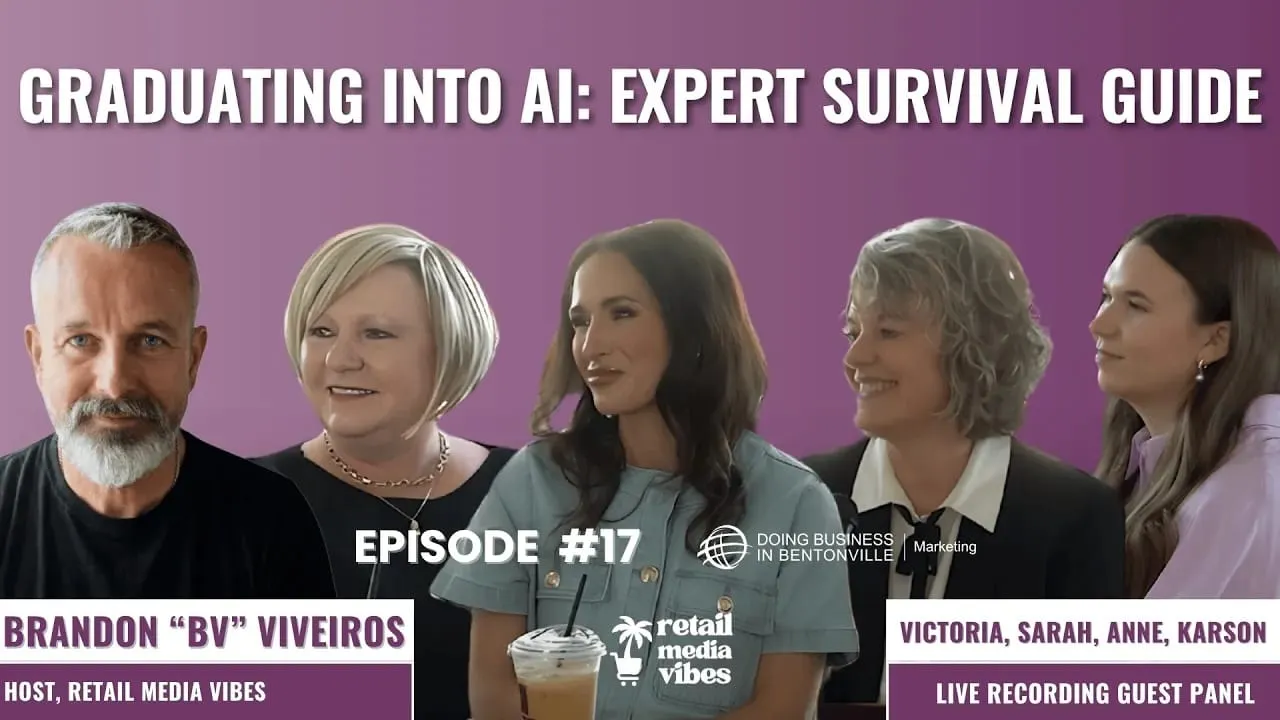
AI is raising the bar for everyone entering the workforce, and it’s also creating a lot of noise about what matters most. We recorded this conversation live from Heroes Coffee in Rogers, Arkansas to get grounded in the real question students are asking: how do I land my first role and thrive when the tools, titles, and expectations keep changing?
I'm joined by Dr. Anne Velliquette from the University of Arkansas (Walton College of Business), Karson Feuerbacher (graduating senior and Hershey intern), Sarah White (omnichannel marketing at Nestlé), and Victoria Van Dusen (SVP at Mars United Commerce). Together, we unpack “AI readiness” without the hype. You’ll hear what hiring managers actually look for in entry-level talent, what great first 90 days behavior looks like, and why agency roles often start with foundational work before you earn client-facing responsibilities. We also talk about using AI responsibly, avoiding copy-paste mistakes, and keeping the human touch through curiosity, emotional intelligence, and relationship building.
We get practical on how to stand out beyond GPA: internships, career fairs, side projects, personal brand, and transferable skills that prove you can execute in the retail media and retail commerce world. We even tackle the uncomfortable parts like managing up, professional polish, and how COVID still shows up in communication habits.
Subscribe to Retail Media Vibes, share this with a student or new grad, and leave a review if it helps. What skill do you think will matter most when AI becomes the default tool at work?
More About this Episode
The AI Readiness Revolution: Navigating the Workforce Entry in a Post-Digital Age
The transition from the academic world to a professional career has always been a journey of transformation. Historically, this bridge was built on the foundation of specialized knowledge and the "soft skills" of communication and collaboration. However, as I sat down with a panel of experts at Heroes Coffee in Rogers, Arkansas, it became clear that the blueprint for early career success is being rewritten. We aren't just talking about a digital shift anymore; we are talking about a fundamental change in how we define "entry-level" in the age of Artificial Intelligence.
The conversation brought together a unique intersection of perspectives: Dr. Anne Velliquette from the University of Arkansas representing the academic front, Victoria Van Dusen from Mars United Commerce on the agency side, Sarah White from Nestle representing the brand perspective, and Karson Feuerbacher, a student ready to step into her first full-time role at Hershey. Despite their different roles in the retail ecosystem, one theme resonated above all others: the most valuable asset a new hire can bring to the table today is not AI expertise, but AI readiness.
Redefining the Entry-Level Expectation
There is a palpable anxiety among students and young professionals that AI might automate away the very roles they have spent years studying to obtain. While the nature of tasks is undoubtedly shifting, the consensus from the brand and agency world is that the human element remains the "luxury good" of the modern workforce.
When we look at what makes an entry-level candidate stand out, the criteria have evolved. Technical proficiency is assumed, but the real differentiator is curiosity and the ability to bob and weave through constant change. Sarah White hit the nail on the head when she described the need for "contextual shepherds." Anyone can prompt a machine to generate a response, but it takes a student of the business to understand if that response is actually right for the brand, the retailer, or the consumer.
The gap between a novice and a professional isn't just about knowing how to use a tool; it is about knowing your craft well enough to judge the tool’s output. We are seeing a major shift in workflow where, previously, we wrote our own drafts and used tools to edit. Now, many start with AI-generated drafts and must apply human judgment, ethics, and critical thinking to refine them. If you are entering the workforce today, your value is found in that refinement process.
The Power of the Human Touch in a High-Tech World
One of the most profound realizations from our discussion was the danger of the "copy-paste" culture. Victoria Van Dusen shared insights into how junior-level associates sometimes rely so heavily on AI to sound sophisticated in client emails that they actually lose the message entirely. When a machine writes to a subject matter expert without human oversight, the lack of authenticity is jarring.
This brings us back to the fundamental importance of professional polish and relationship building. We often talk about AI as a tool for efficiency, but it cannot substitute for the "listening tour" that every new employee should embark upon. Understanding the hierarchy of a company, learning how to manage up, and knowing when to pick up the phone instead of sending an AI-assisted email are skills that a language model cannot teach.
There is also the lingering shadow of the COVID-19 pandemic. We cannot ignore that a generation of professionals entering the workforce spent crucial developmental years behind screens. This has created a secondary challenge: a resistance to in-person collaboration and a discomfort with the "messy" social dynamics of office life. In an era where AI can handle the data, the ability to navigate a boardroom, handle a tech failure during a presentation with grace, and build trust through face-to-face interaction has become more valuable than ever.
Building Your Personal Brand Beyond the Classroom
For students like Karson, the journey involves translating campus involvement into a personal brand. It is a common mistake for graduates to omit "non-professional" experiences from their resumes. However, in the modern retail landscape, things like running an LTK ambassador account or managing a small side-hustle on social media are high-signal activities. They prove that a candidate understands commerce, content creation, and audience engagement.
The traditional resume is still a gatekeeper, but it is being scrutinized differently. Hiring managers are looking for transferable skills like project management and initiative. They are also looking for honesty. There is a growing ability among leaders to spot a resume that has been run through an AI optimizer to perfectly match a job description without any underlying substance. The goal should be to use AI to enhance your story, not to fabricate one.
The Five-Year Horizon: Technical vs. Human Skills
As we looked toward the future, the panel debated whether the most valuable skills in five years would be technical or human-centric. While there is a clear need for technical specialists in trades and high-level data science, the prevailing thought for the corporate and retail world is that human capital is our primary currency.
We are entering a period where "AI-free zones" in the classroom and the office are becoming intentional choices. By stepping away from the tools to brainstorm, debate, and think critically, we preserve the originality that AI often dilutes into a "C-level" average. The future belongs to those who can orchestrate a symphony of AI tools while maintaining a distinct, human point of view.
Readiness Over Fear
The message to those breaking into the workforce is clear: don't be afraid of the technology, but don't let it become a crutch. Use your university years to engage with the ecosystem around you. Take the internships, attend the career fairs, and most importantly, find mentors.
The University of Arkansas and the Walton College of Business are leading the way by integrating real-world business contexts into the curriculum, but the responsibility ultimately lies with the individual to stay "on their toes" rather than "on their heels." AI is making the world feel messy and fast-paced, but the core pillars of a successful career (growth, relationships, and integrity) remain unchanged.
The workforce isn't shrinking; it is evolving. By embracing AI readiness, maintaining a relentless curiosity, and never losing the professional polish that defines a leader, the next generation of retail and marketing professionals will do more than just survive this transition (they will define it).
Keywords for Future Readiness
To navigate this landscape effectively, professionals should focus on mastering these core concepts and integrating them into their daily workflows:
- AI Readiness: The proactive preparation and willingness to adapt to new technological tools while maintaining human oversight.
- Contextual Intelligence: The ability to apply specific business knowledge to filter and refine AI-generated outputs.
- Professional Polish: Maintaining a high standard of communication and etiquette that reflects a strong personal brand.
- Omnichannel Marketing: Understanding the seamless integration of different shopping and communication channels in the retail experience.
- Qualitative Data Synthesis: Using AI to find themes in human feedback and interviews without losing the "why" behind the data.
- Agility and Adaptability: The crucial soft skill of pivoting quickly in response to market shifts or technological advancements.
- Human-AI Orchestration: The strategic management of various AI tools to complete complex tasks more efficiently.
As we move forward, remember that the most sophisticated tool in the room is still the one between your ears. Use the technology to clear the administrative brush so you can spend your time on what truly matters: creative thinking and building the relationships that move the industry forward.