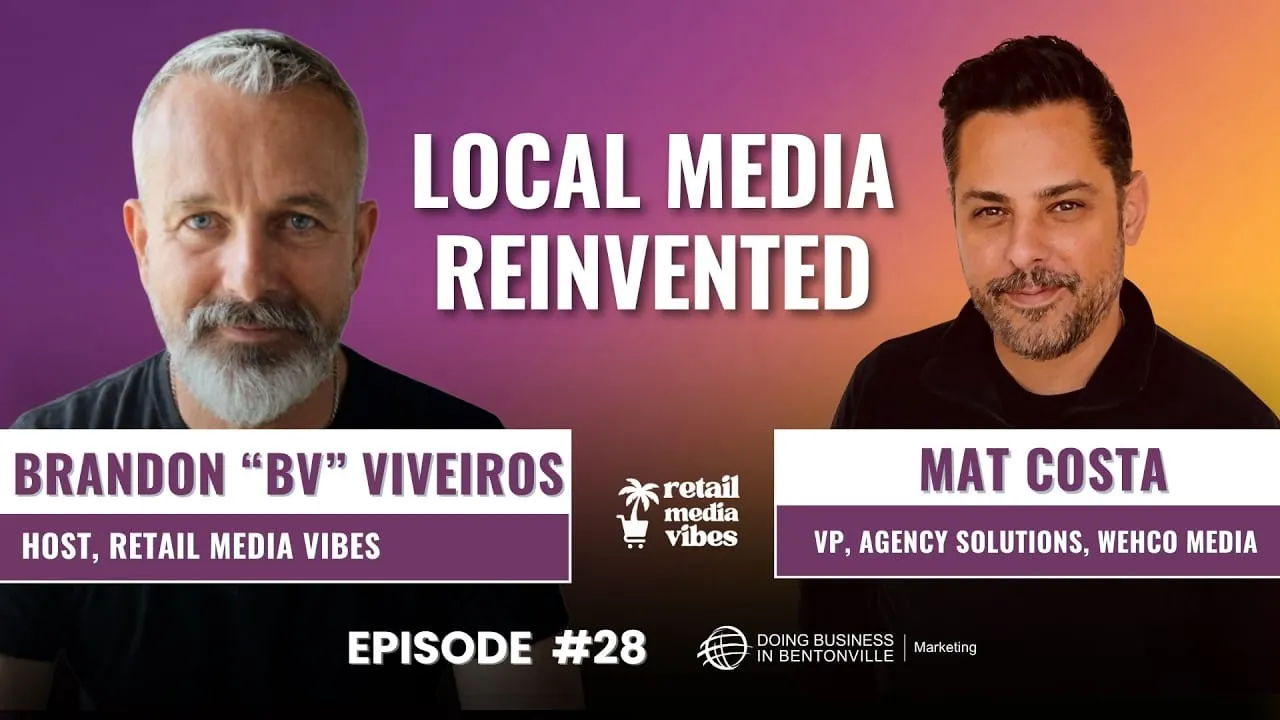
Local media isn't dead; it simply outlived the panic to become a highly targeted engine for brand revenue. Mat Costa brings 25 years of publishing experience to expose how legacy newspapers evolved into modern ad agencies.
Navigating the programmatic supply chain requires cutting through intermediaries that eat up CPM margins. Matt breaks down how publishers are cleaning up bid paths and shifting back to high-value branded content. He also details the ongoing legal battles with major LLMs scraping proprietary data without compensation.
For media planners tired of opaque programmatic fees, this breakdown provides clear steps to verify viewability and execute direct buys. Subscribe and share this episode with a colleague managing local ad spend. Will AI agents eventually negotiate your media contracts directly, or is the human element non-negotiable?
More About this Episode
The Resilient Evolution of Local Publishing and the Future of Digital Media
Local publishing has been declared dead more times than we can count. For decades, critics have pointed to the rise of the internet, the loss of classified advertising, and the dominance of global tech giants as the final nails in the coffin for local newspapers. Yet, local publishers are still here. They have not merely survived; they have evolved in ways that few people outside the industry truly understand. The journey from traditional print to modern digital ecosystems reveals a fascinating story of resilience, technological adaptation, and strategic diversification. Today, local media companies look vastly different from the traditional newspaper businesses of the past. They are operating as digital marketing agencies, executing complex programmatic media buying, and innovating within the retail media space.
The 2008 Catalyst and the Shift in Revenue
To understand where local publishing stands today, we must look back at the economic shifts that forced the industry to innovate out of pure necessity. The year 2008 served as a massive gut punch to traditional newspapers, but the cracks in the foundation started showing long before the financial crisis. Right after the dot com bubble settled, digital disruptors like Craigslist, Zillow, and automotive websites began carving away at the highly lucrative classified advertising verticals that had sustained local news for generations. The total pie of advertising dollars did not magically get bigger. It simply shifted away from local print to these emerging digital entities.
When the 2008 recession hit, national advertisers rapidly pulled back their spending. The thick Sunday circulars and massive broadsheet campaigns from big box retailers started to fade. This was a critical turning point for the industry. Publishers were faced with a stark choice. They could either adapt immediately or close their doors forever. The smartest operators in the space realized that their core asset was not necessarily the printing press itself, but their deep and historical connection to the local community. They possessed a century of trust, local market knowledge, and consumer attention. They just needed a new way to monetize it.
Diversification and the Rise of Publisher Agencies
This urgent need to adapt led to a brilliant pivot within the industry. Forward thinking publishers began leveraging their community ties and technological capabilities to build in house digital marketing agencies. A perfect example of this is the evolution seen within historic, family owned media conglomerates that have served communities for over a century. By launching their own digital marketing arms, these publishers took their expertise in connecting businesses with local audiences and applied it directly to the modern digital realm. They successfully transitioned from selling static print advertisements to offering comprehensive strategic media buying, programmatic advertising, and paid search services.
What makes a local publisher uniquely qualified to run a digital marketing agency? It all comes down to financial stewardship. When a local media company works with a regional roofer, a local plumber, or a mid sized retail business, they understand the stakes. They know that a failed marketing investment might mean that small business owner cannot make payroll the following week. This intense level of accountability breeds highly efficient, locally optimized advertising strategies. As the advertising landscape expands into complex new areas like retail media and shopper marketing, this localized expertise becomes a massive competitive advantage. While national advertising campaigns often paint with a very broad brush, local publisher agencies paint a highly detailed picture. They understand the nuances of the local market and can drive authentic engagement at scale.
Navigating the Murky Waters of Programmatic Media
As publishers moved deeper into digital advertising, they became intimately involved in the programmatic media ecosystem. Programmatic media buying completely revolutionized how advertising inventory is bought and sold, offering incredible scale and targeting efficiency. However, the underlying plumbing of programmatic media remains notoriously messy and often lacks transparency.
When a brand allocates a budget for a digital campaign, that money travels through a convoluted labyrinth of intermediaries. The transaction moves from the brand to the agency, then into a demand side platform, through an ad exchange, over to a supply side platform, and finally to the publisher. Along the way, buyers are forced to bolt on various third party services for data verification, geolocation, viewability tracking, and brand safety. By the time a single advertising dollar finally reaches the actual publisher, it might be reduced to a mere fraction of its original value.
For media planners and advertisers, this lack of transparency is a major structural issue. You might be paying a premium cost per thousand impressions, but without asking the very specific right questions, you have absolutely no idea how much of that budget goes to actual ad placement versus intermediary fees. Tech giants have essentially forced the hand of programmatic buyers by offering clear cost per click metrics, which makes the murky programmatic supply chain look even worse by comparison. This is exactly why direct relationships and curated programmatic paths are making a massive comeback. Savvy media buyers are actively looking for cleaner paths to publishers. They want to cut out the unnecessary middlemen to ensure a better return on investment and a far superior user experience.
Speaking of user experience, programmatic display advertising often gets a terrible reputation due to aggressive monetization tactics. We have all visited a website to look up a simple recipe, only to be inundated with refreshing banner ads that make the page completely unreadable. When publishers prioritize short term revenue over protecting the page, the user is frustrated, and the brand is associated with that frustration. However, when executed properly through strategic direct deals or premium programmatic placements on well protected websites, digital display advertising can still be incredibly effective.
The Value Exchange of Branded Content
One of the most powerful tools in a modern publisher's arsenal is branded content. While traditional display advertising relies on interrupting the user experience, branded content thrives on a mutually beneficial value exchange. If a brand simply places a banner stating their product price, the value provided to the consumer is incredibly low. However, if a brand sponsors a high quality, deeply informative piece of content that genuinely educates or entertains the reader, the value exchange skyrockets.
Publishers naturally excel at this modern advertorial approach because editorial storytelling is embedded deeply in their DNA. Whether it is a major healthcare provider sponsoring the wellness section of a local news site or a brand collaborating on an immersive community feature, branded content allows advertisers to borrow the trust and established authority of the local publication. When users see a brand aligning with the high quality editorial content they already consume and trust on a daily basis, the resulting brand lift is significant. It is a highly effective, deeply engaging strategy that programmatic open markets simply cannot replicate through automated bidding alone.
The True Cost of Journalism and the Subscription Model
Despite all of these advancements in advertising technology and marketing services, the core mission of local publishing remains completely unchanged. That mission is producing high quality journalism. This brings us to a highly debated and often misunderstood topic in the digital age, which is the paid subscription model. There is a persistent, misguided belief among many modern consumers that news should inherently be free. However, there is a fundamental difference between a free press and free content.
Producing the news is an incredibly expensive endeavor that requires massive resources. It requires highly trained reporters covering diverse local beats, skilled editors verifying facts, content managers updating digital platforms, and a robust technological infrastructure to deliver it all seamlessly. For years, the industry hoped that digital advertising revenue alone could sustain the newsroom, but that specific financial model proved utterly insufficient. The harsh reality is that a completely free content model subsidized solely by banner ads simply cannot support the depth of reporting that communities desperately need.
Because of this, paywall technology has advanced tremendously over the years. It has evolved from rigid, frustrating barriers into highly sophisticated marketing technology systems. Modern paywalls utilize massive amounts of first party data to analyze a user's propensity to subscribe, dynamically adjusting based on reading habits and behavioral triggers.
The true underlying value of a local news subscription lies in community connection. While national headlines and global financial updates can be found absolutely anywhere, your local publisher is the only entity showing up to cover the mundane but critical events in your specific town. They are the ones reporting on the town hall meetings, the mayoral races, and the local high school sports teams. These are the foundational stories that bind a community together. When you pay for a local news subscription, you are not just buying digital access to a few articles. You are actively investing in your community and ensuring that vital local issues do not go completely unnoticed. A healthy, functioning democracy depends heavily on a well informed local populace.
Artificial Intelligence and the Fight for Fair Compensation
As we look toward the horizon, the rapid advancement of artificial intelligence presents both incredible operational opportunities and profound existential threats to the publishing industry. On the operational side of the business, AI is an incredibly powerful tool. Publishers are smartly integrating AI agents to improve backend efficiency, assist journalists with extensive data research, and format basic statistical information like sports scores. However, when it comes to the actual editorial content that subscribers read, the human element remains strictly non negotiable. Readers deserve the absolute transparency and deep trust that only comes from human led, ethically driven journalism.
The much more pressing industry issue is how large language models are utilizing publisher content without permission. The massive companies behind these AI systems have systematically scraped original reporting, investigative journalism, and local data to train their commercial models. They have done this without offering any fair exchange or financial compensation to the original creators. This predatory practice has forced numerous publishers and local media consortiums to take aggressive legal action and pursue collective bargaining agreements.
If AI platforms continue to bypass publishers entirely by serving generated answers directly to users, the resulting drop in web traffic could be catastrophic for news organizations. The local media industry must stand united and negotiate as a powerful collective block to establish equitable agreements with these global tech giants. If local publishers cannot financially sustain their businesses, the very pipeline of reliable, fact checked information that trains these massive AI models will eventually dry up completely.
The Future of Local Media and Retail Networks
Looking ahead, the long term survival and prosperity of local publishing will rely heavily on smart, continuous diversification. Publishers must continue to deeply understand their local audiences and craft exclusive content that resonates on a localized level that national outlets cannot match. Interestingly, there is a growing cultural trend of consumers actively craving less screen time and seeking out analog experiences. This digital fatigue could potentially lead to a highly meaningful resurgence in premium print journalism, where readers value a tactile, distraction free reading experience on Sunday mornings.
Furthermore, as massive retail media networks continue to grow and dominate the advertising conversation, they must carefully heed the painful lessons learned by traditional publishers. Over reliance on massive tech platforms is a highly dangerous game. Becoming too big to fail or too dependent on a single source of traffic is a vulnerability that no modern business can afford.
By aggressively maintaining direct relationships with their audiences, diversifying their revenue streams into agency services, and continually proving their unique value to local advertisers, publishers have laid a clear blueprint for incredible resilience. Local media is significantly more valuable than many national advertisers currently realize. Through continued technological innovation, a strict commitment to authentic storytelling, and a steadfast dedication to community journalism, local publishers have proven they are not going anywhere. In fact, they will remain an essential pillar of our society for decades to come.