
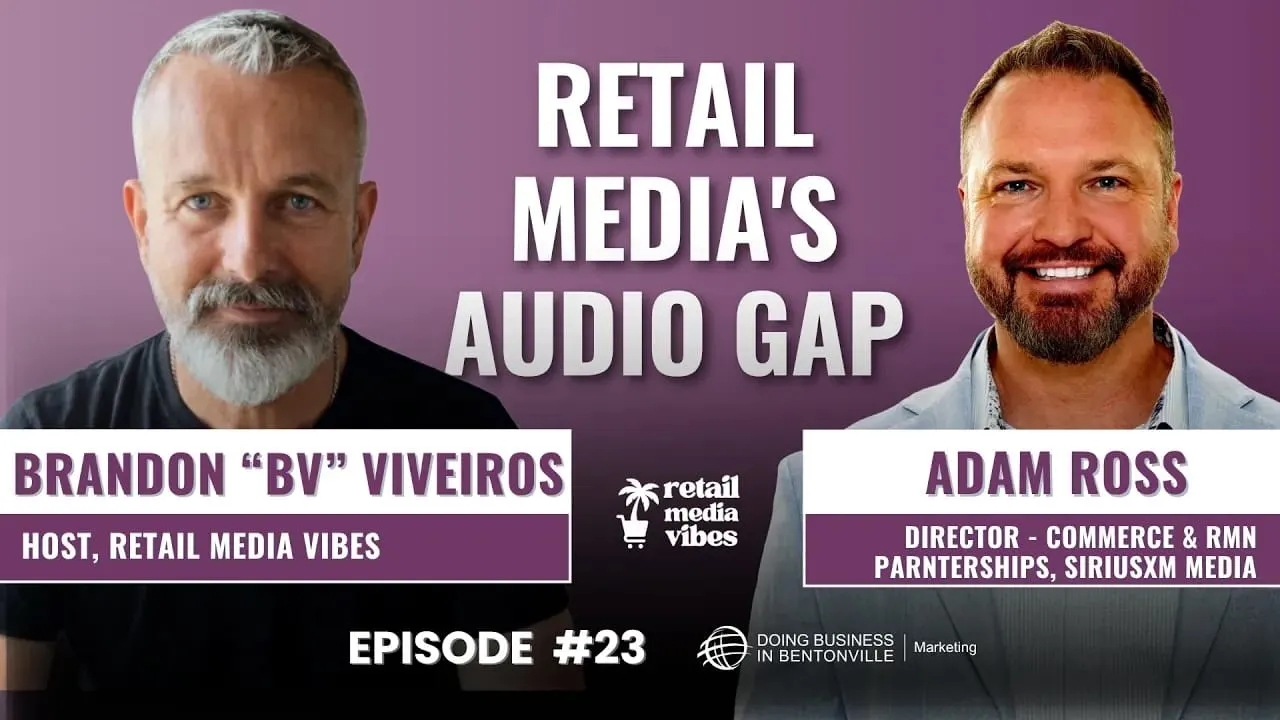
Most commerce teams obsess over bottom-of-funnel search clicks and visual display ads, leaving one of the most effective conversion drivers completely untapped. Despite retail shoppers spending an average of 22% of their digital time streaming music and podcasts, brand investment in digital audio hovers around just 1%. In this episode of Retail Media Vibes, host BV sits down live in Rogers, Arkansas with Adam Ross, Sales Director for Commerce and Retail Media Partnerships at SiriusXM Media, to unpack how marketers can leverage audio to drive measurable, closed-loop commerce outcomes.
We sit down to explore the massive operational shift from upper-funnel brand awareness to data-driven retail media execution. Adam breaks down the three tiers of the SiriusXM ecosystem—satellite in-car listening with connected 360L technology, streaming platforms like Pandora and SoundCloud, and the country's largest podcast network—as well as their groundbreaking new role as the exclusive audio advertising partner for YouTube and YouTube Music. We get into why peak audio consumption aligns perfectly with peak daytime shopping hours, how small and mid-tail brands can utilize zero-cost creative production through Studio Resonate to conquer localized DMAs, and why layering audio into an omnichannel media mix dramatically lifts conversion rates across Amazon, search, and connected TV.
The operational reality of retail media demands rigorous measurement, and audio is no longer a guessing game. By passing back direct identifiers through partners like Walmart Connect and Amazon Marketing Cloud, brands are now tracking precise multi-touch attribution, sales lift, and new-to-brand metrics—including an average 46% new-to-brand buyer uplift demonstrated in recent Kroger case studies. Adam also details how artificial intelligence is transforming dynamic audio creative, enabling brands to serve hundreds of thousands of personalized ad variations based on real-time weather, inventory, and countdown timers without ballooning production costs.
If you care about omnichannel retail strategies, digital merchandising innovation, and maximizing your ad spend efficiency, you’ll get a lot from this. Make sure to subscribe to Retail Media Vibes and share this episode with your commerce and media planning teams. What percentage of your current retail media budget is allocated to demand generation versus bottom-funnel demand capture?
More About this Episode
The Untapped Power of Audio in Retail Media: Why Sound is the Next Growth Frontier for Commerce Brands
Retail media is experiencing an unprecedented evolution, transforming from simple on-site sponsored search ads into a sophisticated, multi-channel digital ecosystem. Yet, as commerce marketers pour billions of dollars into programmatic display, connected television, and on-site banners, a massive blind spot persists across the industry. Brands are fiercely competing for visual attention on crowded screens while completely ignoring one of the most intimate, engaging, and high-converting channels available today: digital audio.
The modern shopper does not spend their entire day staring at a screen. They live dynamic, mobile lives scored by streaming music, immersive podcasts, and live broadcasts. By integrating audio into retail media strategies, brands can unlock a powerful growth engine that bridges upper-funnel brand affinity with bottom-funnel conversion. It is time to examine how sound is reshaping shopper marketing, why the gap between audio consumption and ad spend represents a massive opportunity, and how data-driven audio campaigns are driving quantifiable sales at the cash register.
The Emotional Connective Tissue of Shopper Marketing
To understand why audio is such a potent catalyst for commerce, marketers must first understand the psychology of sound. Most digital advertising relies on visual interruption. A display ad or a social media banner must compete with feed clutter, often appearing adjacent to stressful news headlines or fatiguing visual stimuli. Audio operates on an entirely different wavelength.
Music, sports broadcasting, and podcasts are inherently emotional mediums. A consumer listening to their favorite playlist, tuning into live commentary of their favorite sports team, or absorbing an inspiring talk show is in an active, emotionally elevated state of mind. Because human purchasing decisions are deeply driven by emotion and rationalized later by logic, advertising within an emotional audio environment creates profound brand resonance.
When a brand weaves its narrative into these auditory moments, it stops being a visual nuisance and becomes part of the consumer's personal soundtrack. This emotional connection creates brand affinity that visual display ads simply cannot replicate. Sound builds deep memory encoding, ensuring that when a shopper eventually walks down a store aisle or browses an e-commerce app, that brand is instantly recalled.
The Incrementality Imperative: Reaching Shoppers Beyond the Screen
The single most compelling argument for audio in retail media can be summed up in one word: incrementality. Today's acquisition costs are skyrocketing because brands are repeatedly targeting the same exact users in the same visual environments. Audio provides direct access to valuable, incremental audiences during moments when visual media is completely powerless.
Consider the daily routine of a modern consumer. What are they doing while walking the dog, exercising at the gym, commuting to work, or deep cleaning their home? Their screens are locked and put away, making connected television, video ads, and display banners useless. However, their ears are wide open. Audio is the only digital medium that accompanies consumers through these active, screenless moments of daily life.
This creates contextually brilliant targeting opportunities for commerce brands:
- Health and Wellness Brands: Reach fitness enthusiasts with sports nutrition or supplement messaging right in the middle of their workout playlists.
- Household and Cleaning Products: Engage consumers with home care essentials while they are listening to energetic playlists during weekend chores.
- Automotive and CPG Brands: Connect with parents during the morning school run or daily commute, right when they are mentally planning their evening grocery runs.
Despite this omnipresence, there is a staggering discrepancy between consumer behavior and marketing investment. Industry data reveals that the average shopper spends roughly 22% of their total media consumption time listening to streaming music and podcasts. Yet, brands typically allocate less than 1% of their total media spend to audio.
Furthermore, digital audio consumption peaks during the daytime hours, perfectly aligning with peak retail shopping hours. Conversely, connected television consumption peaks late in the evening when retail transactions slow down. Bridging this 21% consumption-to-investment gap allows brands to capture uncontested share of voice, engaging shoppers precisely when they are primed to make purchasing decisions.
Breaking Down the Modern Audio Ecosystem
When many marketers hear the word audio, they still picture legacy terrestrial radio with broad, untargeted geographic reach. The modern audio landscape is actually a highly sophisticated, data-rich digital ecosystem capable of surgical precision. Today's digital audio infrastructure spans three primary pillars, each offering unique touchpoints for retail media activation.
The Connected Vehicle and Satellite Radio
The dashboard of the modern vehicle has transformed into a powerful digital hub. With the widespread adoption of advanced infotainment systems and connected vehicle technology over the last several years, almost every new car on the road operates as an IP-addressable computer. Satellite services are no longer just broadcast signals; they are digital platforms capable of rich audience targeting and deterministic measurement, engaging consumers during the ultimate shopping pathway: the drive to the physical store.
Streaming Music and Audio-First Video
Streaming music services represent massive scale, allowing brands to target listeners based on genre, mood, time of day, and demographic profiles. However, the streaming landscape has also expanded heavily into video platforms. Massive audiences now utilize platforms like YouTube and YouTube Music strictly for audio-first consumption. A user might start a video podcast or a music playlist on their phone, flip the screen face down, and continue listening while working or driving. Capturing these audio-first moments across video platforms represents a massive, largely untapped frontier for retail advertisers.
The Explosive Growth of Podcasts
Podcasting is the fastest-growing segment in the digital media landscape. It attracts lean-in, highly attentive audiences who actively seek out knowledge, entertainment, and self-improvement. For commerce brands, podcasts offer a deeply immersive environment where ad skipping is low and listener engagement is exceptionally high.
Democratizing Retail Media for Mid and Long-Tail Brands
A common misconception among marketers is that high-impact audio advertising is an exclusive playground for enterprise CPG conglomerates with massive production budgets. In reality, audio is one of the most accessible and democratic channels within the retail media ecosystem, offering immense strategic advantages for mid-sized and long-tail brands looking to break through retail clutter.
The cost of entry for digital audio is exceptionally low compared to video production or connected television campaigns. Many audio networks and retail media partners now provide full-service, in-house creative production as added value. Brands do not need to hire expensive creative agencies or voice actors; the media partner can take a basic brand brief and produce high-quality, bespoke audio spots tailored to specific retail events, such as Prime Day, mega-promotions, or seasonal rollouts.
A 30-second non-skippable audio spot provides an incredible canvas for storytelling. While a visual banner ad gets a fraction of a second of attention, 30 seconds of dedicated audio allows a challenger brand to articulate its value proposition, explain why it is superior to legacy competitors, and deliver a clear, retailer-specific call to action.
Additionally, audio allows for hyper-localized execution and smart budget deployment:
- DMA and Regional Targeting: Brands with regional distribution can focus every dollar entirely within specific Designated Market Areas where their product is actually on the shelf, avoiding the waste of national buys.
- Strategic Dayparting: Advertisers can align their ad delivery with specific times of the day when their product is most relevant, such as running coffee ads during morning commuting hours or snack ads during afternoon slumps.
- Owning Share of Voice: Because so many competitors are over-indexing on visual search and display, mid-tail brands can jump into audio and dominate the share of voice within their category without facing bidding wars.
The Dual Power of Podcasts: Influence Meets Precision
When leveraging podcasts for retail media, marketers have access to two distinct execution strategies, each serving a crucial role in the full-funnel playbook.
Host-Read Endorsements
The host-read ad is the auditory equivalent of influencer marketing, but often with much higher consumer trust. Listeners develop deep, parasocial relationships with their favorite podcast hosts, viewing them as trusted friends and expert curators. When a host personally endorses a beverage, a health supplement, or a tech gadget, the listener does not process it as a traditional commercial interruption. It is received as a credible recommendation from a trusted source, driving powerful brand awareness and immediate consideration.
Programmatic Podcast Networks
While host-read ads excel at advocacy, they can be limited in scalability and audience targeting. This is where programmatic podcast network advertising bridges the gap. By integrating with Retail Media Networks, advertisers can now apply rich retail data layers directly across thousands of podcast titles simultaneously.
Instead of buying a single show, a marketer can target specific category buyers, lapsed brand purchasers, or competitor loyalists across an entire network of podcasts. Whether that target shopper is listening to true crime, comedy, or business news, the ad is dynamically inserted as pre-roll or mid-roll inventory. This combines the intimate, lean-in environment of podcasting with the precision targeting of programmatic display.
AI and Dynamic Creative Optimization in Sound
Artificial intelligence is rapidly transforming how brands create and deploy audio advertising, making hyper-personalization at scale a reality. In traditional broadcasting, creating hundreds of customized ad variations required weeks of studio time and significant financial investment. Today, AI-driven creative tools and Dynamic Creative Optimization allow brands to generate limitless variations of an audio spot in real time.
For retail media advertisers, this unlocks unprecedented creative relevance. Imagine a holiday campaign where a brand deploys hundreds of thousands of unique audio spots tailored to the exact listener. AI engines can dynamically adjust the voiceover script based on real-time variables:
- Weather Triggers: Serving hot cocoa or cold-weather apparel ads only to listeners in zip codes currently experiencing freezing temperatures or snowstorms.
- Local Inventory and Store Proximity: Directing shoppers to the specific retail superstore closest to their current GPS location where the item is confirmed in stock.
- Countdown Timers: Dynamically changing the script every single hour to reflect the exact number of days or hours remaining until a major retail sales event or holiday deadline.
By combining AI creative generation with RMN audience data, brands can guide consumers along the entire path to purchase. A shopper might hear a broad awareness message on Monday, a product-benefit educational message on Wednesday, and a direct promotional conversion message on Friday, all dynamically generated and served seamlessly without manual creative overhauls.
Closing the Loop: Advanced Measurement and Attribution
The ultimate litmus test for any retail media investment is accountability. Historically, audio was treated as a top-of-funnel branding exercise because marketers could not track what happened after the ad played. There is no clickable button on a radio broadcast or a smart speaker while a consumer is washing dishes.
Today, that measurement gap has been completely eradicated. Through deep data integrations with major Retail Media Networks, digital audio advertising offers the exact same closed-loop measurement and reporting suites as on-site search or programmatic display. When a consumer hears an audio ad on a streaming platform or a podcast, the impression is logged via robust digital identifiers. When that same consumer later walks into a physical brick-and-mortar store or logs into a retail app to make a purchase, the transaction is deterministically matched back to the audio exposure.
Marketers activating audio through RMN partnerships can now track sophisticated metrics:
- Return on Ad Spend (ROAS): Granular visibility into immediate revenue generated per dollar spent on audio inventory.
- Sales Uplift and Unit Growth: Measuring the direct lift in product sales among exposed listeners compared to a baseline control group.
- New-to-Brand Buyer Uplift: Tracking how effectively audio recruits first-time customers who have never purchased the brand before. Industry benchmark studies across dozens of retail campaigns consistently show audio delivering massive averages in new-to-brand buyer acquisition, proving its power as an exploratory discovery channel.
Crucially, audio highlights the importance of utilizing Multi-Touch Attribution models rather than relying solely on last-click metrics. Search advertising is fundamentally a demand-capture mechanism; it intercepts a consumer who has already decided to buy a product and is typing the keywords into a search bar. Audio is a demand-generation mechanism. It introduces the brand, builds the emotional desire, and fills the top of the funnel. Without the demand generation driven by high-impact channels like audio, there is simply no bottom-of-funnel demand for sponsored search to capture.
Sounding the Alarm for Future Commerce Growth
The future of retail media is undeniably omni-channel. As on-site search inventory becomes saturated and cost-per-click rates continue to climb, smart brands are actively diversifying their media mix to find profitable, high-impact growth channels.
Audio represents the ultimate frontier for this expansion. It commands a massive quarter of consumer media time, operates in distraction-free, screenless environments, builds profound emotional connections, and now boasts the precision targeting and closed-loop measurement required by rigorous commerce marketers. By giving audio a prominent seat at the retail media table, brands can amplify their message above the visual noise, engage shoppers throughout their entire daily routine, and drive sustainable, incremental growth from the headset to the shopping cart.