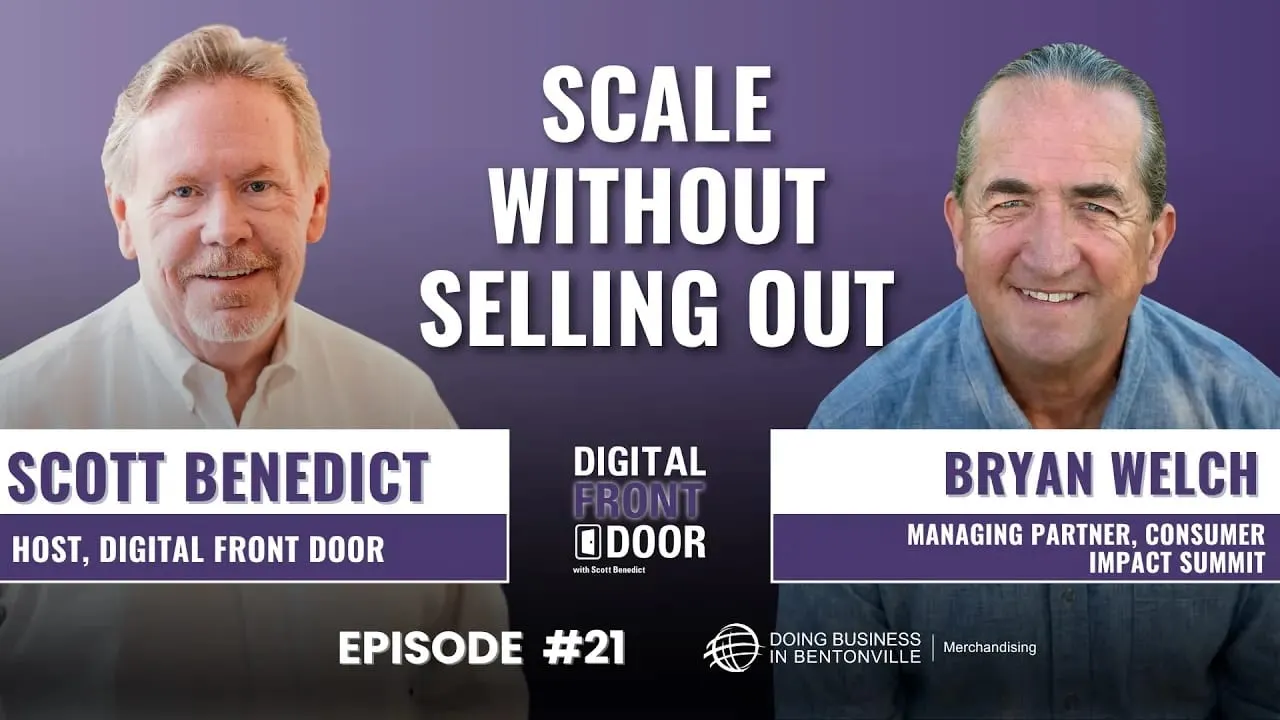
A compelling brand mission will not save a product that fails to perform on the shelf. As consumer demand for sustainability and transparency grows, retail buyers face immense pressure to balance ethical sourcing with operational readiness and financial execution. Bryan Welch, managing partner of the Consumer Impact Summit, joins the show to break down how founders can bridge the gap between strong personal values and the uncompromising demands of major retail distribution.
We get into the tactical reality of scaling a brand without losing your soul in the negotiating room. The conversation covers the concept of incrementalism in earning retail facings, how to leverage direct-to-consumer data to prove your customer base to buyers, and how emerging artificial intelligence is shifting e-commerce toward agentic shopping that favors certified B Corporations. Brian also shares his philosophy on early-stage decision-making, explaining why the initial pricing and supply chain foundations built during the startup phase ultimately dictate whether a brand can compete at scale against legacy CPG giants.
Scaling into national distribution requires confronting the harder side of retail expansion, including complex supply chain logistics, the financial discipline required to hit strict price points, and the reality that relying too heavily on a brand story is a fatal blind spot for founders. You will walk away with a grounded framework for auditing operational readiness, strategies for retaining control during investor negotiations, and a clear understanding of the data metrics that matter most to retail decision-makers.
If you care about CPG scalability, retail category strategy, and purpose-driven entrepreneurship, you will get a lot from this. Please subscribe to the channel and share this episode with a founder or retail operator who needs to hear it. What is the hardest operational compromise you have had to make to grow your business, and how did you protect your core values in the process? Tell us in the comments below.
More About this Episode
Bridging the Gap: How Purpose-Driven Brands Scale in Modern Retail Without Losing Their Soul
A compelling brand mission will never save a product that fails to perform on the shelf. While consumer demand for sustainability, transparency, and ethical sourcing is at an all-time high, retail buyers operate in a world defined by velocity, margin requirements, and operational readiness. For emerging consumer packaged goods (CPG) brands, the ultimate test is bridging the gap between strong personal values and the uncompromising, rigid demands of major retail distribution.
Winning in the modern retail ecosystem requires a dual mindset. You must possess the empathy and vision of a purpose-driven founder alongside the cold, analytical discipline of a seasoned supply chain operator. Scaling into national distribution is not just about telling a better story; it is about mastering the mechanics of high-volume merchandising, unit economics, and digital discoverability.
Here is how founders and retail operators can navigate the complex journey of CPG scalability, defend their core values during negotiations, and build a lasting presence on the shelf.
The Hard Reality of the Retail Shelf
When an item is placed on a physical retail shelf or listed on a massive digital marketplace, it enters direct competition with legacy CPG giants. These heritage brands have spent decades optimizing their supply chains, squeezing out operational inefficiencies, and commanding immense economies of scale.
Founders of purpose-driven brands often make the mistake of assuming that a superior mission will compensate for a slightly higher price point or minor supply chain hiccups. This assumption is a fatal blind spot. Retail buyers are evaluated on category profitability, inventory turns, and supply chain reliability. If an ethically sourced product cannot consistently arrive on time, in full, and at a competitive margin, it will lose its facing to a conventional competitor.
To survive, emerging brands must recognize that ethical sourcing and operational excellence are not mutually exclusive. In fact, sustainable scaling depends entirely on how well your backend operations support your front-end brand promise.
The Evolution of Corporate Consciousness and the Bentonville Ecosystem
For the last two or three centuries, corporate strategy was dominated by a singular focus on short-term profit maximization. Today, we are witnessing a fundamental maturation in global commerce. Consumers are no longer passive buyers; they are actively evaluating the entire lifecycle of the products they bring into their homes, from raw material extraction to labor standards and post-consumer waste.
The Bentonville retail ecosystem sits at the epicenter of this transformation. As the home of the world's largest retailers and initiatives like the Consumer Impact Summit, Bentonville is where high-volume merchandising meets the growing demand for conscious capitalism. Succeeding in this arena requires understanding that modern retail leaders are actively seeking brands that drive positive environmental and social impact, provided those brands can execute at a rigorous corporate standard. Purpose is no longer viewed as a charity initiative; it is recognized as a critical driver of long-term brand equity and customer loyalty.
What Retail Buyers Actually Look For in Purpose-Driven Brands
Every year, retail buyers are bombarded with thousands of product pitches from founders claiming their company will revolutionize the category and change the world. To cut through this noise, operators must move beyond the emotional appeal of their origin story and present a bulletproof business case.
Moving Beyond the Brand Story
A mission statement does not de-risk a supply chain. When a buyer reviews a product line, they are looking for risk mitigation. Relying too heavily on your brand story without presenting solid category data is the fastest way to lose a buyer's attention. You must prove that your product fills a legitimate void in the current retail category strategy and brings incremental shoppers into the store.
Demonstrating Operational Readiness and Financial Execution
Buyers need to see functional, battle-tested metrics. Before stepping into a pitch meeting, founders must be prepared to answer tough operational questions:
- Can your manufacturing facilities handle a sudden ten-fold increase in purchase orders without sacrificing product quality?
- What contingency plans do you have in place to mitigate global supply chain disruptions?
- Have you built enough gross margin into your cost of goods sold (COGS) to support mandatory trade spend, promotional discounting, and potential retailer chargebacks?
- What is your strategy for managing grocery waste and reverse logistics?
When your operational foundation is as impressive as your ethical mission, you transform from a risky startup into a strategic retail partner.
The Strategy of Incrementalism: Winning Shelf Space Step by Step
One of the most dangerous traps for early-stage founders is attempting to scale into national distribution too quickly. Landing a nationwide rollout before your manufacturing and cash flow are mature is often a fast track to insolvency.
The key to sustainable retail expansion is incrementalism. Earning shelf space should be treated as a series of calculated, regional victories rather than an overnight national conquest.
By launching in a concentrated number of regional doors, teams can closely monitor shelf velocity, test promotional mechanics, and refine product packaging based on real-world shopper behavior. Once a brand proves it can dominate a regional footprint and generate strong inventory turns, operators can take that hard performance data to national buyers to justify expanding into adjacent markets.
Leveraging Direct-to-Consumer Data to Validate Retail Demand
In the past, emerging brands had to rely on subjective consumer focus groups and buyer intuition to earn shelf space. Today, savvy operators use their direct-to-consumer (DTC) channels as an incubation engine to harvest undeniable proof of demand.
When pitching a major retail buyer, your DTC data is your most persuasive asset. Instead of making vague claims about brand popularity, you can present granular analytics:
- Exact customer acquisition costs and lifetime value metrics.
- High repeat purchase rates that demonstrate strong product retention.
- Geographic heat maps proving that a dense concentration of your online subscribers resides within a five-mile radius of the retailer's target physical stores.
- Basket size metrics showing which complementary products your customers buy alongside yours.
By demonstrating that a dedicated community of consumers in a retailer's specific geographic footprint is already purchasing your product online, you remove the guesswork for the buyer. You are not asking them to take a chance on an unknown brand; you are inviting them to capture existing demand that is currently happening off-shelf.
Building a Resilient Pricing and Supply Chain Foundation
Early-stage decision-making sets the permanent trajectory for long-term scalability. The initial pricing architecture and supply chain foundations established during a brand's startup phase ultimately dictate whether it can survive retail margin compression at scale.
If a founder prices a product based solely on low-volume direct-to-consumer shipping without projecting the aggressive margin requirements of wholesale distributors, retail brokers, and mandatory promotional calendar participation, the business will enter a financial death spiral as it grows.
Founders must reverse-engineer their pricing structure from the target retail shelf price back through the entire supply chain. This discipline requires finding hidden margins within your own operations. Whether through packaging optimization, consolidating raw material suppliers, or establishing vendor-managed inventory agreements that improve forecasting accuracy, every cent saved in the supply chain is a cent that protects your profitability on the shelf.
The New Digital Frontier: How AI and Agentic Shopping Favor Certified B Corporations
We are currently witnessing a massive transformation in how consumers discover and purchase products. The traditional retail blueprint is evolving rapidly as consumer behavior shifts away from typing static keywords into a search bar toward conversing with artificial intelligence.
From SEO to Generative Engine Optimization
As we enter the era of agentic shopping, AI agents will increasingly make autonomous purchasing decisions on behalf of consumers. A shopper might instruct their AI assistant to replenish their household pantry with organic, carbon-neutral snacks under a specific price point.
This technological leap requires a transition from traditional search engine optimization (SEO) to generative engine optimization (GEO). To win the AI shopper, brands must ensure their digital presence is optimized for large language models.
Why Structured Data is the New Brand Equity
Autonomous shopping agents do not get swayed by emotional banner ads or clever marketing copy; they rely entirely on structured data, pristine product detail pages, and verified product attributes. This shift creates an extraordinary competitive advantage for certified B Corporations and brands with verified sustainability credentials.
When ethical sourcing, carbon footprint measurements, and fair-trade certifications are built into a brand's clean data architecture, AI algorithms can confidently cite, recommend, and purchase those products over conventional competitors. Implementing AI visibility strategies and structuring your product data is no longer just a technical IT concern; it is an absolute requirement for future-proofing your brand's digital market share.
Protecting Your Core Values During Investor and Buyer Negotiations
Scaling a purpose-driven brand requires significant capital, which inevitably leads to high-stakes negotiations with institutional investors, private equity firms, and powerful retail buyers. The ultimate challenge of purpose-driven entrepreneurship is maintaining your ethical standards when facing immense external financial pressure.
Establishing Operational Boundaries Early
To avoid losing your soul in the negotiating room, you must establish clear operational boundaries before discussions begin. Know your non-negotiables. If an investor or retail buyer demands cost-cutting measures that compromise your labor standards, ingredient integrity, or environmental commitments, you must have the financial modeling ready to defend those practices.
You must prove that your ethical standards are not an unnecessary operational expense, but the core structural moat that drives your customer retention and enterprise value. When you can demonstrate via hard data that watering down your sustainability practices will erode customer loyalty and destroy brand equity, you transform a moral argument into an unassailable financial strategy.
Auditing Internal Systems for Sustainable Growth
The skills required to launch a startup are rarely the exact same operations needed to scale one into national distribution. During the critical transition period between regional success and national expansion, founders must conduct a thorough audit of their internal workflows.
This means simplifying bloated software tech stacks, cleaning up disorganized data architecture, and narrowing daily management focus to three or four bellwether key performance indicators. By building transparent, accountable systems that map every internal process, teams can eliminate friction, reduce costly errors, and ensure that the brand's core values remain intact even as headcount and production volumes multiply tenfold.
Building a Lasting Legacy in Modern Retail
True CPG scalability happens when purpose and performance operate in perfect alignment. A brand cannot survive on ethical intentions alone, nor can it build lasting customer love through cold operational efficiency without a soul.
By mastering the hard realities of supply chain logistics, adopting a strategy of disciplined incrementalism, leveraging direct-to-consumer data, and preparing for the future of AI-driven commerce, founders can successfully bridge the gap. You do not have to choose between scaling your business and protecting your values. When you build an operational foundation as strong as your mission, you earn the right to win on the shelf and drive meaningful, lasting change across the retail industry.