
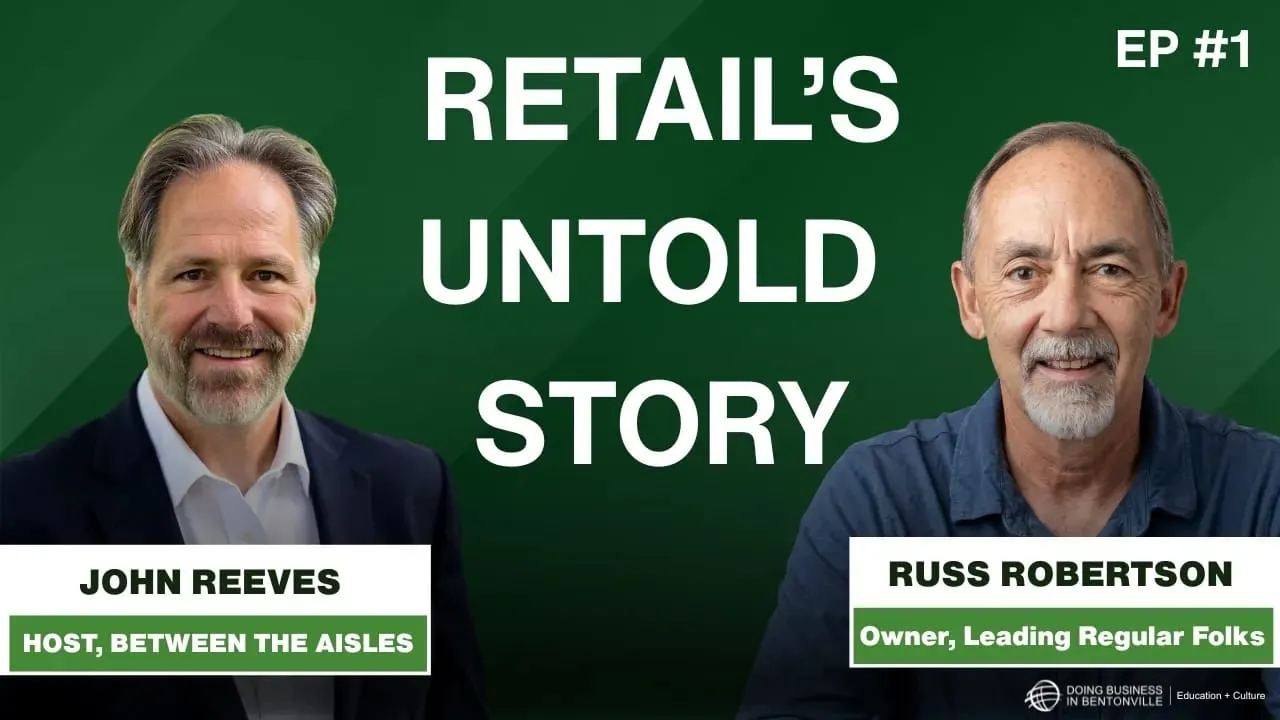
Sam’s Club is a $93 billion business, but the story of how it was built still feels strangely untold. We sit down with Russ Robertson, one of the original Sam’s Club managers, a Blue Coat Award of Excellence recipient, and the author of Building Sam’s Club With Regular Folks, to get a ground level view of what made the early warehouse club model work and what today’s retailers can still learn from it.
We talk about leadership that actually shows up in behavior: knowing your people, developing talent, and earning credibility by doing the work. Russ and I share vivid stories about the old Walmart and Sam’s Club culture, including Bob Hart rolling up his sleeves to clean a bathroom, and why that kind of example sets standards faster than any memo ever could. We also unpack Sam Walton’s “steal ideas shamelessly” philosophy as a discipline of curiosity, integrity, and speed, then connect it to “do it, try it, fix it” as a practical method for innovation.
If you want the real mechanics, we get into the warehouse club business model: tight SKU counts, ruthless expense control, simplified processes, and why early membership rules were so strict that most shoppers did not even qualify. Russ also tells the unforgettable Houston story where he tried to stop car theft with a do it try it fix it solution that drew a reprimand but preserved the autonomy to keep improving.
Listen, share this with a retail friend who loves operating details, and subscribe for more conversations that bring the best of the past into what we build next. If you enjoy the show, leave a review and tell us which lesson you want to see retailers apply right now.
More About this Episode
The DNA of Great Retail: Culture, Discipline, and the Sam’s Club Legacy
When people look at the retail landscape today, they see a world dominated by algorithms, sophisticated supply chains, and high tech convenience. But if you peel back the layers of a $93 billion giant like Sam’s Club, you find that the foundation wasn’t built on technology. It was built on something much more human and much more disciplined. I recently had the pleasure of sitting down with Russ Robertson, one of the original managers of Sam’s Club and a true culture champion within the Walmart organization, to talk about the early days of the warehouse club rush and what modern leaders can learn from that era.
Russ recently released a book titled Building Sam’s Club with Regular Folks, a follow up to his first work, Leading Regular Folks. Our conversation moved quickly from nostalgic stories of the 1980s to deep insights into what actually drives a successful business. Whether you are a retail veteran or just starting your career, there is a specific kind of magic in the early Sam’s Club story that remains relevant today. It is a story of extreme discipline, humble leadership, and the willingness to do it, try it, and fix it.
The Power of Leading by Example
In the early days of Walmart and Sam’s Club, leadership wasn’t about sitting in an office looking at spreadsheets. It was about being on the floor. Russ and I found ourselves reminiscing about legendary leaders like Bob Hart, a former Regional VP. Russ shared a story that perfectly encapsulates the culture of that time. He once walked into a store to find Bob Hart, a high ranking executive, with his sleeves rolled up, cleaning a bathroom. Another time, Bob was found stacking fifty pound bags of Ol’ Roy dog food just because it needed to be done.
This wasn’t a performance for the cameras. It was a statement of values. When an executive is willing to clean a toilet or unload a truck, it builds an incredible amount of credibility with the associates. It sets an expectation that no job is beneath anyone. That kind of leadership creates a bond that goes beyond a paycheck. Russ noted that Bob Hart cared about his people as individuals. When I was facing a health scare later in my career, Bob used his own connections to get me into the Cleveland Clinic for the best heart care possible. He didn’t do that because it was in his job description. He did it because that was the culture. We were his guys, and he took care of us.
The 1980s Warehouse Club Rush
To understand the success of Sam’s Club, you have to go back to the early 1980s. At that time, the warehouse club model was the new frontier. It really started with Saul Price and Price Club in San Diego. Sam Walton, true to his nature, saw what was happening and decided to dive in. This was the era of stealing ideas shamelessly.
When we say stealing ideas shamelessly, it isn’t about intellectual property or anything underhanded. It is about a total lack of ego. Sam Walton would walk into any competitor’s store, whether it was Kmart, Target, or a local mom and pop shop, and look for what they were doing better than us. He would ask new hires what their previous employers did more efficiently. He was a sponge for information. If a competitor had a better way of signing a product or a more efficient way to move pallets, Sam wanted to know about it.
This led to the famous do it, try it, fix it philosophy. We didn’t spend years in committee meetings debating an idea. We tried it on the floor. If it worked, we scaled it. If it didn’t quite work, we fixed it. And if it was a total failure? We followed the third, less discussed rule: do it, try it, kill it. We stopped doing it and moved on to the next thing without looking back.
The Discipline of the Wholesale Model
One of the hardest transitions for retail managers coming over from the Walmart side to the Sam’s Club side was understanding the fundamental difference between retail and wholesale. In a standard Walmart Supercenter today, you might have over 120,000 different items or SKUs. In the early days of Sam’s Club, we were strictly disciplined to stay around 4,000 SKUs.
That discipline is incredibly difficult to maintain. As a merchant, your instinct is to say yes to a great new product. But in a warehouse club, every item has to earn its spot on the floor. We stripped away every unnecessary expense. For the first year or two, we didn’t even have fancy printed signs. We hand wrote our signs. It kept the overhead low so we could pass every cent of savings back to the member.
The results were staggering. Russ pointed out that in 1985, a typical Sam’s Club was about 100,000 square feet. We didn’t have fresh meat, produce, bakeries, pharmacies, or gas stations. Everything was processed by hand, case cut with knives, and marked with pricing guns. Yet, some of those clubs were doing $2,400 per square foot in sales. In today’s dollars, that is about $250 million out of a single nondescript warehouse. That kind of volume is almost unheard of today, even with all the technology we have at our fingertips. It proves that when you simplify the business and focus entirely on the item and the price, the volume will follow.
Trust and Membership
Back then, membership was much more exclusive. Only about ten to fifteen percent of the population actually qualified to be a member. You had to be a business owner or part of a specific group like government employees or teachers. Because of that exclusivity, there was a high level of trust.
I remember my own family members being loyal Sam’s Club shoppers for decades because they knew the due diligence had already been done. If Sam’s Club carried a television, you didn’t need to look at twenty other models. You knew the buyers had already found the best value for you. That trust is the currency of a membership model. You aren’t just selling a product; you are selling the fact that you have done the hard work of editing the selection so the member doesn’t have to.
Taking a Chance on Young People
Perhaps the most important part of the Sam’s Club legacy is how the team was built. When Sam Walton started the club, he tried to recruit seasoned, high performing Walmart store managers. But those managers were paid based on store profits, and they wanted guarantees that they wouldn’t lose money by moving to a brand new, unproven concept.
Sam Walton didn’t do guarantees. Instead, he said, get some of these young guys and give them a shot. This led to a wave of young, hungry managers like Russ Robertson, Carl Roche, and Jerry Oglesby taking the reins. They didn’t have thirty years of experience, but they had energy, they were immersed in the culture, and they were willing to work ninety hours a week to make it successful.
This willingness to bet on potential rather than just a resume is something that still defines the best organizations. It is about finding people who show up, work hard, and understand the basic culture of service. You can teach someone how to read a P&L statement, but you can’t easily teach them to care about the person on the other side of the counter.
The Human Element in a Digital World
In our conversation, Russ made a point that really stuck with me. He noted that while he appreciates technology, he refuses to use AI in his writing. He wants his personality, his mistakes, and his authentic voice to come through. There is a lesson there for all of us in business.
We live in a world where we can automate almost everything. We can use data to predict what a customer wants before they even know they want it. But you cannot automate the feeling of a leader rolling up their sleeves to help you unload a truck. You cannot automate the mentorship that happens between a district manager and a young associate looking for a career.
The story of Sam’s Club is a reminder that retail is, and always will be, a people business. It is about the items, yes. It is about the price, absolutely. But more than anything, it is about the culture that binds those things together. As Russ says, if you take the best of what we did in the past and combine it with the best of today’s tools, that is how you move from where you are to something truly spectacular.
Building something great doesn’t require a secret formula. It requires the discipline to keep things simple, the humility to learn from everyone around you, and the courage to take a chance on regular folks. Whether you are running a single department or a multi billion dollar corporation, those principles remain the gold standard. As we look toward the future of retail, we would do well to remember the lessons learned between the aisles of those early warehouses.