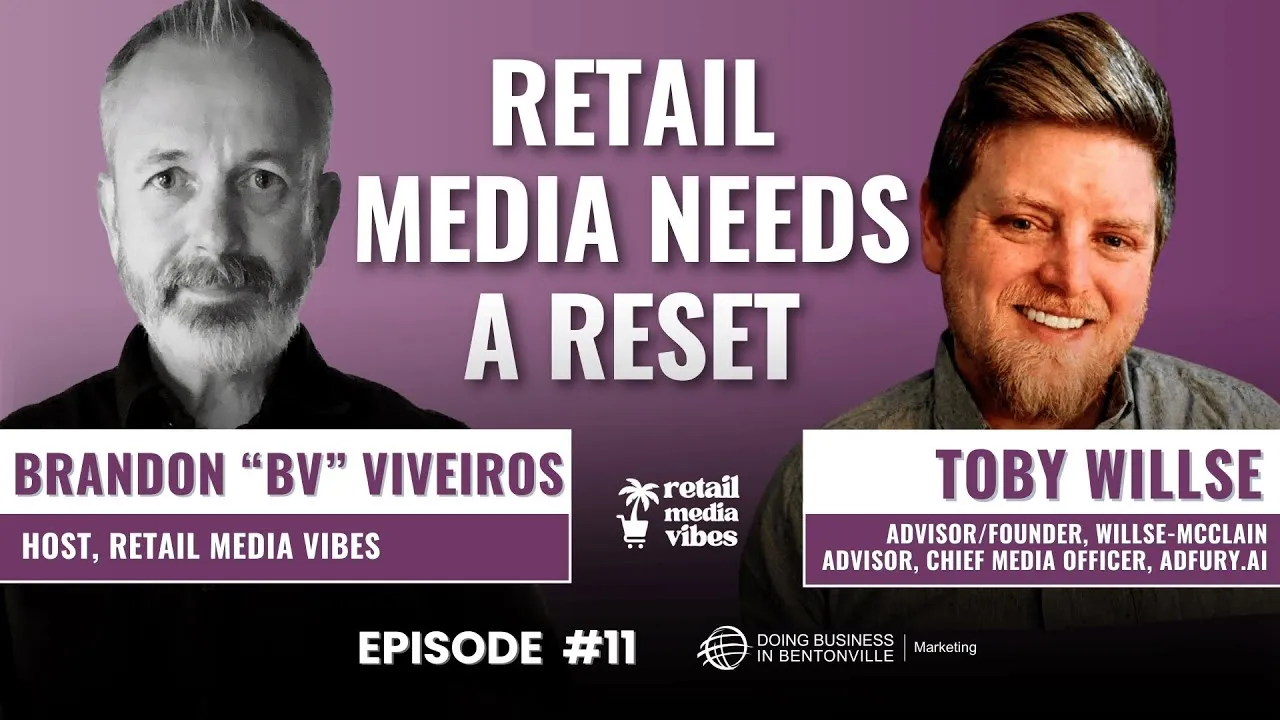
The most expensive mistake in retail media isn’t bad targeting, it’s planning in silos. We sit down with media leader Toby Willse to map how the field evolved from banner buys to agentic commerce, why teams still talk past each other, and what it takes to turn retailer-specific wins into brand-level growth. From his design roots to ad tech tours through AOL and Millennial Media, Toby explains how creative strategy, data access, and relationship management shape outcomes more than any single tactic.
We unpack the headliners from CES and NRF, including Google’s momentum in AI shopping, retailer partnerships, and the coming wave of sponsored prompts. Expect smart provocation on the “collapsed funnel” narrative: CTV with QR codes lowers friction, but it doesn’t magically become a conversion channel. Instead, think of new side doors to the bottom of the funnel and measure accordingly. We lay out a realistic framework for attribution that pairs platform signals with retail POS and modeled incrementality, while admitting there’s no silver bullet and AMC is a powerful slice, not the whole pie.
This conversation also goes human. Retail media teams juggle overlapping retailers, expanding JBPs, and constant change. We share practical ways to fight burnout, from using AI agents for repetitive work to establishing daily learning habits and grounding decisions with store and site walks. And if we could fix one systemic issue? Tear down the walled gardens to enable privacy-safe, interoperable measurement and smarter creative orchestration across channels.
If you care about better KPIs, cleaner alignment between brand and sales, and making AI work for your team instead of against it, you’ll find plenty to steal here. Follow the show, share it with a teammate who’s buried in dashboards, and leave a quick review to tell us your number-one retail media headache.
More About this Episode
Retail Media’s Next Frontier: Integration, Intelligence, and the Human Touch
The acceleration of retail media over the last few years has been nothing short of transformative. As someone who’s been deep in the industry, I’ve had a front-row seat to how this once-niche corner of the media world has matured into a driving force for both brands and retailers alike. It’s not just about media placements anymore, it’s about creating intelligent ecosystems, integrating deeply siloed teams, and ensuring that humans don’t get left behind as technology continues its rapid evolution.
I had the chance recently to sit down with Toby Willse, Chief Media Officer at AdFury and longtime digital media veteran, to talk through the complex and often chaotic state of retail media today. From the expansion of ad tech and data capabilities to the rise of AI-driven commerce, we explored the tensions and opportunities shaping the industry’s next chapter.
The Shift from Creative Execution to Strategic Integration
One of the most fascinating parts of Toby’s journey is his background in graphic design, which he credits as the launching pad for his media career. But it wasn’t the act of designing that hooked him, it was understanding how creative works in a broader strategic context. What makes someone stop and engage with an ad? How should creative assets be deployed across different environments to tell a compelling brand story? These are questions rooted in consumer empathy and data-driven curiosity, and they’re at the core of effective retail media today.
Toby’s early career at AOL, yes, the same AOL that once mailed us endless CDs, gave him a deep understanding of advertising infrastructure, scale, and the messy evolution of legacy platforms into modern media players. AOL’s data richness and commitment to adaptation (through key acquisitions like Millennial Media) helped him see the foundational power of audience targeting and media efficiency, long before those became everyday buzzwords.
The Real Challenge: Breaking the Silos
Ask any brand or agency leader what their biggest retail media challenge is, and you’re likely to hear the same refrain: silos.
Despite the huge investments in retail media from both retailers and brands, teams are often fragmented. Sales and brand marketing don’t always see eye to eye. Customer teams and retail teams may have different objectives. One is focused on growing topline revenue; the other is focused on preserving relationships with merchants. And all of this plays out against a backdrop of rising joint business plan (JBP) expectations and ever-increasing retail media spend requirements.
Toby sees this as one of the most solvable, and most detrimental, challenges in the space.
The fix? It’s not just about hiring more media people or building fancy dashboards. It’s about fostering cross-functional collaboration with clear communication, defined roles, and a shared commitment to the broader business objective: making the brand succeed across channels, not just pleasing individual retailers.
Measurement plays a role here too, but more on that later.
Rethinking Retail Media Strategy: Brand First, Channel Second
One of the more powerful takeaways from our conversation was the idea that brands must stop approaching retail media with a myopic, retailer-first mentality. As Toby put it: “You don’t need to target me across seven different retailers. You hit me on one and you’ve captured my interest. I might go purchase it somewhere else, but you still made the sale.”
This idea cuts to the heart of efficient media planning. Too often, retail media is planned in isolation, with each retailer treated like its own planet. But shoppers don’t behave that way. Consumers shop across multiple platforms and retailers, often within the same week. So why are we planning media as if they don’t?
Toby’s perspective encourages brands to take a step back, zoom out, and assess where their media dollars can do the most good. That might mean doubling down on one key retail media network and using off-platform tactics to amplify reach. It also means having the courage to push back when every retailer insists their network deserves a bigger slice of the budget.
The Rise of AI and Agentic Commerce
Of course, we can’t talk about the future of retail media without talking about AI.
CES 2024 (and the closely following NRF) brought a wave of announcements that underscored just how embedded AI is becoming in retail commerce, not just for product recommendations, but for full agentic commerce experiences where AI bots guide, suggest, and even transact on behalf of consumers.
Toby’s view on this evolution is pragmatic: Google, with its infrastructure, data scale, and market penetration, is well-positioned to dominate in this space. Their partnerships with Walmart and Target are already bearing fruit, and their AI agent (via Gemini) is gaining traction quickly. But there's still a long road ahead in terms of trust, privacy, and adoption.
And while much of the buzz is on consumer-facing applications, the backend impact is just as important. As Toby noted, the biggest near-term shift may not be AI-generated shopping journeys, but AI-driven productivity enhancements for marketers and agencies. Think: automation of reporting, optimization recommendations, and cross-channel alignment, freeing up strategists to focus on what matters most.
Measurement: Still a Maze, Not a Map
It wouldn’t be a retail media conversation without tackling measurement, and here, the waters get murky fast.
As much as brands want a unified, attributable, ROI-positive story from their retail media investments, the current landscape simply doesn’t support that kind of clarity across all channels. Sponsored products? Sure, last-click attribution is straightforward. But what about CTV ads, shoppable content, or influencer integrations? These are awareness and consideration plays, yet many are still judged by conversion metrics alone.
Toby’s take? It’s not about finding a silver bullet or waiting for the “perfect” measurement tool. It’s about aligning your KPIs with your goals, and being honest about what success looks like for different media types. If you're running a top-of-funnel campaign, don’t expect bottom-of-funnel metrics. And stop trying to measure everything all at once with a single metric. That’s where strategies fall apart.
Marketers need to embrace a more nuanced, portfolio-based approach to measurement, one that respects the unique role each tactic plays in the shopper journey.
Managing the Human Load in Retail Media
Beyond the strategy, beyond the tech, there’s another challenge we need to talk about more openly: burnout.
Retail media is fast. It's fragmented. And for many brand and agency teams, it’s an overwhelming exercise in spinning plates across dozens of networks, formats, and KPIs. Add in the pressure to stay current on every innovation, platform shift, and retail update, and it’s no wonder so many professionals are teetering on the edge of exhaustion.
Toby compares it to being a doctor, not because we’re saving lives, but because we’re required to stay constantly informed, or risk becoming irrelevant. That’s a heavy load to carry.
The antidote? Empathy. Automation. And smarter workflows.
AI can absolutely help here, not as a replacement for talent, but as a way to lighten the mental burden and make space for deeper strategic thinking. But just as important is the need for leaders to create environments where it's okay to ask for help, say no, or simply take a breath. The future of retail media depends not just on our technology, but on our people.
Looking Ahead: The Magic Wand Moment
If Toby had a magic wand to fix one systemic issue in retail media today, it would be the walled gardens. The inability to connect, compare, and analyze performance across platforms due to data restrictions is one of the biggest blockers to true retail media efficiency. Break those walls down, and you unlock better targeting, clearer measurement, and more cohesive strategies.
And while that may not happen overnight, the broader trend toward consolidation, both in retail media networks and AI tools, suggests we’re moving toward a more streamlined, collaborative future.
Final Thoughts
The future of retail media isn’t just about more. More networks, more data, more AI. It’s about being smarter. Smarter integration between teams. Smarter measurement strategies. Smarter use of emerging tools.
Most of all, it’s about remembering that behind every media placement, every AI agent, every KPI, there are people trying to navigate an ever-evolving space. The brands that win will be the ones that don’t just chase the latest trend, but build systems, teams, and cultures that are built to last.
Because while the tools may change, the goal remains the same: connect with real people in meaningful ways. Everything else is just tactics.