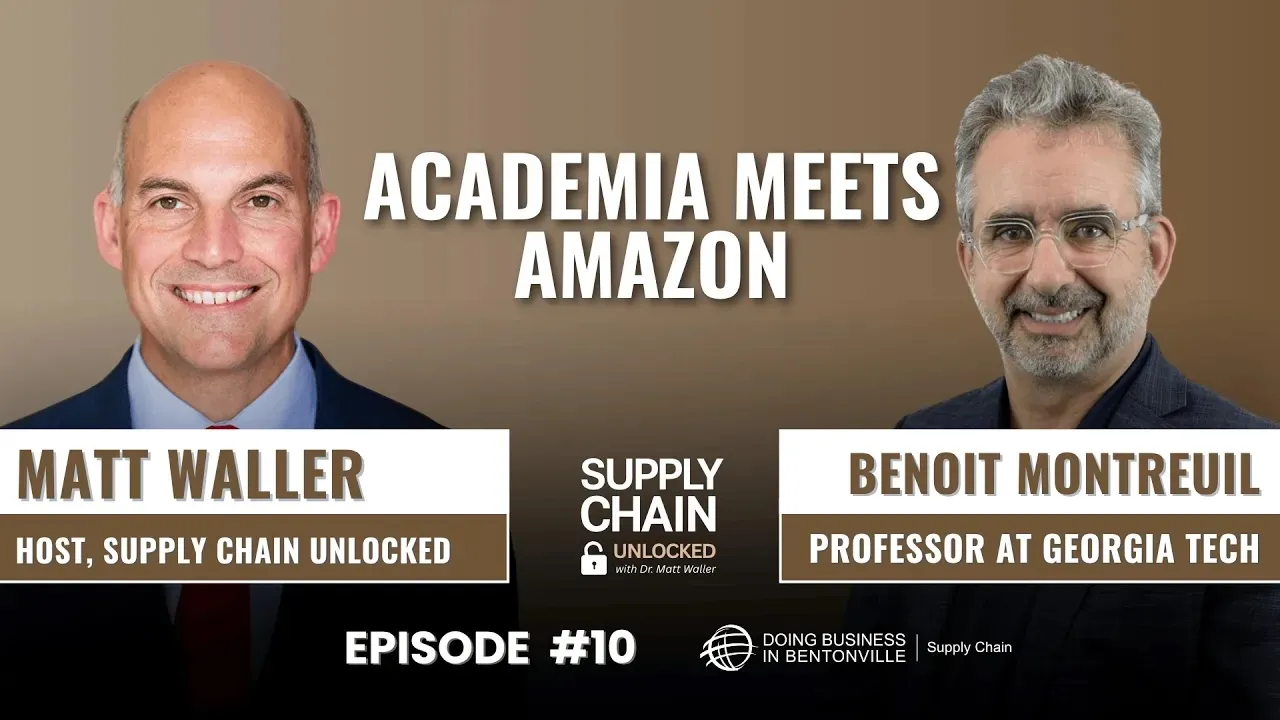
Supply chain leaders love to ask for “the model,” but the hardest part is figuring out what the real problem is in the first place. We sit down with Georgia Tech professor Benoit Montreuil, Executive Director of the Supply Chain and Logistics Institute, to unpack how his team works with major partners like Amazon, Home Depot, and UPS to tackle frontier logistics challenges with real data, real constraints, and real accountability.
We walk through what deep industry-academic collaboration looks like when it’s built for long-term impact: fewer partners, stronger trust, and projects that evolve from listening and data analytics into simulation, optimization, and digital twins. Benoit explains how his lab avoids the classic trap of treating every issue like a single-method problem, why scientific rigor and publishing still matter, and how to train PhD students to operate in teams, under NDA, while delivering outcomes that decision-makers can actually use.
We also get practical about AI in supply chain. Rather than chasing hype, we talk about generative AI as a tool for faster prototyping and experimentation, plus how to manage scope creep with an agile research program and steering committees that can pivot when mission-critical needs appear. Finally, Benoit breaks down the Physical Internet vision: hyperconnected logistics networks where warehouses and transportation capacity are shared like infrastructure, unlocking big gains in cost, resilience, service speed, and greenhouse gas emissions reduction.
If you care about supply chain strategy, logistics innovation, sustainability, and what the next era of e-commerce fulfillment could look like, this one will stretch your thinking. Subscribe, share this with a colleague, and leave a review, then tell us: what’s the toughest supply chain question you’re facing right now?
More About this Episode
Bridging the Gap: How We are Revolutionizing Supply Chain Through Action Research
The divide between academic theory and industrial practice has long been a hurdle in the evolution of logistics. For decades, universities were seen as ivory towers. Places where complex math was born but rarely survived the grit and grime of a real-world warehouse or a global distribution network. However, the landscape is shifting. At the Supply Chain and Logistics Institute (SCLI), we have spent years dismantling those barriers to create a collaborative ecosystem where high-level research doesn’t just observe industry; it transforms it.
My journey back to Georgia Tech as a professor and executive director was not something I initially mapped out, but it has provided the perfect vantage point to witness this transformation. Moving into our brand-new facilities, like the George Tower, is more than just a change of scenery. It represents a new generation of industrial and systems engineering. One that is open, leading-edge, and designed for the level of interconnectivity required to solve the challenges of 2026 and beyond.
Deep Partnerships Over Superficial Connections
In the academic world, it is easy to fall into the trap of breadth over depth. Many institutes seek to partner with hundreds of companies to bolster their logos on a website. We take the opposite approach. We seek deep, multi-year partnerships with "major league" players; the Amazons, Home Depots, and UPSs of the world, as well as transformative innovators like SF Express and MyTech.
When we work with a partner, our students and faculty become an extension of their team. We have doctoral students who are essentially "tattooed" with their partner company’s brand because they are so deeply embedded in their data and operations. These are not superficial consulting gigs. We are looking at the profound transformations needed to face modern challenges. We tackle the questions that keep CEOs awake at night. The ones they aren't equipped to solve internally because they are constantly tethered to the next quarterly result.
By providing our researchers with direct access to live company data and even company-issued hardware, we ensure that our projects are grounded in reality. This isn't about delivering a static report at the end of a semester. It is about "action research" and "living labs." We aim for a minimum viable product (MVP) that the company can actually touch, feel, and eventually commercialize.
The Art of Identifying the Real Problem
One of the greatest lessons I have learned over 40 years in this field is that when a company presents you with a problem, they are usually presenting a symptom. If you accept their initial problem statement at face value, you are a novice. Part of our responsibility at the institute is training the next generation of PhDs to be expert listeners and skeptics.
We teach our students to care, truly care, about the partner's success, which means having the courage to ask the "why" behind the "what." We use data analytics early on to fact-check the narrative. Often, there is a gap between what a company thinks is happening and what the data actually reveals. Because we aren't traditional consultants looking for the next contract, we have the freedom to be honest. If the facts shake the foundation of their current strategy, we present them constructively.
As we peel back these layers, the problem often evolves. We start with analytics, move into optimization and simulation, and eventually develop digital twins. Throughout this process, the "problem" shifts because we are constantly uncovering new layers of reality. This iterative approach ensures that we aren't just solving for today’s inefficiency but building tomorrow’s capabilities.
Tools are Not the Destination
In an era of massive hype, particularly around Artificial Intelligence, it is vital to remember that technology is a means, not an end. I often see brilliant students who are geniuses in stochastic programming or math programming. But if they view every challenge as a nail because they only have a hammer, they are in the wrong place.
We utilize every piece of "artillery" available, from classical optimization to the latest Generative AI and machine learning. But we do not do AI for the sake of AI. We use it because it enables us to solve problems that were unsolvable five years ago. For instance, I recently had a master’s student use ChatGPT to rapidly prototype an early-concept simulation. What would have taken months just a few years ago was done in a few hours. This is the "sweet spot" when human intellect leverages these new capabilities to drive curiosity and exploration.
Our goal is for our students to dominate AI, not be slaves to it. We want them to use these tools to create results so impactful that they shape the next 30 years of global commerce. Whether they go into academia, become entrepreneurs, or join industry leaders, they leave the institute prepared for a world where change is the only constant.
Managing the Evolution of Scope
Working so closely with industry inevitably leads to "scope creep." In a traditional contract, this is a nightmare. In our agile research environment, it is an opportunity for alignment. We utilize steering committees that have the sovereignty to shift the project's direction.
If a mission-critical problem arises (as many did during the COVID-19 pandemic) we are flexible enough to pivot. We recently had a project where we shifted 90 degrees mid-stream because the company’s reality changed. However, this only works because of the mutual trust built through our partnership model. We are transparent about resources; if the scope expands, we must decide together what to remove or how to scale.
This transparency ensures that we are always creating value. If you keep changing without ever finishing, you never deliver results. By using agile management, we ensure that we hit milestones and deliver tangible improvements before moving to the next layer of complexity.
The Vision of the Physical Internet
Perhaps the most ambitious area of our research involves the Physical Internet. This concept, which I began developing nearly two decades ago, applies the logic of the digital internet to the movement of physical goods.
Consider this: there are roughly 500,000 warehouses in the United States, yet most are siloed and used by only one company. In a world of "quick commerce," where consumers expect delivery in 20 minutes, owning your own infrastructure is no longer sustainable. You can never be big enough on your own.
The Physical Internet is about hyperconnectivity. The seamless interconnection of logistics networks. It’s about moving physical "atoms" with the same efficiency that we move digital "bytes." When we move from a model of private, isolated facilities to an open, shared network of thousands of facilities, the results are staggering. We aren't looking for 1% or 2% improvements. We are seeing 20% to 40% reductions in costs and 50% to 60% improvements in greenhouse gas emissions.
This vision requires a fundamental redesign of how we manufacture, supply, and distribute products. It is a massive undertaking that the European Union has already adopted as its long-term roadmap. By creating "physical intranets" within companies and expanding them to industry-wide networks, we are building a logistics system that is economically viable and environmentally sustainable.
A Legacy of Collective Effort
Reflecting on the evolution of this field, I am reminded that none of these breakthroughs happen in a vacuum. The success of the Supply Chain and Logistics Institute is a testament to the students, faculty, and industry partners who have the courage to think differently.
The challenges of the retail value chain and global logistics are more complex than ever, but our ability to address them has never been greater. By bridging the gap between the lab and the loading dock, we are not just observing the future of supply chain. We are actively building it. We must continue to push the boundaries of what is possible, leveraging every tool at our disposal to create a more resilient, efficient, and interconnected world.