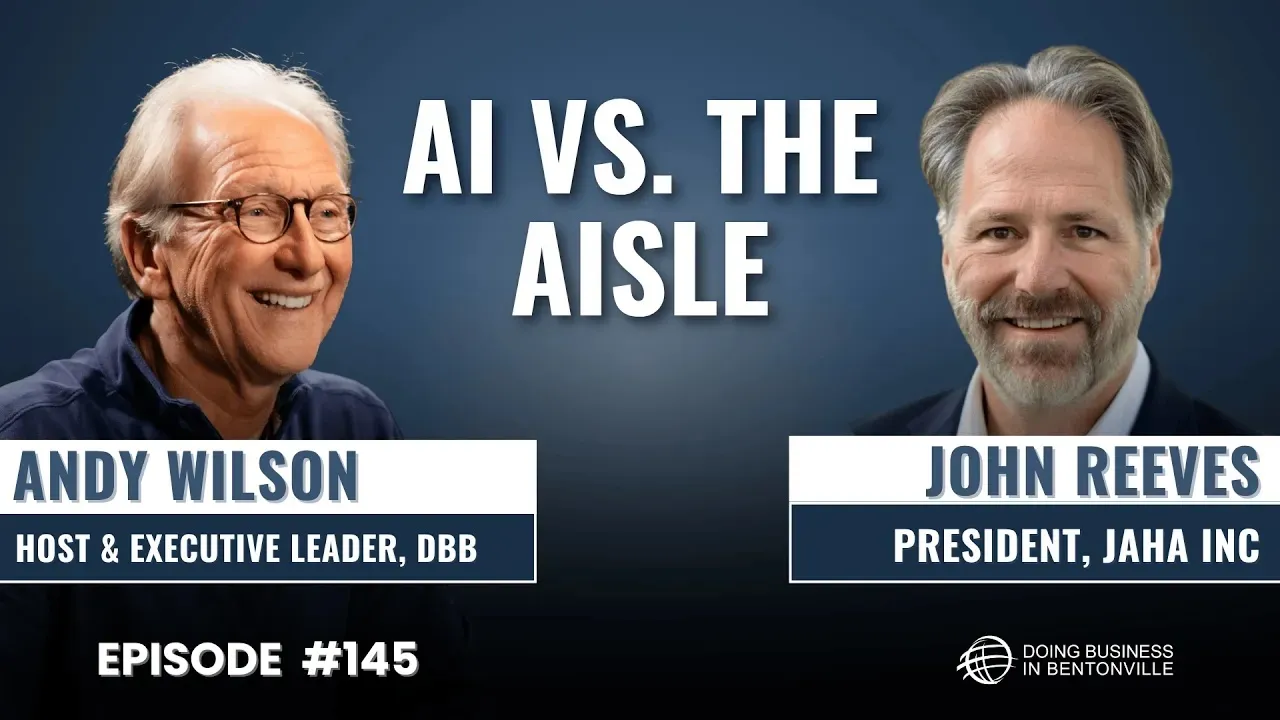
Walmart just crossed a trillion-dollar valuation and is openly positioning itself as a tech-driven retailer. That milestone raises a bigger question we all care about: what has to change inside a company when the future is AI, omnichannel retail, and nonstop competition? I sit down with John Reeves, a 22-year Walmart veteran and lifelong merchant, to break down what we’re seeing on the ground and what we think it signals for 2026.
We dig into Walmart’s leadership transition and why succession planning is not org-chart theater. John shares what great CEOs do differently, including Doug McMillon’s habit of learning directly from stores and asking the questions other leaders avoid. We also talk about the practical side of transformation: using technology to improve merchandising, speeding up decision making, and preparing for how AI in retail will reshape jobs from the back office to the shopping cart bay. One of the most important points is also the simplest: paying associates more can be a strategic advantage when you’re trying to upgrade service, execution, and talent.
Then we widen the lens. Target’s brand is strong, but out-of-stocks, store standards, and long self-check lines can quietly drain trust and profitability, especially when higher-margin categories soften. Kroger’s new CEO hire gets us talking about store-walk leadership and what it takes to refocus a grocery giant on its core. We close with a clear-eyed look at Amazon’s habit loop, plus what Costco’s member trust and private label momentum can teach every retailer.
If you’re building a retail strategy for 2026, listen, take notes, and share this with a friend in the industry. Subscribe, leave a review, and tell us which retailer you’re watching most closely right now.
More About this Episode
The New Era of Retail Leadership: Navigating a Trillion-Dollar Landscape
The retail landscape is shifting beneath our feet at a velocity we haven't seen since the dawn of e-commerce. As we move into 2026, the industry is no longer just about who has the most stores or the lowest prices; it is about who can master the intersection of human-led service and tech-driven efficiency. My longtime colleague John Reeves and I recently sat down to dissect the current state of the "Big Five": Walmart, Target, Kroger, Amazon, and Costco, and the leadership transitions that are defining their futures.
When you look at the headlines, one number jumps out: one trillion dollars. Walmart hitting a trillion-dollar valuation isn't just a financial milestone; it is a signal that the world's largest retailer has successfully rebranded itself as a tech company. This shift in identity is precisely why the recent leadership transitions at the top of these retail giants are so critical to understand.
The Baton Pass: Why Walmart is Winning the Long Game
Succession planning is often the "silent killer" of great companies. Many organizations fail because they don't think deep enough into their bench. At Walmart, we are seeing a masterclass in how to develop a leadership pipeline that spans decades. The transition from Doug McMillon to John Furner is a perfect example of this.
Doug McMillon’s tenure will be remembered for its profound humility. He famously noted that when you see someone who can run the laps ahead better or faster, the right thing to do is hand them the baton and cheer them on. That lack of ego is rare in the C-suite, but it is exactly what allowed Walmart to catch up to Amazon. Doug took the net profit from 6% to 4% to invest in associates and e-commerce. A move that was initially met with skepticism from shareholders but ultimately saved the company.
Now, John Furner takes the helm of a trillion-dollar ship. John is the embodiment of the modern retail executive: young, enthusiastic, and profoundly tech-driven. But he didn't just appear out of nowhere. Like Doug, John’s resume is a roadmap of the entire company, with stints at Sam’s Club and International. This "rotational" style of leadership development ensures that when a leader takes the top spot, they aren't just managing a balance sheet; they understand the soul of the business, from the stockroom to the boardroom.
The Merchant’s Dilemma: Target’s Path to Recovery
While Walmart is hitting record valuations, Target is facing a more complicated reality. For years, we all admired Target for their "merchandise authority." They were the masters of the curated assortment, the high-low fashion collaboration, and the "cheap chic" aesthetic. However, a walk through a Target store today reveals a different story.
The biggest hurdle facing Target right now is the fundamentals: in-stock levels and store standards. It doesn't matter how great your private label apparel is if the shelves are empty or the store feels cluttered. Recent data shows Target’s sales are up in grocery but down in apparel and home. For a retailer like Target, that is a dangerous mix because the margins in apparel and home are what fuel their profitability.
The new leadership under Rick Gomez (and the broader executive team) has laid out four clear priorities:
- Re-establishing merchandise authority.
- Elevating the guest experience (fixing the self-checkout lines and staffing).
- Accelerating technology.
- Strengthening the team and community.
Target needs to get back to being who they said they were. To compete with the scale of Walmart, Target must win on the "joy" of the shopping experience. If they can fix their in-stock issues and reclaim their status as the premier destination for home and fashion, they will remain a formidable number two.
The Return of the Store-First Leader: Kroger’s Bold Move
Perhaps the most interesting "hire" of the year is Kroger bringing in Greg Foran as CEO. For those who remember Greg’s time at Walmart US, he was the leader who famously put on a vest every single day and walked the stores. He didn't just look at reports; he talked to the associates pushing the shopping carts.
Kroger has been heavily focused on acquisitions recently, but they’ve lost a bit of their edge in the core grocery business. Greg Foran is exactly the "disruptor" they need. He has a proven track record of turning around declining sales by focusing on the basics: clean stores, fresh produce, and an engaged workforce.
I expect to see Kroger take a massive leap forward in e-commerce and "pickup today" services under Greg. He understands that in the grocery world, convenience and fresh quality are the only two things that matter. His "hands-on" approach will likely force Walmart and Amazon to stay on their toes in the grocery sector.
Amazon vs. The World: The Habit of Convenience
Amazon remains the elephant in the room with nearly $720 billion in annual revenue. Their head start in the "habit" of e-commerce is their greatest moat. For millions of consumers, clicking "Buy Now" on Amazon is a reflex.
However, the gap is closing. Walmart’s "Who Knew" campaign is a brilliant piece of marketing that is finally convincing Amazon loyalists to check the Walmart app. Both companies are now racing toward the same finish line: one-hour delivery, drone integration, and AI-driven personalization.
Amazon’s acquisition of Whole Foods was a shot across the bow of traditional grocers, but it hasn't quite revolutionized the physical grocery space the way many predicted. As Amazon tries to figure out its physical footprint, the traditional retailers are figuring out the digital one. It is a collision course that benefits only one person: the consumer.
The Trust Factor: Why Costco is Untouchable
Finally, we have to talk about the powerhouse that is Costco. With $123 billion in sales in just the first 22 weeks of the year, they are operating at a level of efficiency that is almost scary.
The secret to Costco’s success isn't just the $1.50 hot dog; it is the absolute trust they have built with their members. When you walk into a Costco, you trust that they have already done the hard work of vetting the best product at the best price. Their private label, Kirkland Signature, is arguably the most successful brand in the world.
While Sam’s Club is making incredible strides in technology (like their "Scan & Go" feature, which is miles ahead of Costco), Costco wins on the "intensity" of the treasure hunt experience. They have turned wholesale shopping into a destination event.
Looking Ahead to the Rest of 2026
If there is one takeaway from the current retail environment, it is that leadership matters more than ever. The CEOs who are winning are the ones who are willing to check their egos at the door, invest in their people, and move at the "speed of light" to adopt new technologies like AI.
Whether it is John Furner’s tech-first approach at Walmart or Greg Foran’s store-level focus at Kroger, the theme is clear: you must be where the customer is.
We are also keeping a close eye on the "off-price" sector. Companies like TJ Maxx and Ross are on fire right now because they offer a physical "treasure hunt" experience that is very difficult to replicate online. In our next discussion, we’ll dive deeper into how these off-price retailers and emerging dot-com brands are disrupting the traditional big-box model.
Retail is never static. It is a living, breathing industry that rewards those who are brave enough to change. As we watch these leaders navigate the trillion-dollar era, the goal remains the same as it was in Sam Walton’s day: give the customer what they want, when they want it, and treat your people well enough that they want to help you do it.