
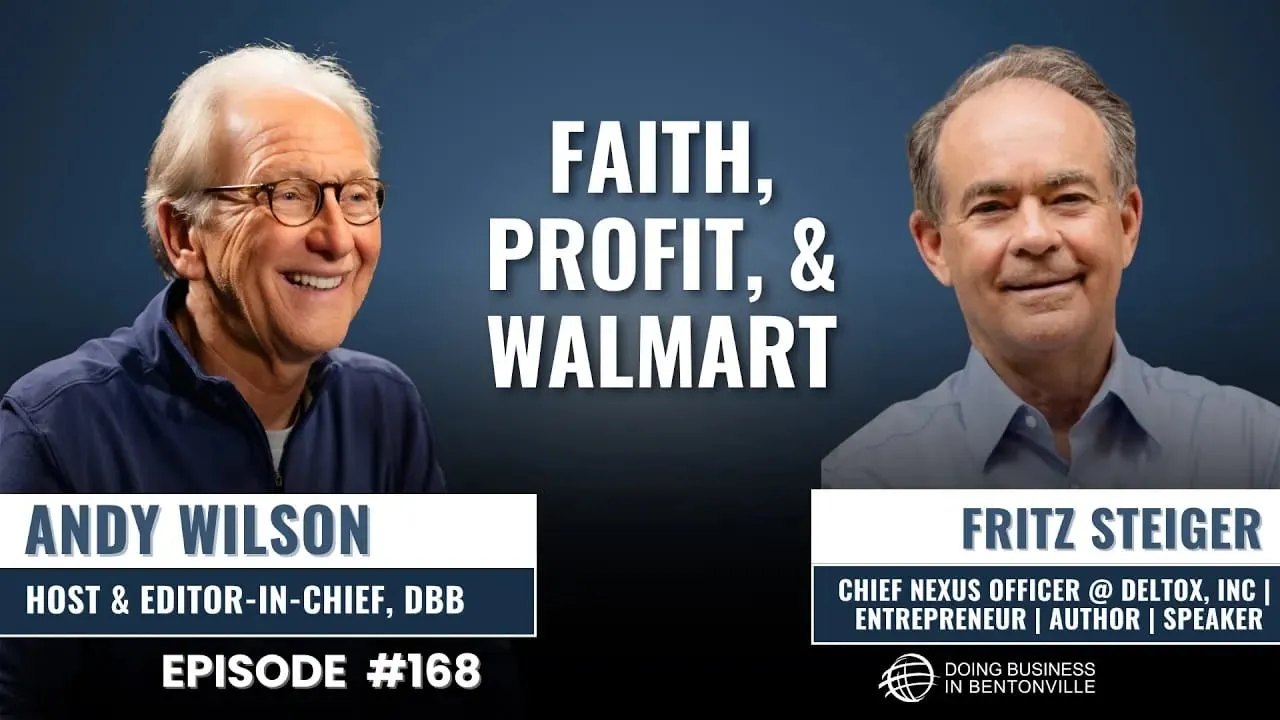
Business leaders face immense pressure to compromise core values for short-term gains. Fritz Steiger, former executive director of the Walmart Foundation, shares his experience managing corporate philanthropy and educational reform. His insights offer a roadmap for integrating personal conviction with corporate responsibility.
Steiger unpacks divine disruption, examining how unexpected shifts create opportunities for genuine innovation. He details the tension between maintaining a true north and satisfying public market demands. The conversation covers Sam Walton's early philanthropic efforts and the tactical challenges of driving the school choice movement against entrenched opposition.
For executives struggling to maintain personal integrity while answering to board members, this discussion provides a clear framework for principle-driven leadership. Subscribe and share this episode with a fellow operator navigating corporate friction. How do you balance market pressures with your foundational belief?
More About this Episode
Embracing Divine Disruption in Business Leadership and Cultural Restoration
In the world of commerce and enterprise, the word disruption is typically associated with market volatility, rapid technological advancements, or unexpected shifts in consumer behavior. We spend countless hours strategizing on how to navigate these external forces to protect our market share and ensure corporate longevity. However, there is a vastly different type of disruption that has the power to reshape not only our professional trajectories but the very fabric of our culture. This concept is known as divine disruption, a profound redirection of our lives and callings that often yields the most extraordinary seasons of growth, innovation, and societal impact.
When we examine the lives of influential leaders and the origins of monumental philanthropic movements, we frequently find a moment of unexpected pivot. Consider the story of Fritz Steiger, a man whose early life was rooted in the agricultural heartland, working alongside his father and brother on a dairy farm in the early 1980s. By all conventional measures, his career path was permanently etched in the soil. Yet, an unexpected connection formed while attending the same church as Sam and Helen Walton led to a pivotal invitation. Sam Walton envisioned a more structured, impactful way to channel the generosity of his growing retail empire, and he asked the young farmer to help him build what would become the Walmart Foundation.
That sudden shift from agriculture to corporate philanthropy perfectly encapsulates the essence of divine disruption. It is the recognition that our inherent talents and unexpected opportunities are not merely coincidences but purpose driven assignments meant to serve a greater good. By stepping into this new role, the foundation was able to launch scholarship programs in small towns across the country, providing life changing financial support to students who simply needed an opportunity to thrive. This initiative laid the groundwork for a lifelong commitment to educational reform and cultural restoration.
Finding a True North in Corporate Leadership
Today, executives face an unprecedented barrage of pressures. Balancing the immediate demands of shareholders with the long term ethical implications of corporate decisions can easily blur the lines of integrity. Many leaders struggle with institutional friction, feeling overwhelmed by the sheer volume of choices that test their personal convictions. To navigate these turbulent waters successfully, leaders require an unwavering foundational compass, a True North that dictates their actions when external pressures mount.
For many successful entrepreneurs and business executives, this True North is rooted in deep spiritual beliefs and Judeo Christian values. Integrity, honesty, and an uncompromising work ethic are not just corporate buzzwords; they are behavioral standards derived from a higher calling. When leaders anchor their identities in these foundational truths, they operate from a place of freedom rather than insecurity. They are not paralyzed by the fear of public opinion or the anxiety of temporary market failures. Instead, they lead with a profound sense of stewardship, viewing their business acumen as a set of talents entrusted to them to benefit their communities and elevate their fellow citizens.
This active posture of engagement is drastically different from the passive management styles often seen in boardrooms today. True leadership requires standing firm in the face of cultural and economic pushback. It involves recognizing that the capacity to innovate, build, and create wealth is a divinely inspired gift. Whether observing the relentless drive of American entrepreneurs building global retail chains or watching private space exploration companies launch rockets into the stratosphere, we are witnessing the manifestation of human potential unleashed. Acknowledging the source of this creativity allows leaders to channel their success toward meaningful societal improvement.
The Fight for Parental Empowerment and School Choice
One of the most critical arenas where business leadership and civic duty intersect is the realm of education. The future of any nation relies heavily on the preparation, moral grounding, and intellectual development of its next generation. Unfortunately, for decades, countless families have found themselves trapped in underperforming educational systems dictated entirely by their zip codes and socioeconomic status. The battle for school choice and parental empowerment is a prime example of how targeted, values driven disruption can transform communities.
The push for educational freedom gained significant momentum through organizations like the Texas Public Policy Foundation, a conservative think tank focused on business issues, tax reform, and empowering parents. In the early 1990s, the concept of utilizing taxpayer funds for educational savings accounts or vouchers was politically stalled. Rather than accepting defeat, passionate advocates and private philanthropists took matters into their own hands. They established privately funded scholarship programs for low income, inner city students in places like San Antonio, Texas. The model was simple but revolutionary: the program would pay half the private school tuition, and the parents would sacrifice to cover the remaining balance.
The response to this initiative was staggering and deeply revealing. Within a single week, thousands of families applied for the pilot program. These were parents living in poverty, recognizing that their children were on a perilous path, and they were willing to make immense personal sacrifices to alter that trajectory. Some parents even forewent paying their utility bills just to keep their children enrolled in a private school that offered a better, safer, and more rigorous educational environment.
This localized success caught the attention of visionary business leaders, most notably John Walton. Recognizing the profound impact of parental choice, he dedicated immense resources, time, and personal capital to expand this model across the United States. Through the establishment of Children First America, advocates spent years crisscrossing the country, rallying corporate leaders and philanthropists to invest in similar privately funded scholarship programs. Despite facing fierce opposition from entrenched educational establishments, leaders like John Walton stood firm, ultimately generating hundreds of millions of dollars in private funding to empower parents nationwide. This movement illustrates the monumental change that occurs when business leaders apply their resources and strategic thinking to solve complex social crises.
Active Engagement Across the Seven Foundational Areas of Culture
We are currently navigating an era marked by significant cultural friction and institutional decline. It is easy for individuals to look at the state of the world and feel a paralyzing sense of powerlessness. However, retreating into a passive posture only accelerates the erosion of the values that built our prosperity. To restore the strength of our communities, leaders and citizens must recognize that they are engaged in a fundamental struggle between right and wrong, good and evil.
This requires a deliberate, active engagement in what can be identified as the seven foundational areas of culture: faith, family, education, business, arts and entertainment, media, and government. For too long, well meaning individuals have confined their values to their private lives, assuming that passive participation in their local communities was sufficient. But as history continually demonstrates, all that is necessary for the triumph of negative forces is for good men and women to do nothing.
Transforming culture begins at the individual level. We must first establish what we fundamentally believe and allow those convictions to transform our minds and actions. If you operate in the business sector, you must ask how your corporate influence can reflect integrity and truth. If you are involved in media or the arts, you must evaluate the messages you are broadcasting to the next generation. If you are a citizen, you must exercise your civic duties, such as registering to vote and participating in the political process, an area where, surprisingly, participation rates among certain demographics remain alarmingly low. Organizations like the Alliance for Restoration are now working tirelessly to amplify the efforts of those who are fighting to bring light back into these critical sectors of society.
Equipping the Next Generation for the Challenges Ahead
The legacy we leave behind will not be measured solely by the wealth we accumulate or the corporate empires we build, but by the cultural and spiritual inheritance we pass down to our children and grandchildren. Passing the baton successfully requires more than just hoping the next generation figures it out; it requires intentional mentorship, documented wisdom, and actionable guidance.
For those looking to deepen their impact, creating structured opportunities for reflection and action is vital. Exploring historical contexts, studying family genealogies, and engaging with foundational texts provide the necessary grounding to face modern challenges. When leaders take the time to map out their journeys, complete with the lessons learned from their own divine disruptions, they create a roadmap for young professionals seeking to navigate a complex world. We must encourage young leaders to study history, engage in policy discussions, and read deeply about the philosophies that have sustained free and prosperous societies for centuries.
Ultimately, navigating the disruptions of our time requires immense courage. The pressures to conform, to compromise on deeply held convictions, or to simply remain silent out of self preservation are incredibly strong. Yet, the call to leadership demands exactly the opposite. We are reminded by ancient wisdom to be strong and of good courage, to not be afraid or dismayed regardless of the cultural climate.
Whether you are leading a Fortune 500 company, managing a small local enterprise, guiding a family, or working to reform local policies, the mandate remains the same. Embrace the unexpected shifts in your path. Allow your talents to be utilized for the greater good of your community. Stand firmly on the foundation of your core beliefs, and never underestimate the impact of a single life fully dedicated to active, values driven engagement. The future of our communities and our broader culture depends entirely on leaders who are willing to step out of their comfort zones, confront the challenges of the day, and carry on boldly.