From Curiosity to Strategy: How Individuals and Leaders Can Move on AI Now
As artificial intelligence rapidly reshapes how work gets done, many professionals find themselves in a familiar position: eager to experiment and learn, while their organizations move more cautiously. A new framework circulating among Bentonville-area retail and CPG leaders outlines a practical, two-level approach—what individuals can do right now to build AI fluency, and what organizations and executives must do to turn experimentation into strategy.
The message is clear: waiting for a formal roadmap may slow learning, but uncoordinated experimentation without leadership engagement can stall impact.
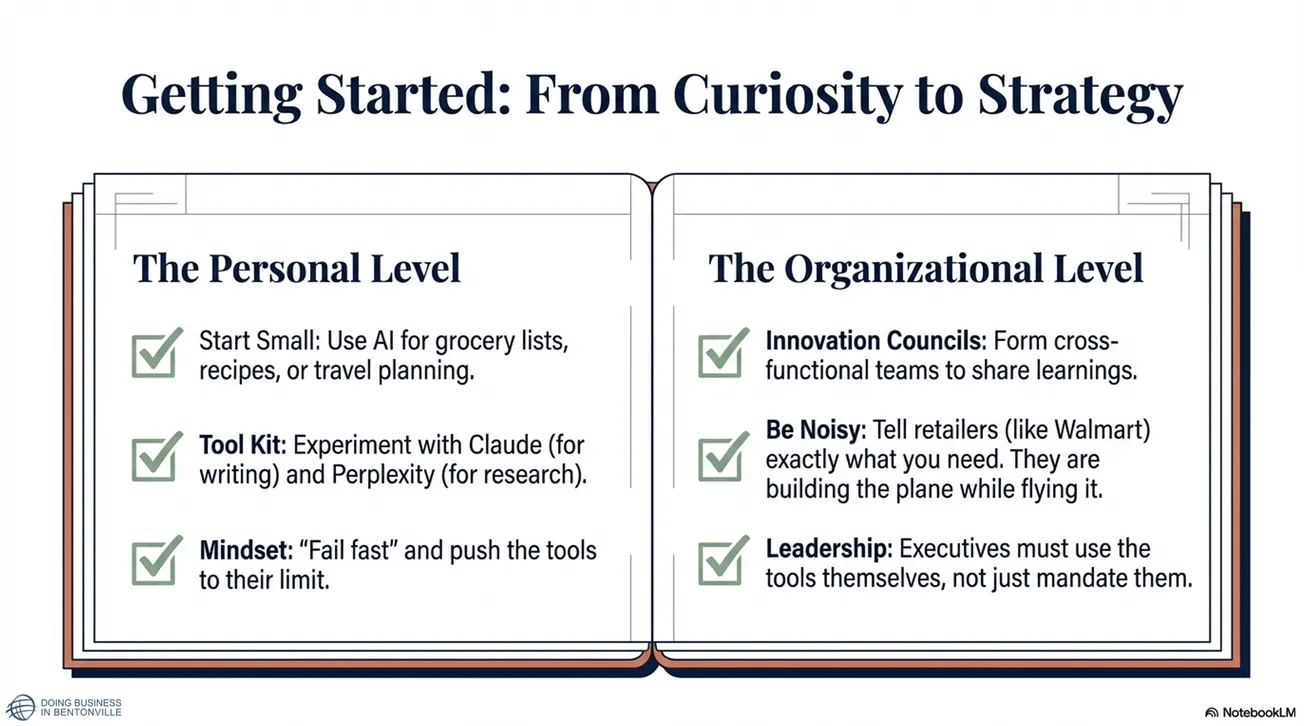
The Personal Level: Building AI Muscle Before the Mandate
For individuals, the path to AI literacy doesn’t start with enterprise systems or complex use cases. It starts small.
Start with everyday tasks.
Using AI tools for grocery lists, meal planning, writing drafts, or travel research builds familiarity quickly. These low-risk use cases help users understand strengths, limitations, and prompt design without organizational friction.
Create a personal AI toolkit.
Many early adopters are experimenting with multiple tools depending on the task. Writing-focused tools like Claude, paired with research-oriented platforms like Perplexity, expose users to different models and approaches. This hands-on comparison sharpens judgment about where AI adds real value.
Adopt a “fail fast” mindset.
Learning AI isn’t linear. The most effective users push tools to their limits, test edge cases, and learn from poor outputs as much as good ones. This experimentation builds intuition that can’t be gained from policy documents alone.
At this level, AI learning is less about perfection and more about pattern recognition—understanding where human judgment still matters most.
The Organizational Level: Turning Experimentation Into Advantage
While individuals build skills, organizations face a different challenge: moving from isolated experimentation to shared learning and scalable impact.
Form innovation councils.
Cross-functional groups create a forum to share use cases, lessons learned, and risks. These councils prevent duplicated effort and help surface practical applications across merchandising, marketing, supply chain, and operations.
Be explicit with retail and technology partners.
Retailers like Walmart and other major platforms are actively building AI capabilities in real time. Vendors and partners who clearly articulate what they need—data access, automation, insights—can influence how those tools evolve.
Leadership must lead by example.
Perhaps the most critical takeaway: executives cannot delegate AI adoption. Leaders who actively use the tools themselves gain credibility, set cultural norms, and make better strategic decisions about where AI fits—and where it doesn’t.
Mandates without usage rarely change behavior. Visible leadership participation does.
Why This Matters Now
In omnichannel retail and the broader consumer goods ecosystem, AI is no longer experimental—it’s becoming foundational. The gap between organizations that learn quickly and those that wait for certainty is widening.
This dual-track approach—individual curiosity paired with organizational intent—offers a practical bridge. It allows talent to build fluency today while leadership works toward governance, scale, and long-term strategy.
The organizations that win won’t be the ones with the most polished AI vision decks. They’ll be the ones where learning is already happening.