
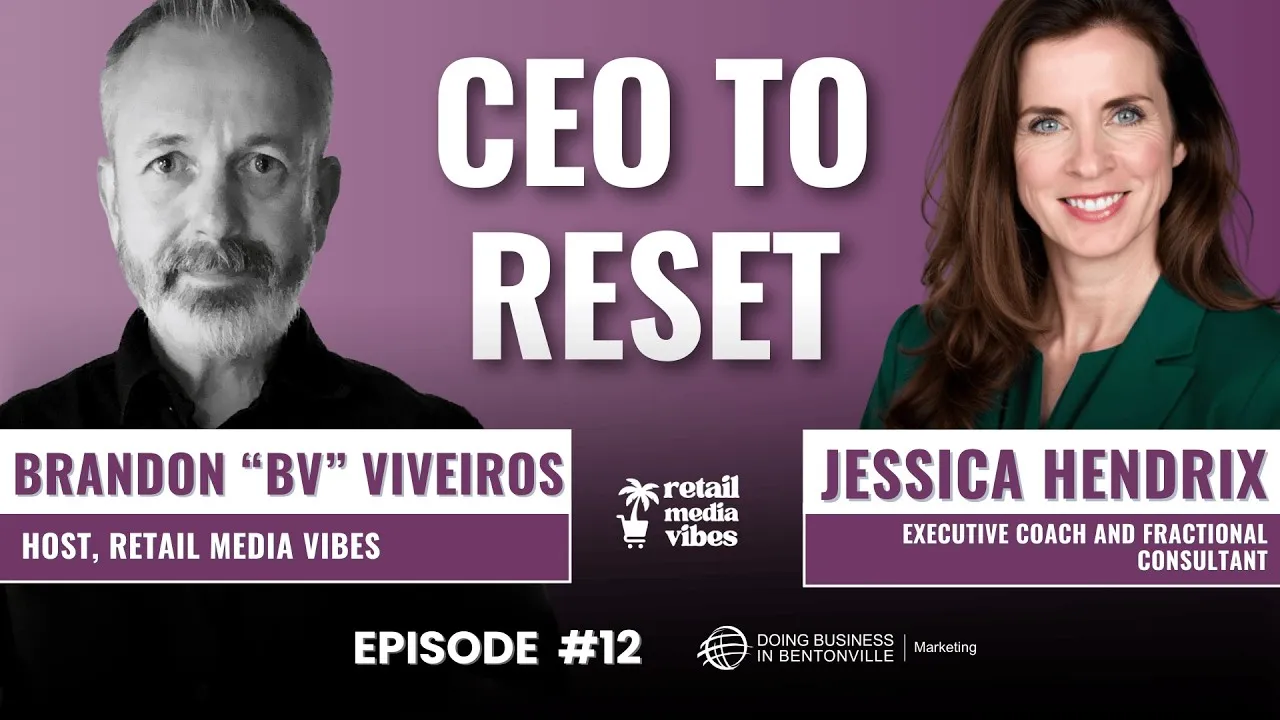
Leadership isn’t a title; it’s a set of choices you make when the ground won’t stop moving. That’s the through line of our conversation with Jessica Hendrix, former CEO of Saatchi & Saatchi X and a leader who’s navigated retail, agencies, and a CMO seat while keeping culture and clarity front and center.
We trace Jessica’s path from selling phones at a mall cart to guiding a global agency inside Publicis. She breaks down how she set vision in shifting markets using a simple framework, business, work, people, and why choosing fewer goals with more intention can actually accelerate results. We dig into the evolution from “shopper marketing” to commerce, the rise of retail media, and how Gen Z now steers family purchases from a phone. Her take is practical: the channels changed, the job didn’t: meet people in the moments that move them to buy, reduce friction, and measure what matters.
Culture comes alive in the details. Jessica talks transparency with limits, vulnerability that builds trust, and the power of authenticity to unlock talent. We go deep on the Enneagram, her Two, wing Three wiring, and how leaders can pair high performance with high humanity without burning out. She shares real boundaries that worked, two-night travel caps, morning school walks, quarterly solo resets, and the grace-and-accountability balance that keeps teams healthy and productive.
There’s a raw, important chapter here, too: a year of breast cancer, skin cancer, and spinal surgery that ended with a clean bill of health. Jessica’s lessons are urgent and universal, keep the checkups, design for recovery, accept help, and they reinforce her central message: take care of your people by taking care of yourself. Today she’s consulting and coaching, helping leaders set cleaner goals, build resilient cultures, and navigate AI-era change without losing their center.
If this conversation sparked something for you, follow the show, share it with a colleague who leads teams, and leave a review with one takeaway you’ll act on this week. Your note helps others find the podcast and keeps these stories flowing.
More About this Episode
Leadership, Retail Media, and Reinvention: Lessons from the Front Lines of Shopper Marketing
There are moments in your career when you realize the job you are doing is not just a job. It is a chapter. And sometimes, if you are lucky, it becomes a defining chapter.
Over the years working in retail media, shopper marketing, and agency leadership, I have had the privilege of learning from people who shaped how I think about business, culture, and leadership. One of those leaders is Jessica Hendrix. Her journey from retail sales to CEO of Saatchi & Saatchi X and later Chief Marketing Officer at Hy-Vee is a masterclass in growth, reinvention, and leading with humanity in high performance environments.
Her story is not just about titles. It is about navigating change in the evolving world of retail and commerce, building culture inside complex organizations, and understanding when it is time to write a new chapter.
Let’s unpack the lessons.
From Retail Floor to Agency CEO: The Foundation of Modern Leadership
Jessica did not start her career aiming for the C suite. She began in retail, selling wireless phones out of a cart in a mall. That experience, far from glamorous, became foundational.
Retail teaches you two things fast:
- Relationships drive outcomes.
- You only win when you align with the person across from you.
Whether helping a customer overcome credit challenges or solving a CPG sales problem with Walmart, the skill is the same. Find common ground. Understand the real objective. Build trust.
In today’s retail media ecosystem, that lesson matters more than ever. Retail media networks, CPG brands, agencies, and retailers operate in a tightly interconnected environment. Success depends on alignment across stakeholders. Performance marketing alone is not enough. The relational capital between partners often determines the outcome.
Jessica carried that mindset into Saatchi X, where shopper marketing was evolving rapidly. When she joined, terms like PDQ, endcap, and in store activation defined the tactical playbook. Over time, the industry shifted toward digital commerce, retail media platforms, and omnichannel execution. Tactics changed. The core principle did not.
Meet shoppers where they are. Influence the purchase moment. Convert intent into action.
That constant became her strategic anchor through two decades of transformation in retail and commerce marketing.
Setting Vision in a Dynamic Retail Media Landscape
Retail media is one of the fastest evolving sectors in marketing. AI driven optimization, closed loop attribution, data clean rooms, and fragmented channels define the current landscape. It is tempting for leaders to chase every new development.
Jessica approached vision differently.
Her framework centered on three pillars: the business, the work and the people.
Revenue targets, margin goals, and operational health sit in the business category. Creative excellence, award winning campaigns, and innovative commerce solutions live in the work. Talent development, culture, and leadership growth form the people foundation.
The key insight is this: less is more.
In volatile environments like retail media, leaders often feel pressure to move faster and do more. But clarity beats complexity. Simple, clearly articulated goals repeated consistently create alignment. Slow thinking enables fast execution when the moment requires it.
For leaders navigating AI disruption and shifting retail strategies, this is critical. Strategy cannot pivot weekly based on competitor moves. It must be rooted in core values and long term objectives.
Company Culture in High Performance Organizations
Shopper marketing agencies and retail organizations operate under intense pressure. Tight timelines, demanding clients, and quarterly business reviews define the rhythm.
In that environment, culture can erode quickly without intentional leadership.
Jessica’s approach to company culture rested on three pillars: transparency, vulnerability and humanity.
Transparency does not mean sharing every detail. It means communicating what you can and clearly stating when you cannot share more. Even acknowledging constraints builds trust.
Vulnerability means leaders allow themselves to be seen as human. Referencing family struggles, acknowledging personal challenges, or admitting uncertainty creates space for others to do the same.
Humanity means recognizing that employees do not arrive at work as blank slates. They bring social pressures, family responsibilities, financial concerns, and cultural context with them. High performance and high humanity are not mutually exclusive. They are interdependent.
In retail media environments where performance metrics dominate, remembering the human behind the KPI is essential.
The Enneagram, Self Awareness, and Leadership Growth
Leadership development often focuses on external skills. Strategy. Finance. Presentation. But self awareness may be the most underrated capability in executive leadership.
Jessica identifies as an Enneagram Two, known as the helper. Twos are motivated by supporting others and adding value. In leadership, that trait can be powerful. It fosters mentorship, talent development, and strong team relationships.
It also comes with risk.
When you are the person everyone relies on, your identity can become tied to being indispensable. That can lead to overextension, burnout, and neglect of personal well being.
For leaders in retail media or shopper marketing roles, especially those managing large teams and complex clients, self awareness is not optional. Understanding your motivations helps you set boundaries, delegate effectively, and avoid turning your greatest strength into your greatest liability.
Jessica’s quarterly retreats, early morning quiet time, and commitment to reflection were not indulgences. They were sustainability strategies.
The Evolution of Shopper Marketing into Commerce and Retail Media
The transformation of shopper marketing into what we now call commerce marketing or retail media is one of the defining shifts in the industry.
When Jessica entered the agency world, shopper marketing focused heavily on physical tactics: print circular ads, in store radio remotes, endcaps and point of sale displays.
Today, commerce sits at the center. Retail media networks operate as sophisticated advertising platforms. Data drives targeting. Social commerce influences purchase intent before the shopper even enters a store or opens an app.
But one truth remains unchanged: influence the consumer at the moment of decision.
What has changed dramatically is who influences that decision. Younger generations now shape household purchase behavior through social platforms, creator content, and digital carts. A fourteen year old can influence a Walmart or Target basket through a few taps on a phone.
For brands investing in retail media, understanding this multi layered influence ecosystem is essential. Commerce is no longer linear. It is interconnected and generationally driven.
The CEO Mom: Leadership Across Life Stages
One of the most powerful parts of Jessica’s story is how she navigated executive leadership while raising young children.
When she became CEO of Saatchi X, her kids were four and six. That decision required boundaries.
She limited travel to two nights at a time. She took early flights and returned late to protect family routines. She worked early mornings and late evenings to stay present during key moments like school drop offs and bedtime.
Leadership is not a straight line. It intersects with life stages. Parents of young children operate under different constraints than those with teenagers or grown children. Recognizing this reality, rather than pretending it does not exist, creates healthier leaders and organizations.
In high demand industries like retail media, sustainability requires intentional boundary setting. Otherwise, self sacrifice becomes the default expectation.
When the Universe Whispers: Health, Burnout, and Reset
After nearly a decade as CEO and a subsequent move into a CMO role at Hy-Vee, Jessica faced a personal wake up call. In a single year, she was diagnosed with breast cancer, skin cancer, and required spinal surgery.
The diagnoses were serious, but she caught them early and is now cancer free. The deeper lesson was about self care.
Executive leadership roles often reward endurance. Long hours. High stress. Constant availability. Over time, that pattern can normalize neglect of personal health.
Her experience underscores a hard truth: no role is worth your health. Regular checkups, recovery time, and stress management are not optional for leaders operating at scale. They are part of the job.
For those in retail media and commerce leadership positions, where velocity and complexity are high, this lesson is particularly relevant.
Reinvention: Choosing the Next Chapter
Leaving a long held leadership role is rarely easy. Grief and excitement coexist. Identity shifts. Relationships evolve.
Jessica’s move from agency CEO to retailer CMO and then into executive coaching and fractional consulting reflects a willingness to choose growth over comfort.
Many professionals wait too long to leave roles that no longer fit. Change can feel risky. But staying in a role that no longer aligns with your learning goals or life stage carries its own cost.
Today, she focuses on executive coaching, fractional leadership, and mentoring others navigating similar crossroads. The thread remains consistent: helping others grow.
Final Takeaways for Leaders in Retail Media and Commerce
Retail media is changing fast. AI will continue to reshape targeting, optimization, and creative production. Commerce ecosystems will become more complex. But the human side of leadership will only grow in importance.
In a world obsessed with performance, do not forget humanity.
That balance might be the real competitive advantage.