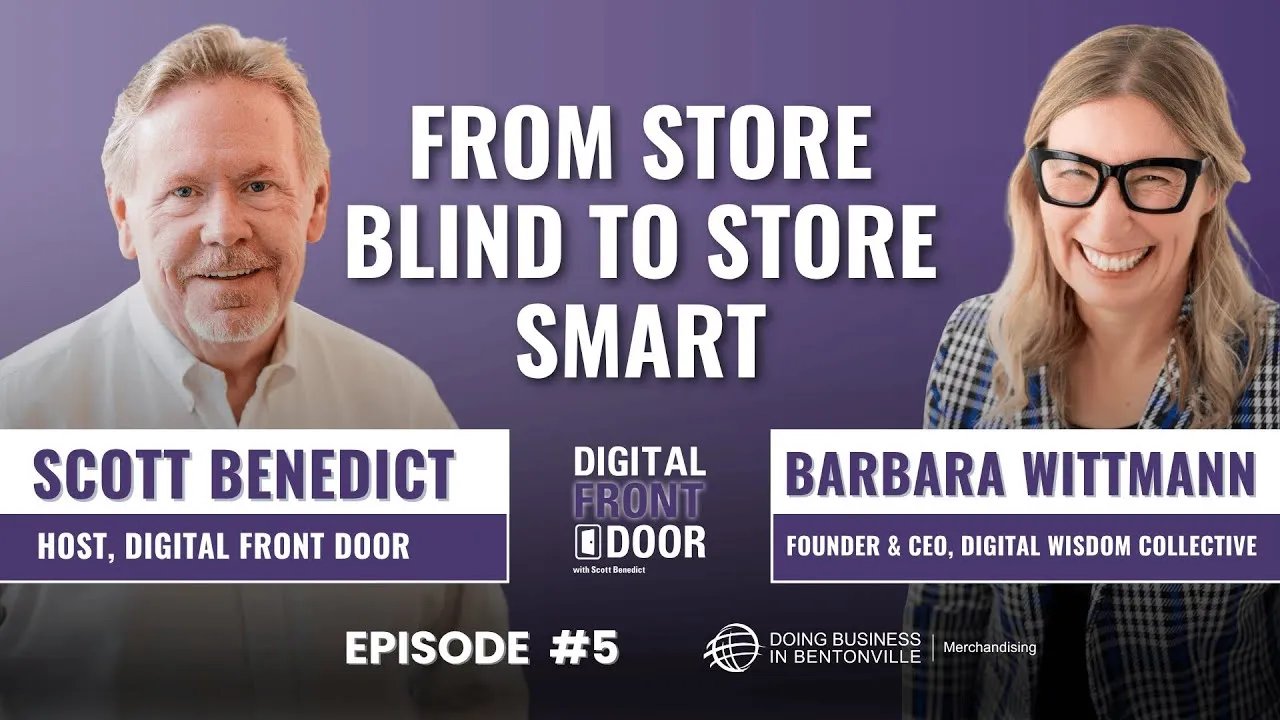
If your retail transformation feels like a tool parade with little traction, this conversation will change your roadmap. We sit down with Barbara Wittmann, founder and CEO of the Digital Wisdom Collective, to unpack why technology isn’t the bottleneck—culture, clarity, and middle management are. Barbara has rescued “dead patient” projects across retail for 25 years, and she explains how empowering the right people, not buying the next platform, creates compounding impact.
We dig into the anatomy of human infrastructure: the trusted, often quiet, mid-level leaders who connect silos, translate strategy into action, and spot risks early. Barbara shares how to find them, how to give them a safe sandbox to practice new behaviors, and how small cross-functional cohorts can turn timid experts into confident catalysts. You’ll hear practical tactics like building shared mental models, setting clear guardrails, and starting every meeting with the same purpose and end-state visuals to keep distributed teams aligned across time zones.
Instead of drowning in dashboards, we explore how static high-level maps of systems and data restore orientation, why problem definition beats solution chasing, and how most retailers can unlock more value by optimizing existing stacks. Barbara’s “Mindset Before Machines” mantra reframes executive decisions: invest in people, language, and navigation before adding another tool. She paints a picture of the digitally wise organization where human architecture, technical architecture, and decision artifacts converge to strengthen the whole.
If you’re ready to reduce initiative overload, surface hidden change makers, and turn AI, data, and platforms into real results, press play. Subscribe, share this episode with a colleague who shapes transformation, and leave a review telling us which tactic you’ll adopt first.
More About this Episode
Digital Transformation Begins With People: How Retailers Build the Human Infrastructure That Makes Technology Work
Digital transformation has become one of the most important strategic priorities in retail. The pace of innovation continues to accelerate and leaders face constant pressure to modernize systems, adopt data driven tools, and integrate AI into every part of the business. Yet for all the investment in platforms and automation, the most significant barrier to transformation is rarely the technology itself. The real challenge is people and culture. Retail organizations often move faster with their tools than with the human capability required to use them well.
This reality shaped our recent conversation with Barbara Wittmann, founder and CEO of the Digital Wisdom Collective. After more than twenty five years leading complex retail and IT transformations, she has seen a consistent pattern. Digital projects fail not because the technology was flawed, but because organizations lacked the human architecture to understand, adopt, and execute change effectively. When teams are not aligned around purpose, when mid level leaders are stretched thin, or when the people closest to the work are not engaged in defining the problem, transformation stalls.
Retailers can prevent this outcome by reframing digital transformation as a people first journey. The tools matter, but the human capability that powers them matters more. Barbara’s experience across global retail organizations offers a clear view into what gets in the way and how leaders can build a culture that supports lasting innovation.
The True Source of Transformation Failure
Many retailers approach transformation through a technology lens. They purchase new platforms, layer on new dashboards, and attempt to integrate new data sources. When those projects slip or fail, leaders often assume the issue lies in the software or the vendor. Barbara’s work proves otherwise. Across hundreds of projects, the root cause is almost always found in people rather than systems.
Most transformation problems arise because teams are misaligned, lack clarity, or are left out of the design process. The middle layers of the organization carry the weight of execution, yet they are often overloaded with competing initiatives. They receive technology that was selected and designed without their input. They are expected to deliver outcomes without support or clear connection to strategic goals. Under those conditions, even the best technology cannot deliver value.
Retailers often skip the foundational step of defining the business problem. Teams jump quickly to a solution, usually due to pressure to move faster or save budget. Without clarity on the actual pain point, every downstream decision becomes misaligned. When the solution reaches users, the mismatch becomes obvious and the project must be rebuilt. Retail leaders can avoid this cycle by slowing down long enough to ask the right questions and include the right people from the beginning.
Human Infrastructure The Hidden Foundation of Retail Innovation
Technology alone cannot transform a retail organization. Transformation requires a stable human infrastructure. Barbara describes this infrastructure as a core group of people who share a mindset for innovation, understand the values that guide decision making, and can connect operational dots across silos. These individuals often sit in the middle layer, where complexity is not delegated but absorbed.
Human infrastructure is not created through top down training alone. It emerges when organizations identify the hidden changemakers already inside the business. Every retailer has these individuals. They are the people colleagues quietly consult when they need clarity. They may not be the loudest voices in meetings, and they may not hold senior titles, but they carry institutional knowledge, empathy for the customer, and a unique ability to translate across functions.
When these hidden changemakers are empowered, they drive transformation not as interpreters of executive directives but as catalysts who mobilize teams. They ask better questions. They see issues earlier. They create bridges between technology and operations. Most importantly, they influence others by example rather than authority.
Barbara’s work reveals an important truth. Many of the employees with the greatest potential to accelerate digital transformation would never be flagged by traditional high potential programs. They are often quieter and more thoughtful. They listen more than they speak. When given support in a psychologically safe environment, they quickly develop the confidence to lead. In fact, nearly seventy percent of participants in her programs are promoted within a year. They grow because they finally have the space to test ideas, articulate their insights, and build new mindsets without fear of judgment.
Why Retailers Need a Testing Sandbox for People
Retail organizations understand the value of test cycles for software. No one launches new technology without user testing, integration testing, and performance validation. Yet these same organizations expect employees to upgrade their thinking and behaviors without any comparable test environment. Leaders train people and immediately expect them to perform differently within the same cultural constraints.
The Digital Wisdom Collective addresses this gap by creating cross industry and cross hierarchy cohorts that serve as a safe testing environment for human development. Participants experiment with new mindsets, explore challenges outside their normal work context, and practice having difficult conversations. The environment is intentionally diverse. People learn that solutions can come from unexpected places and that other industries face similar obstacles. The result is a more confident and more capable internal network that carries new behaviors back into the organization.
This external ecosystem also becomes a long term resource. Participants continue to receive support, guidance, and new upgrades to their thinking. As they evolve from changemakers to change leaders, they maintain a community that reinforces their growth and complements their internal ecosystem. Retailers gain long term capability rather than one off training.
Cutting Through the Noise of the Retail Data and Tool Explosion
Retailers now operate in an environment overflowing with dashboards, analytics platforms, retail media measurement tools, AI assistants, and automation layers. Many leaders feel they are drowning in tools and starving for insight. Barbara warns that the instinct to add more tools often makes the problem worse. Most retailers use only a fraction of the functionality in their existing systems. Adding more layers increases confusion and complexity.
The real problem is not a lack of tools but a lack of navigation. Organizations have detailed process maps and documentation, yet no clear, shared picture of how their systems and data fit together. The absence of high level visibility prevents teams from seeing where duplication exists, where data breaks occur, and where opportunities for simplification are hiding.
Barbara creates navigation infrastructure that functions like a map. Retailers can see where they are, where they need to go, and how different systems interact. These maps cut through noise and build alignment across distributed teams. They also give empowered changemakers the tools required to make informed decisions without relying on outside consultants to interpret what is already there.
Building Shared Mental Models Across Distributed Retail Teams
The retail workforce has changed dramatically. Hybrid models, global teams, and AI assisted workflows have decentralized communication and execution. Under these conditions, alignment becomes more important than ever. Shared mental models create that alignment by ensuring everyone understands the same meaning when talking about the same concepts.
Leaders can support this by introducing clear artifacts. These include glossaries of key terms, crisp visuals that articulate purpose, and consistent references that reinforce goals and guardrails. Beginning every meeting with a reminder of what the team is solving helps prevent drift, especially when time zones, cultures, and functions vary. Visual clarity reduces misunderstanding and accelerates decision making.
Values also need to be co created rather than mandated. When teams define how trust, transparency, or accountability should show up in their daily work, they build ownership. These values become behavioral guides that support transformation rather than constraints that spark resistance.
Creating a Culture of Digital Wisdom
Digital wisdom is the convergence of people, data, technology, and decision making. Retailers cannot achieve it through tools alone. It requires leadership that embraces curiosity, encourages experimentation, and allows space for cycles of learning. Organizations that try to innovate through constant linear motion often suffocate their best ideas. Teams move from one project to another without enough time to think, reflect, or collaborate. Innovation does not survive in environments that never pause.
Digitally wise organizations recognize that ecosystems operate in cycles. They understand that people need moments of stillness to evaluate new ideas and integrate insights. They prioritize clarity over speed. They encourage teams to ask why before how. They invest in building human architecture alongside technical architecture.
The future of retail will reward organizations that make these investments. Technology will continue to evolve at unprecedented speed, but the retailers that thrive will be those that build cultures prepared to adapt with intention. A digitally wise organization empowers its people, aligns its tools to its purpose, and makes decisions that strengthen the entire system rather than add isolated layers of complexity.
The next wave of transformation will belong to leaders who understand that technology is only as powerful as the people who use it. Human maturity must advance alongside digital maturity. When that happens, retailers unlock the true potential of their data, their systems, and most importantly, their teams.