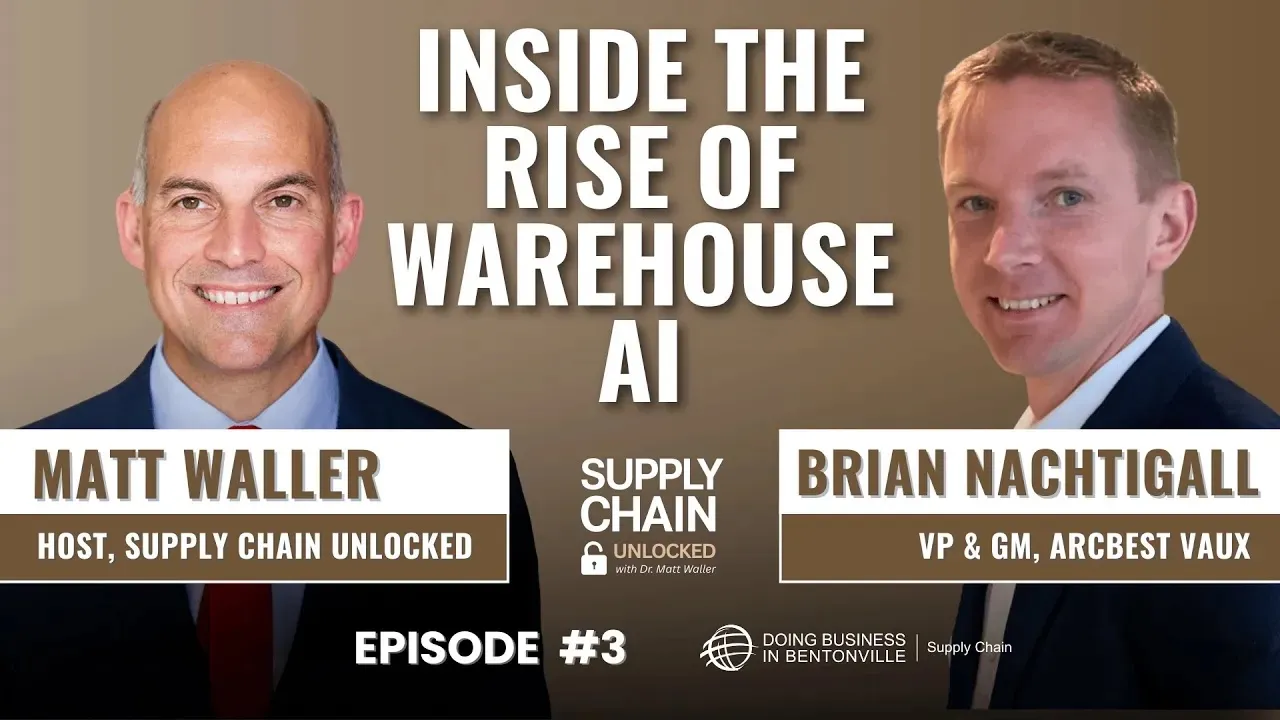
What if your warehouse could flex labor across sites on demand, cut safety risk, and feed cleaner data into your WMS—all without a massive retrofit? We sit down with Brian Nachtigall, VP & GM of Vaux at ArcBest, to unpack smart autonomy that blends autonomous forklifts with remote teleoperation for a fast, pragmatic path to automation. No gimmicks, no buzzword soup—just a clear look at how deep learning, digital twins, and disciplined operations deliver measurable wins right now.
Brian traces his journey from Bain to Cognex to Boston Dynamics, sharing what he learned about scaling machine vision, building reliable autonomy stacks, and applying management systems that actually fit the culture. We break down the Vaux suite: robotic forklifts that map your facility, fleet management that coordinates traffic safely, and a human-in-the-loop model that lets operators “dial in” only when tasks get tricky. That pooled remote labor becomes a powerful lever for load balancing across DCs, smoothing demand spikes and reducing stockouts, late fees, and excess safety stock that quietly erode margins.
We also explore warehouse digitization and why data integrity is the real multiplier. By capturing accurate pallet locations and on-forklift dimensions with Vaux Vision, your WMS makes better calls, slotting improves, and the bullwhip effect softens. Beyond forklifts, Vaux's freight movement platforms accelerate shuttle runs, protect sensitive electronics for data center logistics, and enable scaffolding to move non-stackable freight efficiently. Throughout, Brian’s stance is grounded: automate what you can, keep people in the loop for edge cases, and compound gains over time rather than chasing lights-out promises.
If you care about safer operations, faster deployments, and resilient supply chains, this conversation offers a blueprint. Subscribe, share with your ops team, and leave a review with the one bottleneck you’d automate first—we’ll feature our favorite responses in a future episode.
More About this Episode
Smart Autonomy and the Next Frontier of Warehouse Innovation
Warehouse automation is undergoing one of the most significant transformations in the history of the logistics industry. New advances in artificial intelligence, robotics, and connected systems are reshaping how companies manage freight, labor, and data. At the center of this transformation is Vaux, an innovation driven division within ArcBest that is redefining what is possible inside modern warehouse environments. The company focuses on practical and scalable automation that improves efficiency without disrupting existing operations.
Guiding this effort is Brian Nachtigall, whose unusually diverse experience has prepared him for this role. His early work in investment analysis at Princeton, combined with strategy experience at Bain and hands-on leadership in automation at Cognex and Boston Dynamics, gives him a deep understanding of how technology, data, and business strategy come together. That blend of disciplines forms the foundation of the Vaux approach, which is centered on intelligent automation supported by human expertise.
A Strong Foundation for Scalable Innovation
ArcBest provides Vaux with a significant competitive advantage. ArcBest has more than a century of experience in transportation and logistics, and its long history has created a deep understanding of real world operations. From surviving the major structural shift of the Motor Carrier Act of nineteen eighty to becoming an integrated logistics provider with advanced analytics capabilities, the company has consistently embraced innovation while maintaining a strong human centered culture.
This legacy forms a powerful base for Vaux. The division benefits from ArcBest teams that understand the realities of safety, routing, freight handling, and warehouse variability. Startups often struggle with the subtleties of how freight moves through a facility. Vaux avoids that barrier by drawing on ArcBest expertise in operations, information technology, data science, and safety. This allows the division to move quickly from concept to working solution and ensures that products are designed with practicality at the forefront.
The Vaux Approach to Smart Autonomy
The core innovation within Vaux is its smart autonomy model. Instead of promising fully automated facilities that rely on expensive infrastructure and long lead times, Vaux offers a more flexible and achievable path. The company combines autonomous robotic forklifts with human in the loop teleoperation. The robotic forklifts perform most tasks autonomously. When a situation requires human judgment, an operator can remotely log into the machine and complete the action from a safe and comfortable office location.
This model allows companies to begin automating without redesigning their facilities or installing costly equipment. The system works within existing processes. The required communications network can be deployed quickly. The result is a practical and fast way to reduce operating costs, improve safety, and gain consistency across warehouse operations.
The Vaux Suite of Solutions
Vaux offers three primary product groups that together address a wide spectrum of warehouse challenges.
The first is the autonomous forklift system that supports intelligent pallet movement. It is built to perform tasks reliably with minimal infrastructure changes and enables rapid deployment for customers. The combination of autonomy and remote operation provides flexibility and efficiency that traditional manual forklift operations cannot match.
The second offering is the Vaux freight movement system. This solution uses staging platforms that allow companies to load and unload freight more quickly. It is especially valuable in operations where cycle times are short or freight cannot be stacked. Industries such as automotive benefit from this technology because shuttle runs between suppliers and assembly plants often require rapid loading. Vaux platforms have also proven useful in the data center sector, where delicate equipment must be handled with minimized vibration and reduced touches.
The third offering is Vaux Vision, which uses sensors and cameras installed on forklifts to capture detailed dimensions of freight. This feature provides a new level of data accuracy for companies that need precise information for routing, pricing, and space utilization. Vaux Vision is especially valuable for retailers, distributors, and third party logistics providers that manage freight for multiple partners and rely on accurate dimensional data.
Digitizing the Warehouse Environment
One of the most powerful contributions Vaux is making to warehouse innovation is its work in digitization. Using detailed mapping and continuous data capture, Vaux creates digital twins of warehouses. These digital twins provide a real time simulation of the facility. They update as freight moves and as conditions change. This enables more accurate planning, better workflow management, and improved decision support for systems such as warehouse management software and enterprise resource planning platforms.
Digital twins also strengthen data integrity, which is a major challenge in traditional warehouse environments. Many systems rely on manual updates, which can lead to misplaced freight, inaccurate inventory levels, and operational delays. Autonomous forklifts that track movement and capture location information solve this problem. The result is improved confidence in data and a more synchronized supply chain.
A New Model for Labor Flexibility
The Vaux labor model is one of the most transformative elements of the smart autonomy approach. Companies with multiple distribution centers often struggle with labor imbalances. One facility may experience a surge in volume while another is underutilized. Weather patterns, promotional activity, or regional demand shifts can create unpredictable spikes.
With the Vaux remote labor pool, companies can balance demand across the entire network. Operators can support facilities from any location. When a distribution center faces staffing shortages or spikes in workload, Vaux can turn on remote labor support quickly. In one customer case, Vaux activated remote forklift operators within four hours to prevent operational delays when a customer faced unexpected staffing gaps. This experience demonstrated the real world value of the Vaux model and changed the customer’s long term automation strategy.
This flexibility reduces stockouts, lowers the need for safety stock, improves service levels, and mitigates the bullwhip effect. It also reduces liability costs because operators are removed from the warehouse floor and placed in safer environments.
A Human Centered Philosophy for the Future
Although Vaux focuses on advanced automation, the company maintains a firm commitment to the human centered culture that defines ArcBest. Technology is viewed as a set of tools that help people work more effectively rather than as a replacement for the workforce. The human in the loop approach reflects this philosophy. Automation handles the predictable and repeatable tasks. Humans provide oversight and judgment. This balance delivers immediate value while supporting long term progress toward greater autonomy.
Preparing for the Next Stage of Warehouse Innovation
Looking ahead, Vaux will continue to expand the reach of its current solutions while investing in research and development that deepens the value of warehouse digitization. The company aims to provide even more detailed data about freight, workflow patterns, and facility utilization. These innovations will strengthen the intelligence of warehouse management systems and allow businesses to make decisions with more granularity and accuracy.
For leaders seeking to future proof their intralogistics capabilities, the guidance is straightforward. Focus on automation that delivers value today. Avoid costly attempts to implement fully autonomous systems that require long timelines and major facility changes. Embrace solutions that offer incremental improvement and that combine automation with human expertise. The Vaux smart autonomy model aligns with this philosophy and offers a practical path to continuous improvement.
A Vision Grounded in Practical Impact
Brian Nachtigall remains focused on building a business that improves warehouse efficiency and creates meaningful opportunities for employees. The goal is not only to reduce operating costs but also to enhance reliability, improve safety, and support the broader supply chain ecosystem. By combining advanced robotics with real world experience and a people focused philosophy, Vaux is shaping the future of warehouse innovation in a way that is both cutting edge and practical.
Vaux demonstrates that the future of warehouse automation is not defined by a complete shift to robotics. Instead it is defined by intelligent systems that support people, improve data, and create operational flexibility. As more companies seek ways to modernize their operations, Vaux stands out as a model of how to implement innovation responsibly, effectively, and at scale.