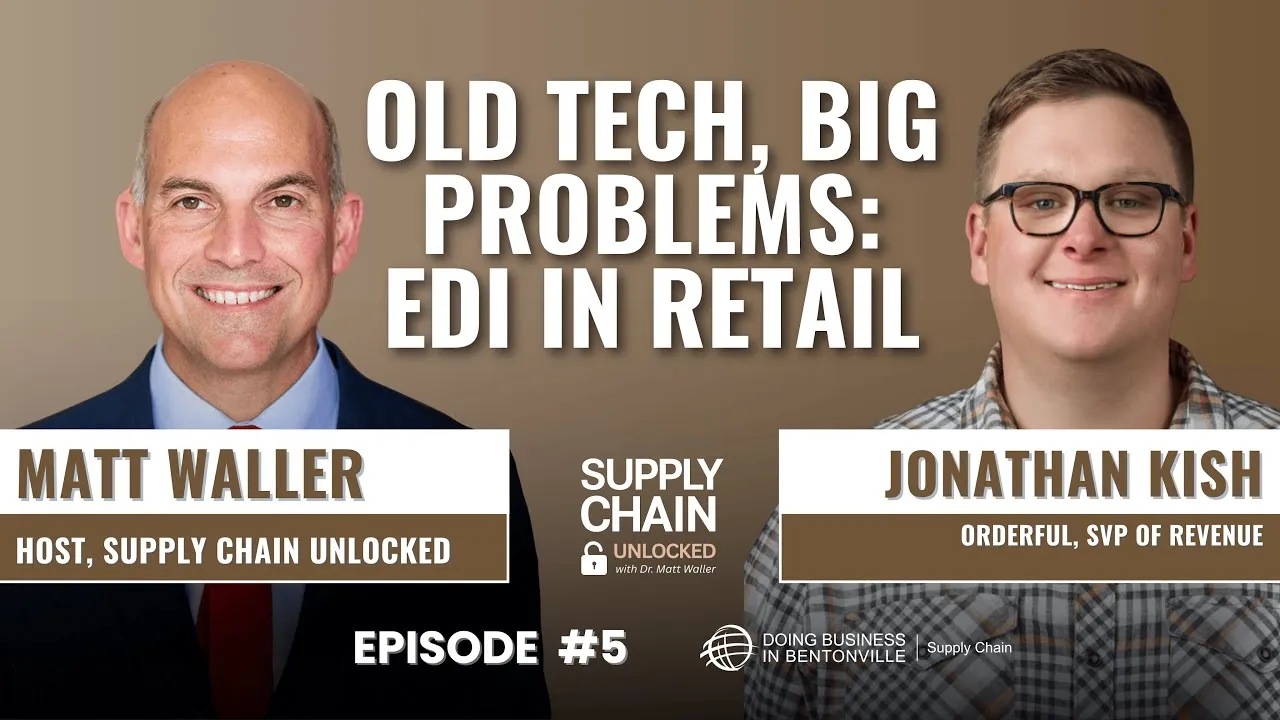
Orders don’t move without clean data. We go deep with Jonathan Kish, SVP at Orderful, to reveal why EDI still runs global retail, where it quietly breaks omnichannel performance, and how modern teams can turn a tangle of maps and testing into a fast, reliable growth engine. From empty shelves to OTIF deductions, the symptoms are familiar; the root causes live in outdated mapping, slow retailer testing cycles, and inventory that never syncs across stores, marketplaces, and drop ship networks.
Jonathan explains how retailers standardize on EDI specs and why that foundation won’t vanish just because APIs are popular. He breaks down the documents that matter: 850s for POs, 856s for ASNs, 204/210 for freight, 810 for invoices, and 997 acknowledgments, and shows where small errors become big penalties. We explore the onboarding bottleneck that delays first purchase orders by months, plus the ripple effects on cash flow, vendor scorecards, and customer promise dates. Real case studies highlight how a single JSON-style integration and automated validations can migrate hundreds to thousands of partners in weeks, not quarters, without rewriting code per retailer.
We also look ahead. As agentic shopping grows and real-time inventory promises are made in chat, search, and social, the margin for data errors shrinks. Jonathan shares how AI-driven validation and captured testing “tribal knowledge” can compress EDI cycles from months to days, and eventually hours, while web-based EDI opens a simple path for smaller suppliers to trade without engineers or per-transaction fees. If you care about omnichannel reliability, faster vendor onboarding, and fewer chargebacks, this conversation is a practical blueprint for turning EDI from a drag into an advantage.
If this helped clarify your EDI strategy, follow the show, share it with your ops and IT teams, and leave a quick review so others can find it.
More About this Episode
Why EDI Is Holding Back Your Omnichannel Retail Strategy—and How to Fix It
In the age of real-time data, generative AI, and intelligent shopping agents, it’s ironic that one of the biggest obstacles facing omnichannel retail today is a decades-old technology: EDI.
Short for Electronic Data Interchange, EDI is a foundational system that underpins how retailers, suppliers, logistics providers, and carriers exchange critical information—from purchase orders to shipping notifications. And yet, for many businesses, it’s a hidden bottleneck—a legacy infrastructure slowing down growth, eroding trust, and undermining competitiveness in today’s rapidly evolving retail environment.
In this article, I want to dive into how EDI—despite being essential—often operates in the background, unnoticed by senior leadership. And more importantly, I want to explore how companies like Orderful are rethinking EDI infrastructure to support the speed, flexibility, and automation required for modern omnichannel commerce.
EDI: The Invisible Linchpin in Retail's Value Chain
If you’re involved in omnichannel retail—whether as a brand, retailer, 3PL, or logistics platform—you’re using EDI, even if you don’t realize it.
That’s the problem. Most senior decision-makers aren’t aware of the systems powering (or impeding) their order flow, shipping updates, inventory syncs, and chargeback mechanisms. And in the current omnichannel environment, that ignorance can be expensive.
Consider Walmart’s stated mission: a people-led, tech-powered omnichannel retailer. That mission applies not only to Walmart itself, but also to its entire ecosystem—suppliers, carriers, and service providers. Suppliers who aren’t aware of their EDI architecture—or whose EDI is poorly managed—risk falling short of Walmart’s standards for speed, accuracy, and real-time coordination.
Why EDI Still Matters in the API Era
If APIs are the standard for modern software connectivity, why does EDI still exist? It's a fair question—and one many tech-forward professionals ask.
The answer lies in the entrenched, complex web of retailer and supplier relationships. Each major retailer has customized EDI specifications—sometimes separate ones for procurement, transportation, and drop-ship operations. For a supplier dealing with dozens (or hundreds) of trading partners, each with their own EDI formats, the complexity scales fast.
Changing away from EDI would require a massive, synchronized industry-wide shift. With trillions of dollars in transactions flowing through EDI each year, that shift isn’t happening anytime soon.
The Real Cost of Poor EDI
So, what does poorly managed or legacy EDI actually cost your business?
- Delayed Onboarding
- Integrating with a new retailer can take 8–20 weeks—or longer—if your EDI infrastructure is rigid or manually managed.
- For fast-growing brands, this delay directly impacts revenue.
- Chargebacks and Compliance Issues
- Sending incorrect data—whether in units, weights, shipment details, or timelines—leads to OTIF (On Time In Full) fines and chargebacks.
- For suppliers operating on thin margins, these charges are painful.
- Inventory Inaccuracy
- Omnichannel excellence relies on real-time inventory updates across systems. If EDI feeds are delayed or inaccurate, customers experience stockouts, delays, or order cancellations.
- The result: damaged trust and lost loyalty.
- Scaling Bottlenecks
- For retailers, onboarding hundreds of suppliers often means scaling large manual EDI teams.
- For platforms, every new partner adds engineering workload due to the “one map per partner” problem.
- Risk to Customer Experience
- Whether it's an out-of-stock item, late shipment, or unresponsive tracking, customers don't care that your EDI system is the root cause—they just shop somewhere else next time.
Why Most Companies Don’t Fix EDI (Until It’s Too Late)
Even when EDI pain points are clear, many businesses delay modernization for three main reasons:
- They Think It’s a Sunk Cost
- “We’ve already integrated it—why go through that pain again?”
- Legacy decisions get grandfathered in, even when they’re actively causing harm.
- They Don’t Know There’s a Better Way
- Most assume that long lead times, high consulting costs, and mapping headaches are just part of the EDI experience.
- Innovative platforms like Orderful challenge that assumption.
- Limited Resources
- Teams are stretched thin, and EDI becomes a back-office issue until it starts visibly affecting customers or revenue.
Orderful’s Approach: Rethinking EDI for the Omnichannel Era
Enter Orderful, a next-generation EDI platform that’s rewriting the rules of how supply chain data is exchanged.
At its core, Orderful is built around a deceptively simple insight: the problem isn’t EDI itself—it’s how companies build, map, and test EDI integrations.
Here’s what makes Orderful different:
- One Integration, Global Coverage
- With a single JSON-based integration, suppliers can connect to any trading partner across retail, logistics, or wholesale.
- No more building one-off maps for every retailer.
- Automated Testing and Validation
- Legacy onboarding takes 12 weeks. Orderful has reduced that to 9 days—and aims for 9 minutes, even 9 seconds in the future.
- AI-Powered Mapping
- Using AI trained on five years of retailer guidelines, Orderful normalizes all variations of purchase orders, ASNs, invoices, and shipping docs.
- That intelligence lives in their product—not in emails or tribal knowledge.
- Web EDI for Less Technical Suppliers
- For small suppliers or those without an ERP, Orderful offers a self-serve Web EDI product that can onboard a retailer in under two weeks, with flat pricing and no transaction fees.
- Decoupling Testing from Mapping
- Because mapping is done up front, EDI testing becomes asynchronous and scalable—allowing retailers to onboard 2,000+ suppliers in months, not years.
EDI’s Role in the Future of AI Shopping and Agentic Commerce
EDI may be old, but it’s not irrelevant. In fact, it’s more important than ever.
As platforms like OpenAI integrate with Walmart.com, and as “agentic shopping” becomes more common—where intelligent agents buy, replenish, and manage purchases on your behalf—the assumption is that inventory is accurate, availability is real-time, and fulfillment is seamless.
None of that works without fast, clean, validated EDI.
Retailers and suppliers who fail to modernize their EDI risk being left behind as AI shopping ecosystems demand instantaneous data flow and fulfillment agility.
Real-World Impact: Success Stories
Here are two examples of how Orderful is transforming EDI at scale:
1. G3 Apparel (Supplier)
- Migrated 450+ retailer connections to Orderful in 92 days during an ERP migration.
- Cut integration complexity by decoupling mapping from testing.
- Moved from legacy infrastructure to a scalable, modern stack.
2. Top 30 U.S. Retailer
- Onboarded 2,000 suppliers in under 9 months.
- Used Orderful’s real-time validation to eliminate manual testing delays.
- Enabled supplier onboarding without scaling internal teams.
The Future: Can EDI Be Fully Automated?
Jonathan Kish, SVP at Orderful, believes the answer is yes—and the company is already halfway there.
While Orderful has effectively eliminated mapping through its Mosaic API layer, the next frontier is automating the testing process, which currently involves back-and-forth communication between suppliers, retailers, and EDI teams.
Orderful’s engineering team, backed by AI and massive schema data sets, is actively building toward a future where onboarding a new trading partner can happen in real time—without human intervention.
That’s not a distant dream—it’s a 12 to 18 month roadmap.
Final Thoughts: It’s Time to Treat EDI as a Strategic Asset
EDI is often treated as an invisible infrastructure component, left to IT or buried deep in logistics teams. But in an omnichannel world, where speed, accuracy, and trust define the customer experience, EDI is a strategic asset—or a liability.
Here’s the bottom line:
- If you want to scale your business across channels, you need clean, reliable, and fast EDI.
- If you want to onboard new retail or carrier partners quickly, your EDI cannot be a bottleneck.
- If you want to integrate into AI-powered marketplaces or drop-ship networks, your data must be current and consistent.
Companies that modernize their EDI will win on speed, accuracy, and flexibility—while those stuck on outdated systems will struggle with lost orders, late shipments, and eroded trust.
As Sam Walton once said, “There is only one boss—the customer.”
And in today’s market, the customer doesn’t care why something is late. They just expect it to be there. On time. Every time.