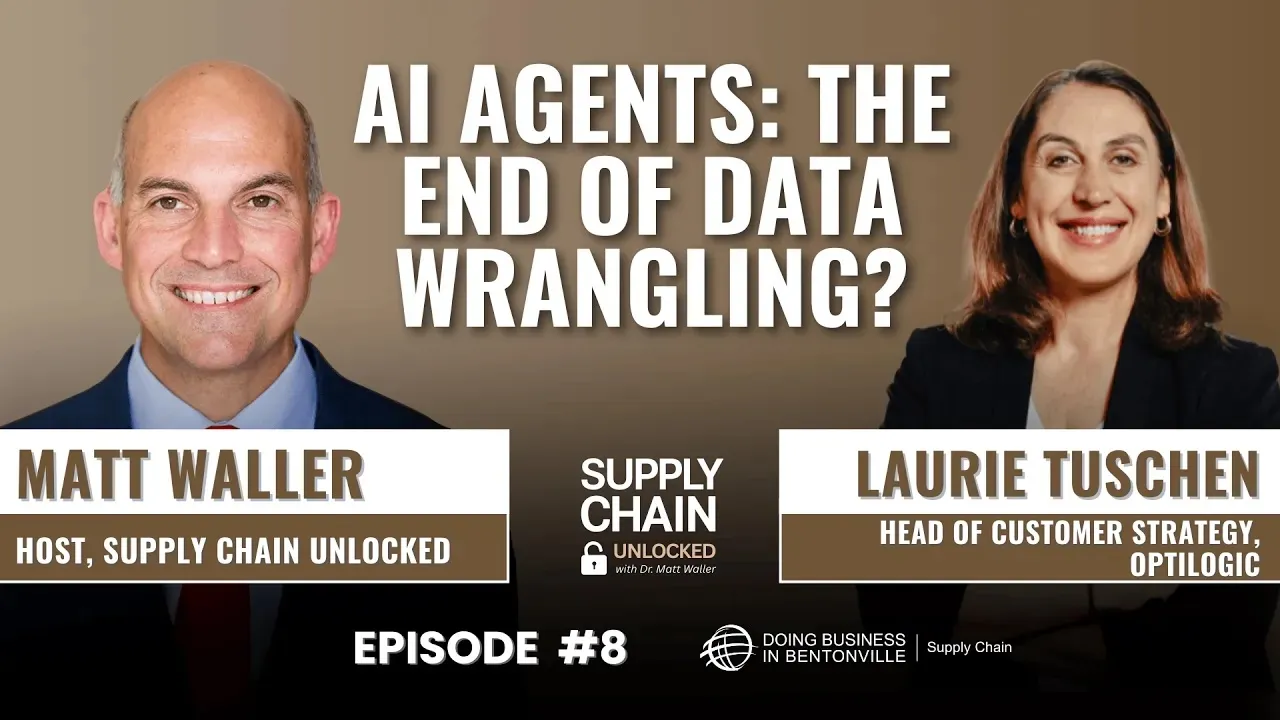
What if your supply chain could answer hard questions in minutes instead of days? We sit down with Laurie Tuschen, Head of Customer Strategy at Optilogic, to explore how modern design stacks blend optimization, simulation, and AI to deliver faster, smarter decisions without adding new buildings or bloated spreadsheets. From the early days of mainframes to sensitivity-at-scale tools, Laurie shows how teams can test uncertainty directly and pinpoint when a decision breaks, where capacity buffers matter, and how mode shifts change the cost-to-service curve.
We walk through the practical power of a digital twin: a living model that captures facilities, flows, policies, and costs so leaders can run continuous what-ifs. When tariffs swing or lanes get disrupted, the twin helps reroute through existing assets, rebalance inventory, and protect service levels. Instead of periodic, months-long studies, cloud-native collaboration turns design into a weekly habit. Stakeholders enter data through intuitive apps, see clear scenario results, and build alignment around quantified risk, not gut feel.
AI is the accelerant, not the autopilot. Large language models make the twin queryable in plain English, while AI agents fill data gaps, profile quality, and automate scenario assembly. Humans stay firmly in the loop to judge tradeoffs and feasibility, but they spend their time on insight instead of grunt work. The payoff is real: flipping the old 80/20 so more energy goes to evaluating options, answering more project requests, and making resilient choices under cost volatility, labor constraints, and global shipping shocks.
If your team is ready to move beyond spreadsheets and embrace continuous design, this conversation maps the path; faster modeling, richer scenarios, and decisions that hold up when the world shifts. Listen, share with a colleague who owns network strategy, and leave a review with your toughest what-if we should tackle next.
More About this Episode
Supply Chain Design in the Age of AI: From Mainframes to Intelligent Digital Twins
In the early days of supply chain optimization, designing a distribution network was a technical marathon. You gathered freight rates manually. You built complex mixed integer linear programming models. You submitted runs to a mainframe and waited all weekend for answers. If you wanted to test a variation, you started over.
Today, supply chain design is entering a fundamentally different era. Cloud computing, simulation, digital twins, and AI agents are reshaping how companies model networks, manage volatility, and make strategic decisions. In a recent conversation with Laurie Tuschen, Head of Customer Strategy at Optilogic, we explored how supply chain optimization has evolved from static modeling exercises to continuous, intelligent decision systems.
For supply chain leaders, the shift is not incremental. It is structural.
The Evolution of Supply Chain Optimization
Traditional supply chain network design centered on cost minimization. Analysts collected transportation rates, demand forecasts, and facility capacities, then ran optimization models to determine assignments such as which distribution centers should serve which stores or markets. These models, often built on mixed integer linear programming, were powerful but rigid.
The challenges were significant:
- Data preparation consumed enormous time and effort.
- Models were large, complex, and difficult to share.
- What-if analysis required manual reconfiguration.
- Collaboration across functions was slow and fragmented.
Optimization alone also had a critical limitation. It produced a mathematically optimal solution based on a fixed set of assumptions. But real supply chains operate under uncertainty. Demand fluctuates. Freight rates shift. Labor availability changes. Disruptions occur.
Pure optimization rarely captured that variability in a meaningful way.
Simulation and the Rise of Robust Supply Chain Design
One of the most important advancements in modern supply chain modeling is the integration of simulation alongside optimization.
Simulation introduces uncertainty into the model. Instead of assuming a single deterministic demand forecast or fixed transportation cost, companies can test variability. What happens if demand rises by five percent? What if ocean freight rates spike? At what point does a transportation mode shift become economically viable?
This is where robustness becomes central. Leaders do not just want the lowest cost solution. They want to understand how resilient that solution is under stress. Sensitivity analysis at scale allows organizations to identify tipping points where a network configuration stops being optimal.
In the past, running multiple permutations required brute force. Analysts manually adjusted inputs and reran models repeatedly, often over days or weeks. Now, integrated optimization and simulation engines make it possible to test a wide range of scenarios quickly.
The result is not just a solution. It is insight into the boundaries of that solution.
From Static Models to Digital Twins
The concept of the digital twin is redefining supply chain strategy. A digital twin is not simply a model. It is a digital representation of the physical supply chain that includes data, policies, costs, flows, and constraints.
The power of a supply chain digital twin lies in its baseline. Once the current network is modeled accurately, companies can measure the impact of changes relative to that baseline. Adding capacity, shifting production, altering transportation modes, or rerouting flows can be evaluated in terms of cost, service, and profit impact.
A digital twin supports continuous decision making. Instead of conducting network design once a year for major footprint changes, organizations can use the twin to evaluate smaller, ongoing adjustments. In an environment defined by tariff changes, geopolitical instability, labor volatility, and fluctuating freight costs, that agility is essential.
Digital supply chain design is becoming less about episodic transformation and more about continuous refinement.
Cloud Platforms and Collaborative Modeling
Another inflection point in supply chain optimization came with the adoption of cloud software.
Previously, models were massive files residing on individual machines. Sharing them required moving large datasets and specialized tools. Cross-functional collaboration was slow and cumbersome.
Cloud-based supply chain design platforms changed that dynamic. Models can now be centrally stored, version controlled, and accessed by authorized stakeholders across the organization. Inputs can be collected through intuitive interfaces. Outputs can be visualized and shared in real time.
This shift matters because supply chain design is inherently cross-functional. Transportation, manufacturing, finance, procurement, and sales all have a stake in network decisions. A cloud-based modeling environment supports collaboration in a way traditional tools never could.
Supply chain optimization is no longer confined to a technical back office. It is becoming a strategic enterprise capability.
Modeling Complexity: Modes, Inventory, and Profit
One of the historical constraints in network design was modeling complexity. Evaluating multiple transportation modes, stop-offs, LTL versus truckload options, or incorporating inventory carrying costs alongside transportation costs significantly increased model difficulty.
Modern platforms reduce that friction. Automated data acquisition and cleansing workflows allow organizations to pull in new rate data, benchmark transportation costs, and integrate production and inventory variables without rebuilding the model from scratch.
This broader modeling capability matters because transportation cost is not always the dominant driver. In high-value or time-sensitive supply chains, inventory holding costs and service levels may outweigh freight considerations. A comprehensive supply chain optimization approach must account for transportation, inventory, production, and revenue simultaneously.
When companies construct a true digital twin, they often discover cost drivers that challenge their assumptions.
Cost Volatility and Continuous Supply Chain Design
Today’s supply chains are characterized by volatility. Tariffs shift sourcing strategies. Ocean freight disruptions impact transit times and costs. Labor shortages alter production feasibility. Capacity constraints fluctuate.
In this environment, supply chain design cannot remain a once-a-year exercise. Companies are increasingly adopting continuous supply chain modeling practices. Instead of waiting for major capital investments, they evaluate smaller flow adjustments, sourcing shifts, and transportation reconfigurations on an ongoing basis.
The objective is not always to build a new distribution center. Sometimes it is to adjust flows within the existing network to mitigate cost spikes or manage tariff exposure.
Agility, not just efficiency, has become the defining performance metric.
AI in Supply Chain Optimization
Artificial intelligence is accelerating this transformation.
The first wave of AI adoption in supply chain software centered on large language models. These tools allow users to query their digital twin or network model conversationally. Leaders can ask questions about landed cost, service levels, or the impact of specific changes without navigating complex interfaces.
The next wave involves AI agents.
Unlike traditional automation, AI agents can perform multi-step tasks. In supply chain design, that may include data profiling, cleansing, gap filling, and even preliminary scenario construction. Agents can retrieve missing freight rates, benchmark new lanes, format data for modeling, and prepare simulations for review.
Importantly, this does not eliminate human oversight. Supply chain design involves strategic trade-offs and contextual judgment. AI can accelerate data preparation and scenario generation, but humans remain essential for interpretation and decision making.
The goal is to invert the time allocation. Historically, analysts spent 80 percent of their time preparing data and 20 percent analyzing results. With AI-driven automation, that ratio can flip. More time can be devoted to evaluating strategic options and less to data wrangling.
Redefining the Role of Supply Chain Experts
A common concern surrounding AI is job displacement. In supply chain design, the opposite effect may occur.
When data preparation becomes faster and scenario modeling becomes more scalable, supply chain teams can evaluate more questions. Projects that once sat in backlog due to capacity constraints can now be addressed. Decision velocity increases.
Rather than reducing the need for expertise, AI amplifies it. Skilled modelers and supply chain strategists become more valuable because they can apply their insight across a broader set of decisions.
As modeling capacity expands, so does the marginal benefit of strategic supply chain talent.
The Future of Intelligent Supply Chain Networks
Supply chain design has progressed from static mainframe-based optimization runs to dynamic, cloud-enabled digital twins augmented by simulation and AI agents.
This transformation enables:
- Faster what-if analysis
- Greater robustness through sensitivity testing
- Continuous network refinement
- Integrated modeling of transportation, inventory, and production
- Automated data cleansing and scenario generation
- Enhanced cross-functional collaboration
The supply chain is no longer a back-office cost center. It is a strategic lever for resilience, profitability, and competitive advantage.
As volatility persists and complexity increases, organizations that embrace intelligent digital twins, integrated simulation, and AI-enabled workflows will outpace those relying on static annual studies.
Supply chain design is not just evolving. It is becoming a continuous, intelligent system.
And that shift may be one of the most important competitive advantages a company can build in the decade ahead.