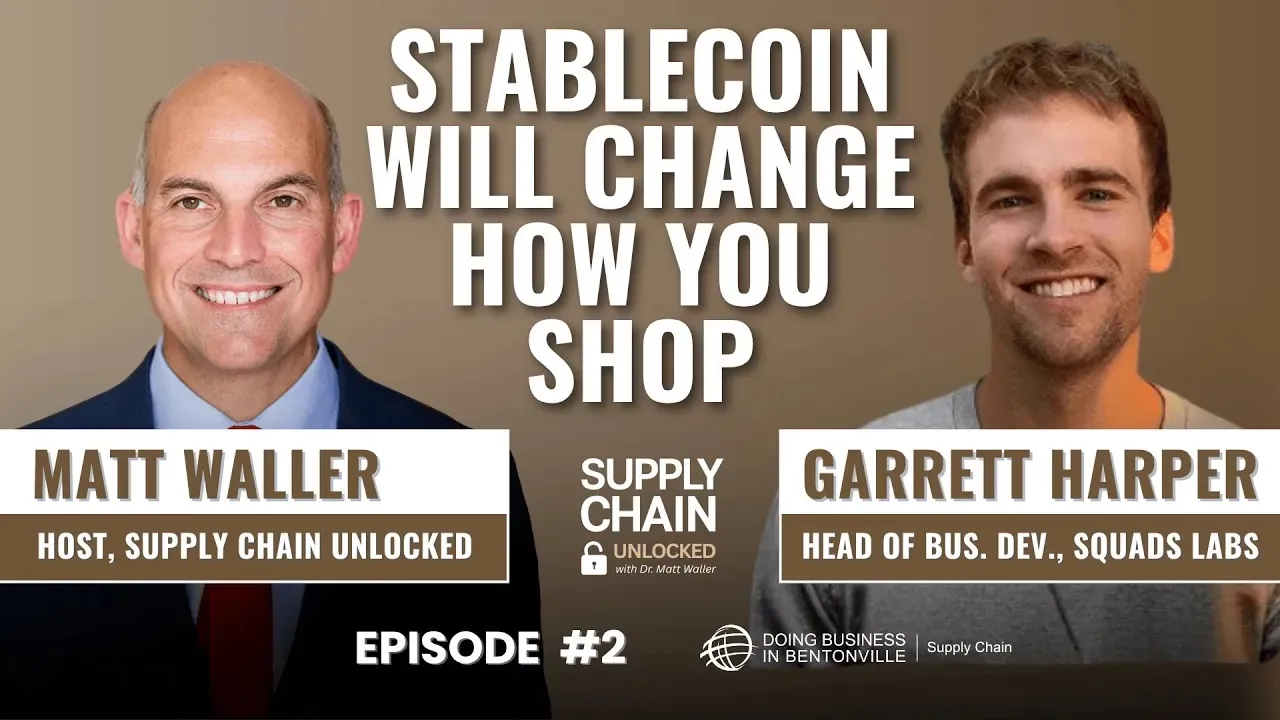
Money should move as fast as your cart. We sit down with Garrett Harper, Head of Business Development at Squads Labs, to unpack how Stablecoin is quietly becoming the payment rail that matches modern retail speed: instant refunds, cheaper settlements, and programmable rewards that actually feel valuable. If “buy online, pick up in store” reset fulfillment, Stablecoin is poised to reset how cash flows through every step of the retail value chain.
We start with a clear breakdown of what Stablecoin is, why most are backed by short-term U.S. Treasuries, and where the real product–market fit already exists: access to dollars and cross-border payments. From there, we connect the dots to omnichannel operations. Imagine payouts that land in seconds, loyalty that accrues in real time, and fewer intermediaries taxing every transaction. That’s not a crypto pitch—it’s an upgrade to user experience and unit economics. We explore how retailers like Walmart can harness yield to fund better rewards and lower fees, all while keeping the Stablecoin plumbing behind the scenes so shoppers never have to think about “using crypto.”
Then we look ahead to agentic and ambient commerce. AI agents will reorder staples, handle price checks, and even settle micro-purchases across platforms. Videos, streams, and everyday contexts become shoppable surfaces with automatic, transparent revenue splits. Smart contracts make that trust-by-design, enabling if-then money that legacy rails can’t match. We also dig into how processors and networks respond—why companies like Stripe are experimenting with Stablecoin settlements to cut costs and speed payouts—and how transparency on public chains can strengthen trust for marketplaces, long-tail sellers, and nonprofits.
If you care about omnichannel strategy, payments efficiency, and what happens when AI meets checkout, this conversation maps the road ahead. Subscribe, share with a colleague who owns payments or loyalty, and leave a review with the one Stablecoin use case you want most next.
More About this Episode
Stablecoin Technology and the Future of Omnichannel Retail
Retail is entering a new phase of transformation, driven by evolving consumer expectations, expanding global commerce, and emerging technologies that are reshaping the way value moves. Among these innovations, stablecoin technology is gaining significant traction as a foundational element in the financial infrastructure supporting modern commerce.
While stablecoins are typically associated with the broader cryptocurrency ecosystem, their application in retail is distinct. They represent a stable, efficient, and programmable financial tool that aligns well with the objectives of omnichannel retail. Stablecoins offer the potential to improve transaction speed, reduce costs, enhance transparency, and ultimately create better experiences for consumers and businesses alike.
This article explores how stablecoins are positioned to influence the future of omnichannel commerce and why forward-looking retailers should begin understanding and integrating this technology now.
What Is Stablecoin?
A stablecoin is a type of digital currency designed to maintain a consistent value, typically pegged to a fiat currency such as the US dollar. Unlike traditional cryptocurrencies like Bitcoin, which experience price volatility, stablecoins are engineered for stability. They are often backed by real-world assets, such as cash reserves or short-term US Treasuries, and issued on public blockchains.
When a company issues stablecoins, it typically deposits fiat currency into a reserve account and issues an equivalent amount of digital tokens. These tokens can then be transferred quickly and securely across the internet, offering a one-to-one parity with the underlying fiat asset.
This capability makes stablecoins particularly attractive for business transactions where predictability, speed, and low costs are essential.
The Relevance of Stablecoins in Omnichannel Retail
Omnichannel retail requires seamless integration of digital and physical shopping experiences. Consumers expect to browse, buy, receive, and return products through a mix of platforms, including e-commerce websites, mobile apps, physical stores, and social media channels. Stablecoins enhance this integrated model by providing a more efficient and flexible approach to payments and financial operations.
1. Faster Transactions and Refunds
In traditional payment systems, refunds and payments can take several days to process. ACH transfers, credit card settlements, and bank holds introduce delays that affect customer satisfaction. Stablecoins enable real-time transfers, allowing retailers to issue refunds or customer credits almost instantly. This improvement in speed enhances the consumer experience and sets a higher standard for responsiveness.
For example, a customer returning an item through a buy-online-pickup-in-store model could receive an instant refund through a stablecoin-based payment layer. This level of efficiency strengthens customer trust and builds brand loyalty.
2. Reduced Transaction Costs
Credit card processing fees typically range between 2 to 3 percent per transaction. For retailers operating on thin margins or with high volumes, these fees represent a significant cost center. By adopting stablecoin payment rails, retailers can reduce or even eliminate these fees, particularly for peer-to-peer transactions or closed-loop payment systems.
Financial technology companies like Stripe and Ramp are already exploring stablecoin-based settlement systems as a way to optimize internal transfers and eliminate unnecessary third-party fees. Retailers may eventually follow suit, using stablecoins to reduce transaction costs and improve profitability.
3. Enhanced Supply Chain Transparency and Trust
Omnichannel success depends on a resilient and transparent supply chain. Many retailers work with long-tail suppliers across multiple geographies, which introduces complexity and potential risks related to payment disputes, settlement delays, and lack of visibility.
Stablecoins, especially when used in conjunction with smart contracts, offer built-in transparency. Every transaction on a public blockchain is recorded and traceable, allowing both parties to verify payment activity in real time. Smart contracts can further automate conditional payments, such as releasing funds only upon delivery confirmation or compliance with quality standards.
This creates a higher degree of trust in supplier relationships and supports more scalable and efficient supply chain operations.
4. Loyalty Programs and Incentives
Stablecoins are not limited to basic payments. Their programmable nature enables retailers to develop innovative loyalty and incentive programs. For instance, a retailer could issue digital reward tokens that accrue interest or can be redeemed for select product categories.
These tokens could be restricted to specific seasons, products, or promotional campaigns, giving retailers precise control over how rewards are distributed and used. This flexibility opens the door to more dynamic and personalized customer engagement strategies.
5. Enabling Agentic and Ambient Commerce
As artificial intelligence continues to evolve, commerce is shifting toward agentic and ambient models. In agentic commerce, AI-powered agents act on behalf of consumers, managing recurring purchases, making product recommendations, and completing transactions. Ambient commerce refers to the integration of shopping into the consumer’s environment, where any digital touchpoint, from social media to streaming content, can become a point of sale.
For these models to work efficiently, AI agents require a native method of handling value transfers. Traditional banking systems are not built to accommodate automated, real-time transactions between autonomous agents. Stablecoins are well suited to this new commerce model because they offer real-time programmability, cost efficiency, and compatibility with automated systems.
Retailers that embrace this vision will be better positioned to operate in a digital economy where intelligent systems drive many of the day-to-day shopping decisions.
Stablecoins in Cross-Border Retail
Cross-border payments are another area where stablecoins can deliver immediate value. International transactions using traditional systems are slow, expensive, and often involve multiple intermediaries. Stablecoins enable direct, real-time payments across borders without the need for currency conversion or settlement delays.
For retailers operating globally or sourcing from international suppliers, this reduces friction and increases cash flow predictability. Even companies with multiple legal entities across jurisdictions can benefit by using stablecoins to move funds internally with greater speed and cost control.
Stablecoins and the Role of Trust
In an era of rising digital fraud, deepfakes, and phishing scams, trust is more valuable than ever. Consumers are increasingly skeptical of unsolicited emails, text messages, and links, many of which attempt to impersonate trusted retailers. Stablecoins can contribute to rebuilding trust through transparent and verifiable financial interactions.
Transactions on public blockchains are immutable and auditable. Nonprofit organizations, for example, can use stablecoins to show donors exactly how funds are spent. Retailers can similarly demonstrate compliance, resolve disputes more effectively, and foster greater confidence in their financial relationships.
At a broader level, the transparency and security offered by stablecoin infrastructure may give large, trusted retail brands like Walmart an even greater advantage as commerce becomes more decentralized and digital.
Will Consumers Use Stablecoins Directly?
From the consumer’s perspective, the use of stablecoins should be invisible. Much like they do not need to understand how credit card networks operate, shoppers should not need to know that their refund, rewards program, or online payment is powered by a stablecoin.
Retailers should integrate stablecoins behind the scenes, using them to optimize internal operations and pass on benefits in the form of faster service, better loyalty programs, and reduced transaction friction. The goal is not to teach consumers about blockchain, but to improve outcomes through more efficient financial infrastructure.
Why Retailers Should Pay Attention
Stablecoins are no longer speculative. They are already in use in major financial and technology platforms, with over $300 billion in total market capitalization and growing adoption. The potential to reduce costs, increase speed, enhance trust, and unlock new forms of commerce makes stablecoin technology a relevant and timely tool for retailers focused on omnichannel transformation.
Retailers that take the initiative to understand and integrate stablecoin capabilities will be better prepared to compete in a global, AI-enhanced, and increasingly digital commerce environment. As innovations like agentic commerce and ambient commerce gain traction, stablecoins may become as essential to the next generation of retail as credit cards were to the internet era.
Investing in stablecoin infrastructure today is not about chasing a trend. It is about future-proofing retail operations for a world that demands speed, flexibility, and transparency. The companies that recognize this early will set the standard for how modern commerce operates.