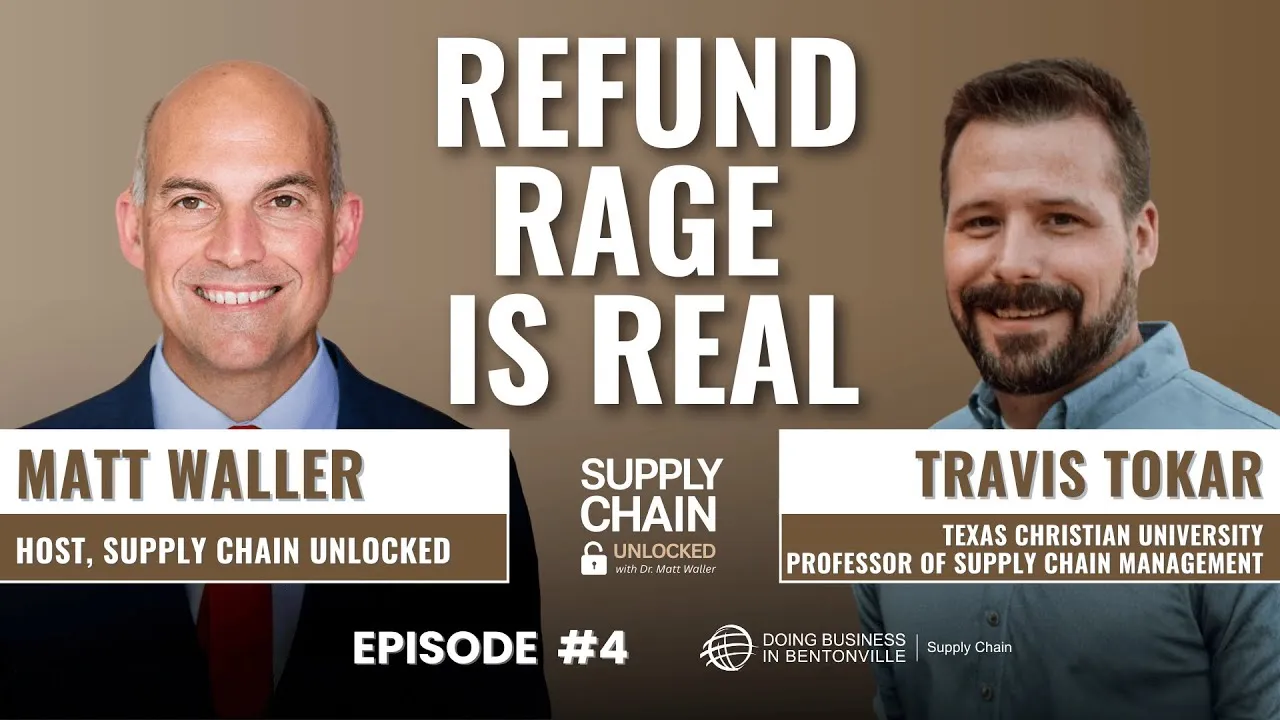
Ever wonder why a “standard” return policy can feel so unfair at the counter? We unpack the psychology and operations behind returns with Dr. Travis Tokar, Professor of Supply Chain Management at TCU, and explore how loss aversion, fairness, and frontline interactions shape customer reactions far more than a PDF policy ever will.
We walk through the five policy levers: money, exchange, time, scope, effort, and show which ones trigger loss perceptions that spark anger, and which ones customers accept when the rules are clearly justified. You’ll hear why framing a 15% fee as an “85% refund” doesn’t help, how justice theory explains real-world reactions, and why linking stricter terms to item-specific costs (like data wiping for electronics) earns legitimacy. We also compare mail-in versus store returns, highlighting where centralization saves money, when a fast shelf restock wins, and how to nudge shoppers to lower-cost channels with faster refunds, nearby drop-offs, or small incentives.
Beyond costs, we dig into what matters for loyalty: measuring more than return rates, using returnless returns strategically to boost goodwill, and training frontline teams to balance consistency with humane exceptions. Travis shares experiments, real policy patterns across retailers, and practical tests worth trying, like adaptive leniency for high-value customers and firm guardrails for serial returners. It’s a candid playbook for designing return policies that reduce friction, respect customers, and protect margins.
If this conversation gave you new ideas for your returns strategy, follow the show, share it with a teammate, and leave a quick review telling us which policy change you’ll test next.
More About this Episode
Why Return Policies Feel Harsh; And What Retailers Can Do About It
Returns are a reality of retail, particularly in an omnichannel world. Whether you're running an ecommerce platform, managing in-store operations, or trying to balance inventory across multiple sales channels, returns add friction and cost, not only in logistics, but also in customer relationships.
But what's especially fascinating is this: some return policies feel harsh to shoppers even when, on paper, they appear completely standard or even generous by industry norms. So why is that?
The answer lies at the intersection of consumer psychology, fairness perception, and the real-world application of policy. In this article, I want to dig into why certain return policies feel punitive to shoppers, even when retailers might view them as reasonable, and what companies can do to better manage that perception while still protecting their margins.
The Psychology Behind Why Returns Feel Like a Loss
The first thing to understand is how people process losses. Behavioral economics has shown time and again that people experience losses more intensely than equivalent gains. That’s not just anecdotal, it’s quantifiable. A $20 parking ticket feels roughly twice as bad as the joy you'd get from finding a $20 bill in your coat pocket. This principle, known as loss aversion, is foundational in consumer decision-making.
So how does this relate to return policies?
When any element of a return policy, whether it’s a restocking fee, a time limit, or an exchange-for-store-credit-only clause, is perceived as taking something away from the shopper, it triggers this emotional response. For the shopper, it’s not just a policy, it’s a loss.
Key Elements That Influence Return Policy Perception
Based on both published research and analysis of retail practices, there are five core elements of return policies that shape consumer perceptions:
- Monetary: Do shoppers get a full refund or is a fee deducted?
- Exchange Format: Are refunds issued in cash or store credit?
- Time Limit: How long do customers have to initiate a return?
- Scope: Are all products eligible, or are there exclusions (e.g., sale items)?
- Effort Required: Is the process straightforward or does it require extra work, such as original packaging, receipts, or visiting a physical location?
Of these, monetary penalties and exchange limitations are consistently perceived as the harshest, likely because they are direct and easily categorized as a loss. A 15% restocking fee or being told you’ll receive store credit instead of a refund clearly signals a reduced outcome, triggering loss aversion.
Fairness and Justification Matter More Than You Think
Loss aversion is one part of the puzzle. The other is fairness, or more precisely, perceived fairness.
Consumers are more accepting of strict return terms if they believe those rules are justified. If a return fee is clearly tied to the cost of inspecting and refurbishing electronics, or if store credit is only issued when no receipt is available, shoppers are more likely to view the policy as fair. But when terms feel arbitrary or inflexible without explanation, they generate frustration.
Fairness has three dimensions in this context:
- Distributive justice (Was the outcome fair?)
- Procedural justice (Was the process fair and consistent?)
- Interactional justice (Was the customer treated with dignity and respect?)
When policies are applied impersonally on paper, most shoppers evaluate only procedural fairness. But in a real-life scenario, especially when a return is denied, all three types of justice are triggered. That’s when the perception of harshness intensifies.
Why Paper Evaluations of Policies Fall Short
Many retailers assess their return policies through surveys or consumer panels, often using paper evaluations or online forms. While helpful, this approach misses a key point: consumer reactions differ when policies are applied to them personally.
In one of our early studies, we compared how participants evaluated a return policy in the abstract versus how they felt when imagining themselves being denied a return. The difference was significant. When people pictured themselves in the return scenario, especially a denial, their emotional and behavioral reactions intensified.
It’s one thing to read that returns aren’t accepted after 30 days. It’s another to be standing at a customer service desk, receipt in hand, only to hear, “Sorry, you’re one day past the deadline.”
Where Framing Falls Short
One strategy some retailers consider is framing, the idea that how you present information affects how it’s perceived. For example, saying “85% refund” instead of “15% return fee” might sound more positive.
Framing works in many areas of marketing, but our research shows that in return policy scenarios, it doesn’t make much difference. The monetary impact is so strong that simply changing the wording doesn’t soften the perceived loss. When a policy feels harsh, wordplay won’t save it. Real justification and fairness are far more powerful.
What Retailers Are Already Doing Right — And Could Do More Of
Interestingly, most retailers are not applying blanket return fees across all products. Instead, they target specific categories like electronics or customized goods. And when they offer store credit, it’s often because the shopper lacks proof of purchase.
This selective and context-based application shows an understanding of fairness, and offers a valuable clue. Retailers might benefit from being more transparent about why certain rules exist. If a return fee covers data wiping or restocking labor, spell that out in the policy. Clear explanations foster fairness.
There’s also evidence that returnless returns, where customers are told to keep the item but receive a refund anyway, can boost loyalty. This isn’t suitable for high-value items, but for low-cost or bulky products, the math can work. Especially when shoppers are encouraged to donate the item, the goodwill generated may outweigh the margin hit.
Mail-In vs. In-Store Returns: Cost vs. Experience
The cost structure of return channels varies significantly by product and context. Mail-in returns incur shipping and handling costs but can be more efficient for central processing, particularly if the item needs technical inspection or refurbishment.
Store returns, on the other hand, can be cheaper for fast reshelving, and they offer a chance to convert a return into another sale. Plus, store associates may be able to resolve the issue and save the sale entirely. But not all stores have the space or labor to manage high return volumes.
Retailers wanting to steer customers toward the most cost-effective return path can use nudges, like faster refunds, reminders of nearby drop-off points, or small incentives, to encourage the preferred behavior.
Exception Handling: A Hidden Loyalty Builder
One area ripe for further research is exception handling. When frontline employees bend the rules, say, accepting a return slightly past the deadline, it often creates an outsized loyalty impact. Customers remember that kind of accommodation.
However, it also introduces inconsistency, which can backfire if word spreads that some people are treated better than others. The key is to equip staff with clear, flexible guidelines and trust them to exercise judgment, rather than enforce rigid scripts.
A Future with Personalized Return Policies?
One provocative idea is the potential for personalized return policies based on shopper behavior. A high-value, loyal customer could receive a more lenient return window, while serial returners face tighter restrictions.
This is already happening informally, and in some cases algorithmically, as companies flag excessive returners. But taking it further raises fairness concerns. If shoppers discover they’re subject to different rules, will they revolt? Possibly. But with transparency and careful design, personalization could strike a balance between generosity and protection.
A Call for Smarter Metrics
Finally, retailers need to expand their metrics beyond just return rate. Return volume is important, but it doesn’t tell the whole story. It doesn’t show:
- Customer lifetime value
- Margins recovered through restocking
- Loyalty and word-of-mouth impact from positive return experiences
As we move into an era of smarter, more nuanced return strategies, retailers should measure not only how many products come back, but who is returning them, why, and what happens afterward.
Final Thoughts
Returns aren’t just a cost center. They’re a moment of truth, a critical interaction that can deepen customer relationships or destroy them. The policy itself matters, but so does how it’s explained, applied, and experienced.
Retailers who take the time to understand the emotional and fairness dynamics behind returns, and who thoughtfully balance rules with empathy, are far more likely to retain customer trust and loyalty in the long run.
As the retail landscape evolves, so must our return strategies. The smartest companies won’t just tighten the rules, they’ll reimagine them.