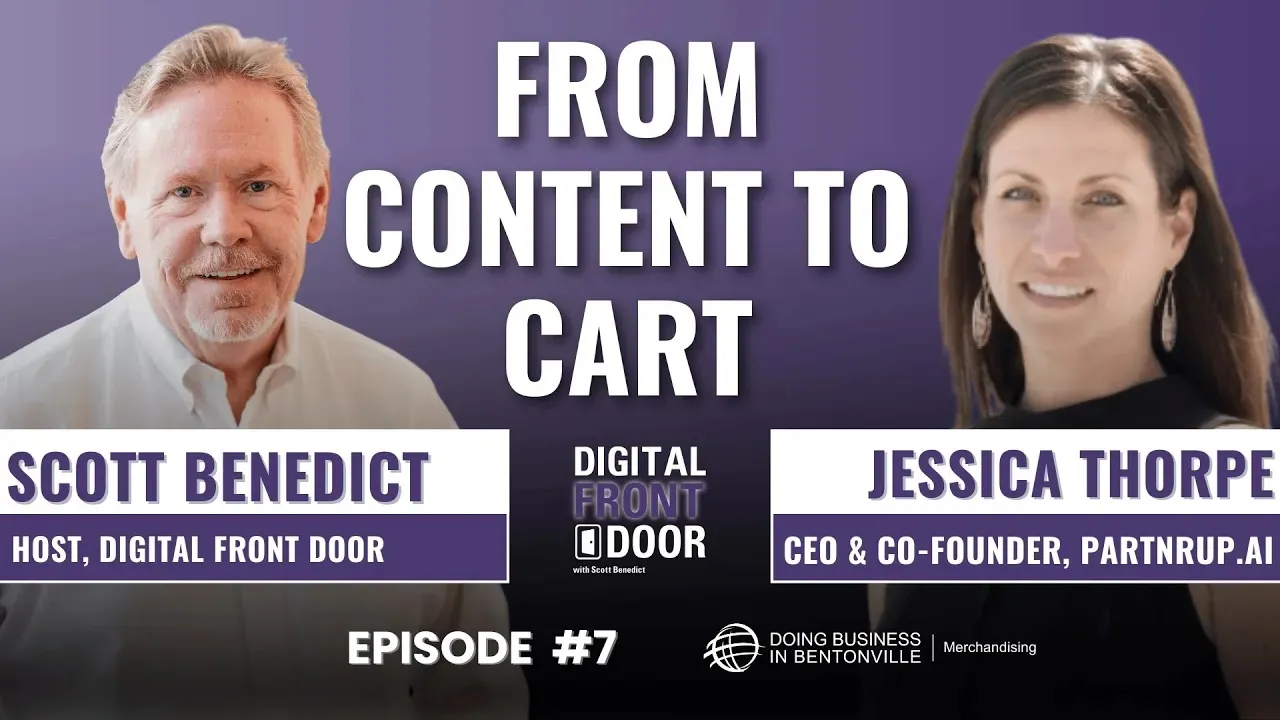
What if the real “digital shelf” lives inside your social feed? We sat down with Jessica Thorpe, CEO of PartnrUp, to unpack how creators, user-generated video, and smart automation now drive verifiable lift at retailers like Amazon and Walmart, and why that changes how brands plan, fund, and measure growth.
We walk through the big shift from top-of-funnel hype to bottom-line impact: creator videos show up where shoppers research, answer the questions brand assets miss, and carry affiliate links that shorten the path to purchase. Jessica breaks down a practical operating system for partnership marketing, streamlining creator discovery, contracting, and syndication, so teams can reuse content across social, retail media, and product pages. The result is a ROM model that stacks value: reach from social distribution, outcome from tracked clicks and sales, and merchandising gains from higher PDP conversion.
We also draw a firm line on AI. Automation should handle scale job; shortlisting creators, outreach, briefs, and campaign support, while humans deliver the authentic storytelling that builds trust. You’ll hear data-backed insights on mobile vs desktop buying, how to correlate social traffic with glance views and sales, and why mixing UGC with brand content on product pages delivers the strongest results. Looking ahead, we explore creative variability, personalization across hooks and formats, and how one-to-one creator-audience tools will route shoppers to their preferred retailers without losing attribution.
If your team manages influencers in PR, performance in media, and the digital shelf in ecommerce, this conversation lays out how to connect the dots and prove impact where it counts. Subscribe, share with a teammate who owns the PDP, and leave a review with the metric you care about most, we’ll tackle it in a future show.
More About this Episode
How Creator Commerce is Reshaping the Digital Shelf: A New Era of Retail Influence
In today’s retail landscape, a transformative shift is underway, one that is redefining how consumers discover, consider, and ultimately purchase products. At the heart of this transformation is creator commerce, a powerful intersection of influencer marketing, user-generated content (UGC), and artificial intelligence. No longer confined to mere brand awareness, creator-led content is now driving measurable conversions, influencing retail strategies, and altering the very structure of the digital shelf.
In this article, we’ll explore how brands can harness the evolving creator ecosystem to not only fuel top-of-funnel engagement, but to drive real sales, close attribution loops, and optimize omnichannel strategies. Drawing from a deep conversation with Jessica Thorpe, CEO of PartnrUp, a company pioneering the space of partnership marketing, we’ll uncover how retailers and brands can thrive in this new era.
From Word-of-Mouth to Digital Influence
At its core, creator commerce is the digital evolution of word-of-mouth marketing. For decades, retailers have leaned on consumer reviews and ratings to guide purchase decisions. But today, those voices have scaled and evolved. Now, instead of hearing about a great product from a friend or family member, shoppers are turning to content creators on YouTube, TikTok, Instagram, and beyond, trusted voices whose opinions often outweigh even those of brands and retailers.
Jessica Thorpe, whose work spans nearly two decades in video-driven commerce, explains it this way: “People buy things they need, or things they’ve heard about from someone they trust. Today, that trusted source is often a content creator, someone whose opinion carries more weight than a brand ad ever could.”
This consumer trust is not accidental, it’s earned through authentic storytelling, real product experience, and consistent value delivery. And as Thorpe notes, this shift has driven creator content from a mere brand play into a legitimate retail sales channel.
The Rise of the Digital Shelf 2.0
Traditionally, the digital shelf has referred to product pages on retailer websites, where images, bullet points, and reviews provide shoppers with the information they need. But that model is no longer sufficient. The new digital shelf now includes TikTok product demos, YouTube reviews, Instagram Reels, live shopping events, and short-form video testimonials, all of which often occur before a shopper ever visits a retailer’s site.
This broader “pre-shelf” experience is where brands are increasingly winning, or losing, consumer interest.
Platforms like Amazon and Walmart are beginning to embrace this shift. Amazon, for instance, now allows creator videos directly on product detail pages. These videos frequently outperform traditional assets by addressing unique customer concerns and presenting products in real-life contexts. As Thorpe notes, when influencer videos appear on a product page, they often answer different questions than branded content, helping reduce returns, increase conversion, and enhance trust.
In a controlled web lab study, Amazon found that the presence of UGC video increased conversion rates, proving that creator content has a tangible impact deep in the funnel.
Creator Content as a Full-Funnel Strategy
One of the major paradigm shifts in retail marketing is the reclassification of influencer content. Once seen purely as an upper-funnel awareness tactic, it’s now recognized as a full-funnel driver of consideration, conversion, and even post-purchase engagement.
Creators are no longer just amplifiers. They are educators, product demonstrators, reviewers, and in many cases, closers. And the platforms they use, from TikTok to YouTube, are increasingly being used not just for entertainment, but as search engines for product research.
According to Thorpe, “YouTube isn’t just a video platform, it’s a product research destination. Consumers go there with specific needs, and brands must show up in those search results with creator-led content if they want to be part of the consideration set.”
This insight is especially critical in the age of AI-driven search. If your brand’s content isn’t optimized to appear in AI-powered results (from platforms like Google’s Search Generative Experience or ChatGPT integrations), you may never even make it into the shopper’s initial shortlist.
Measurement and Attribution: Closing the Loop
One of the key developments enabling the rise of creator commerce as a retail driver is improved attribution and measurement. Thanks to advancements in affiliate technology, data partnerships, and retail media integration, brands can now tie influencer content directly to in-store and online sales.
Platforms like YouTube, which were early adopters of affiliate linking in video descriptions, have made it possible to track downstream conversions. PartnrUp, Thorpe’s company, has worked on campaigns where influencer activity not only lifted awareness but measurably increased in-store sales at retailers like Walmart.
Additionally, brands now have access to tools that allow them to match influencer-driven traffic with glance views, cart additions, and completed purchases across e-commerce channels. This level of visibility is what’s enabling creators to be seen as performance partners, not just content collaborators.
AI and Automation: Scaling Without Sacrificing Authenticity
With hundreds or even thousands of creators engaging across campaigns, brands need scalable systems to manage outreach, contracting, compliance, and reporting. This is where AI steps in, not to replace human storytelling, but to streamline operational inefficiencies.
PartnrUp leverages AI agents to automate tasks like creator discovery, outreach, and campaign management, freeing up human teams to focus on strategic storytelling and brand alignment. For example, AI can pre-screen creators based on demographics, content style, and audience alignment with a specific product category. It can draft outreach emails, assist with contracting, and handle repetitive creator questions like shipping timelines or usage rights.
However, Thorpe offers a caution: AI must be used responsibly. “There’s a fine line between using AI to assist in production and using AI to impersonate human experience. The moment you try to fake authenticity, you lose trust, and that trust is the cornerstone of this entire ecosystem.”
In other words, AI should support, not substitute. Brands looking to shortcut the creative process with synthetic content risk undermining their credibility.
Breaking Down Silos: A New Retail Operating System
One of the greatest barriers to maximizing creator commerce is internal organizational structure. In many companies, influencer marketing sits with PR or brand teams, while e-commerce and retail sales operate in entirely different silos. This disconnect limits the strategic deployment of content where it’s needed most, on the digital shelf.
Thorpe argues for a unified model, one where influencer content is purpose-built for cross-functional value. This includes upper-funnel engagement, product detail page enhancements, affiliate-driven conversions, and even post-purchase support. PartnrUp’s platform acts as an “operating system” for this type of partnership marketing, integrating creators, content syndication, affiliate links, and measurement into a cohesive workflow.
Brands that break down these silos are seeing superior outcomes. They’re not just building brand equity, they’re driving unit sales, increasing velocity, and strengthening retailer relationships.
The Role of Mobile and Shoppability
The dominance of mobile can’t be overstated. According to data shared by Thorpe, 30 to 50 percent of transactions from influencer-driven links now happen on mobile devices. Social platforms have evolved from discovery engines into fully integrated commerce ecosystems, with in-app checkouts, product tagging, and shoppable video all reducing friction.
The path to purchase is shortening dramatically. Today, a consumer can watch a TikTok review, tap a link, and buy directly in seconds, all without leaving the platform. For brands, this means that creative content must be designed not only to inform and engage, but to convert.
Shoppability is no longer a feature. It’s a foundational requirement of modern retail content.
The Future of Creator Commerce: Personalization, Media, and Retail Integration
Looking ahead, the creator commerce space is poised to become even more integrated with broader retail and media strategies. Here are a few key areas of convergence:
- Retail Media NetworksAs retailers build out their retail media ecosystems, expect to see creator content become a core creative asset. It offers authenticity, diversity, and proven conversion potential, exactly what brands need to fuel performance media campaigns.
- Personalized Content at ScaleAI-driven personalization will enable brands to deliver custom content formats, tones, and creators tailored to individual shoppers, based on past behavior, demographics, and platform usage.
- Creator-Powered DTC and Brand CommunitiesMore creators are launching their own communities, capturing first-party data, and becoming media owners in their own right. Brands can collaborate with these communities to run exclusive product drops, personalized offers, and feedback loops.
- Ethical AI and Authenticity StandardsThe industry will likely see a push toward standardizing disclosure practices, safeguarding against AI deception, and protecting the credibility of content. Those who lead with transparency will earn long-term consumer trust.
Final Thoughts
Creator commerce is no longer an experimental tactic. It’s a strategic imperative.
As Jessica Thorpe and the team at PartnrUp have demonstrated, creator content is influencing the full spectrum of the shopping journey, from inspiration to conversion and even post-purchase support. When combined with smart AI usage, solid measurement practices, and an integrated omnichannel approach, it becomes a growth engine for both brands and retailers.
In a world where authenticity sells and attention is scarce, the creator is the new shelf. And for brands ready to embrace that reality, the opportunities are immense.