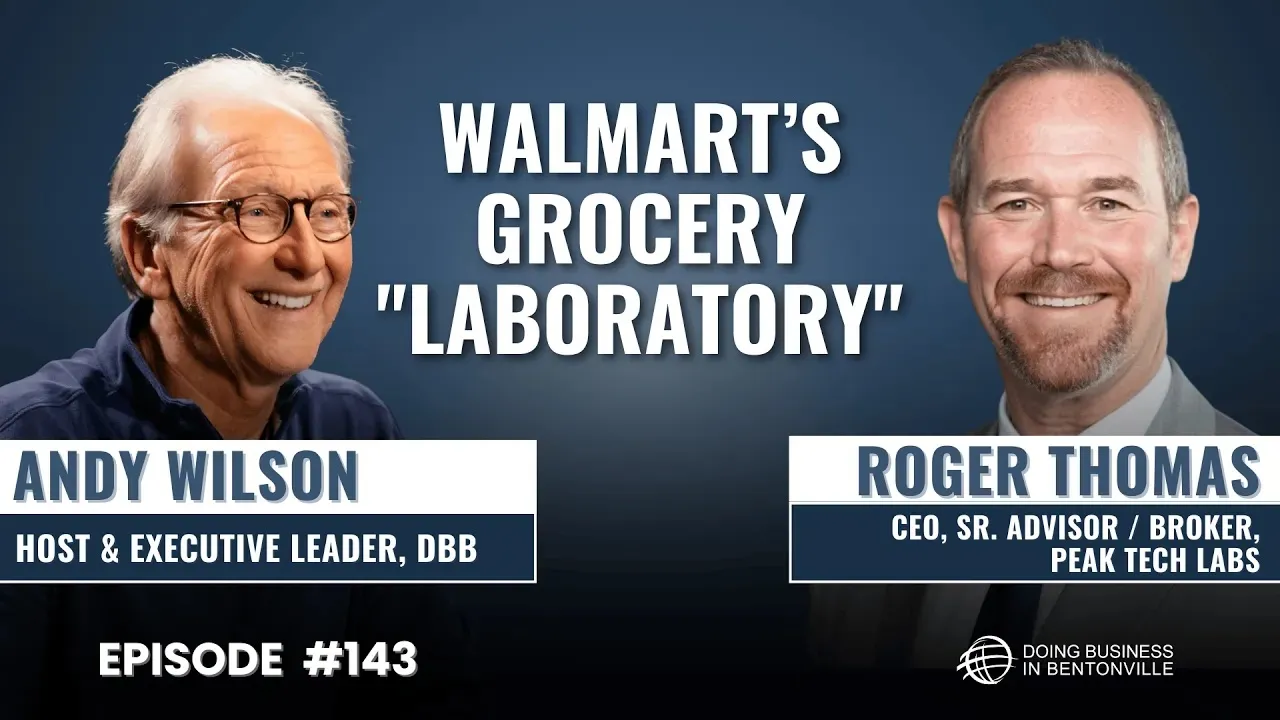
Walmart didn’t become a grocery powerhouse by accident. A big part of that story starts in Northwest Arkansas with a family-run grocery operation, Food For Less, and a relationship built on trust with Sam Walton and the early Walmart leadership team. We talk through how placing Food For Less stores beside Walmart locations created a real “learning lab” for grocery, helped shape the Supercenter model, and proved what can happen when partners share ideas instead of treating each other like competition.
Then we jump forward to the next transformation: technology. Roger Thomas, CEO of Peak Tech Labs, walks us through the waves that reshaped business, from the internet boom to the Great Recession’s sudden demand for video conferencing, and why infrastructure IT only feels “boring” until it breaks. We get practical about what businesses need now: Unified Communications as a Service, resilient connectivity, and cloud-first systems that support how teams actually work today.
The most urgent topic is AI. We dig into organizational AI and why private AI and secure AI are becoming essential for companies handling sensitive data like healthcare records, education information, government data, and proprietary strategy. We also explore cloud physical security, where cameras, access control, and modern monitoring are moving into the IT lane fast. If you’re building in retail, serving Walmart suppliers, or leading a growing company that wants a real competitive edge, this conversation offers both history and a clear path forward.
If this helped you think differently about partnerships, AI, or business technology strategy, subscribe, share the show with a friend, and leave a review so more builders can find us.
More About this Episode
The Grocery Secret That Built a Retail Empire: The Food For Less Legacy
The history of retail in Bentonville is often told through the lens of a single giant, but if you dig into the roots of how Walmart became a global powerhouse, you find a story built on partnerships, mutual trust, and a family-run grocery chain called Food For Less. Most people today see Walmart as a dominant force in grocery, but there was a time when the "merchandise store" was just that, a place for general goods. The transition into the grocery space, which effectively fueled Walmart's unlimited growth, didn't happen by accident. It happened because of a "laboratory" provided by the Phillips family and their Food For Less stores.
I recently had the pleasure of sitting down with Roger Thomas, whose ties to the Phillips family go back forty years. Our conversation took us down memory lane, but it also shed light on why Walmart is the company it is today. Without the groundwork laid by Food For Less in the 1970s and 80s, the Walmart Supercenter as we know it might never have existed.
The Phillips Family: Pioneers of the Warehouse Model
Long before every street corner had a supermarket, the Phillips family was running Phillips Grocery Stores and Phillips Food Centers throughout Northwest Arkansas. By the time Roger married into the family in 1986, they held the franchise rights to Food For Less across Arkansas, Oklahoma, and Missouri.
Food For Less was a pioneer. It was one of the first true "warehouse" grocery stores. This was the era where the concept of bagging your own groceries to save money was radical. At the heart of this enterprise was Harlan Phillips, a man who was as brilliant as he was humble. Despite running a massive operation of over thirty stores, Harlan’s favorite place to be was at the end of a cash register bagging groceries. He lived and breathed the business, and that hands-on ethics permeated the entire family culture.
A Partnership Built on Trust: The Sam Walton and Harlan Phillips Connection
The seismic shift in retail history occurred because of the friendship between Harlan Phillips and Sam Walton. They were buddies in the 60s and 70s, and at some point, a conversation happened that changed everything. Sam’s vision was broad, but he knew he needed to learn the grocery business. He approached Harlan with a simple but revolutionary idea: "What if we put your Food For Less stores right beside my Walmart merchandise stores?"
For those who remember the landscape in the mid-80s, this was a common sight. You would see a Walmart building and, right beside it, a Food For Less building. They were separate entities with separate space between them, but they acted as an unintentional "supercenter" prototype.
Inside Walmart, Sam was very clear about this relationship. He told his officers that Food For Less was not a competitor; they were a partner. He viewed them as a laboratory where Walmart could learn the complexities of the food business, perishables, supply chains, and high-frequency turnover. Sam was adamant that the Phillips family be treated with honor and paid fairly. It was a partnership built on a shared vision and, most importantly, absolute trust.
The Birth of the Supercenter
By 1988, just a few years after this side-by-side experiment reached its peak, the Walmart Supercenter was born. The integration was so successful that Walmart eventually moved to bring the grocery operation entirely under its own roof.
This transition was the "unlimited growth" unlock. As Sam used to say, there is a limit to how many discount stores you can build selling only general merchandise, but the demand for food is infinite. By leveraging the expertise of the Phillips family, Walmart was able to scale grocery services at a level that challenged, and eventually surpassed, world-class grocers. Today, with over 3,600 Supercenters, it is hard to imagine that this global dominant force started with a few family-run warehouses in rural Arkansas communities like Berryville and Rogers.
The Next Frontier: From Grocery Aisles to Private AI
The entrepreneurial spirit that drove the Phillips family hasn't disappeared; it has simply shifted into the digital space. Roger Thomas is now at the helm of Peak Tech Labs, a company that reflects the same commitment to "doing business right" that he witnessed forty years ago.
Just as Food For Less was a pioneer in warehouse grocery, Peak Tech Labs is navigating the frontier of the "Intelligence Revolution." We are currently seeing a massive shift in how businesses handle data, specifically with the rise of Private or Organizational AI.
Many professionals are familiar with public AI tools like ChatGPT, but for businesses handling sensitive government data, medical records, or proprietary financial information, public tools are a liability. Peak Tech Labs specializes in creating secure, private AI environments. This allows a company’s employees to leverage the power of large language models without broadcasting their internal data to the entire world.
The Rise of the "AI Agent" and Decision Advantage
Roger's vision for the future of work involves every business person having their own AI "assistant" or "agent." We’ve all said, "If only I could duplicate myself." In the 2026 business landscape, that is becoming a reality.
Organizational AI isn't just about writing emails faster; it’s about "Decision Compression." It allows humans to move away from the "scut work" of data entry and manual analysis, focusing instead on high-value strategy and storytelling. This mirrors the shift we saw in the grocery business: automating the background processes so you can focus on the customer standing right in front of you.
Lessons from the Great Recession: Resilience Through Tech
Peak Tech Labs also carries forward the lesson of resilience. During the 2008 recession, Roger saw how technology like video conferencing, which cost upwards of fifty thousand dollars at the time, saved businesses that could no longer afford to fly representatives across the country.
Today, that same resilience is found in Cloud Physical Security and Unified Communications (UCaaS). The responsibility for building security has shifted from facilities directors to IT departments. Everything from license plate recognition to facial risk recognition is moving into the cloud. This transition from "analog days to cloud days" is exactly the kind of seismic shift Roger has navigated throughout his career, from the pre-internet tech boom to the current AI wave.
Doing Business with Honor
The common thread from the Phillips grocery stores to Peak Tech Labs is a commitment to integrity. Roger mentioned that he never wants to get the "best end" of a deal; he wants his partners to walk away feeling they won. In a world of fast-moving tech and aggressive retail, that level of transparency is rare. It’s why he remains a registered member of the Better Business Bureau and Dun & Bradstreet, he wants the "third-party word" to back up his brand.
Whether you are bagging groceries in Berryville or architecting a private AI network for a Fortune 500 supplier, the principles remain the same:
- Listen to the Customer: Sam and Harlan did it in the aisles; tech leaders do it in the architecture.
- Embrace the Experiment: Not every laboratory works, but the ones that do change the world.
- Lead with Trust: You can't build a supercenter, or a secure network, on a foundation of skepticism.
Conclusion: Grabbing the Next Wave
The story of Food For Less and Peak Tech Labs is a testament to the power of the American entrepreneur. We live in a region where a small rural grocery store can become the blueprint for the world's largest retailer, and where a family-run tech firm can help secure the next generation of artificial intelligence.
As we move forward into 2026, the goal is to capitalize on these new tools before the competition does. We are in the "less than a year old" phase of organizational AI. It is an exciting, high-stakes time to be doing business in Bentonville. The frontier is open for those who are willing to learn, adapt, and, most importantly, do business with honor.