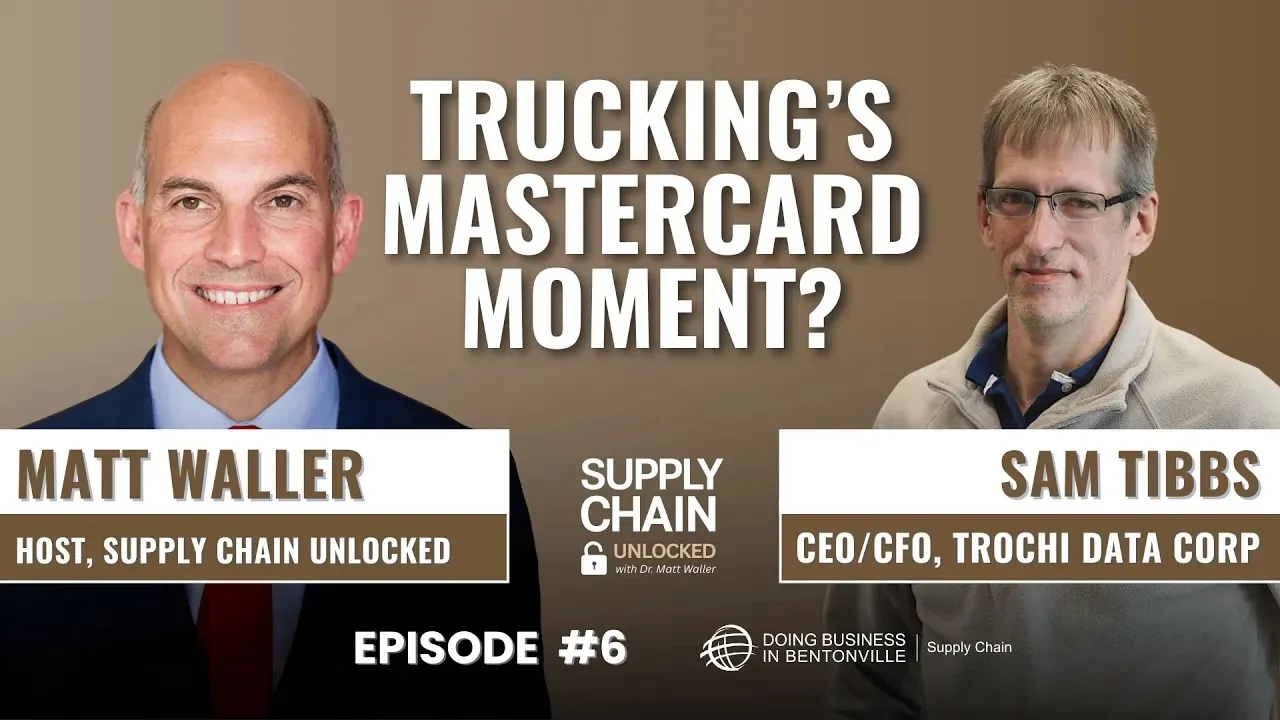
What happens when a Navy nuclear power alum and finance PhD turns his focus to trucking? Sam Tibbs joins us to make a bold case: freight doesn’t have a tech problem, it has an incentive problem. He traces the unlikely route from teaching and data science to building the tools that exposed lane-level profit and drove the most-used variables in Sonar, then explains why today’s rate products miss the mark. If your pricing relies on paperwork extracted after delivery and guesses that fill in missing details, you’re driving with fogged windows.
We dig into the real bottleneck: timely, detailed data at the moment of booking. Sam argues that brokers create the signal, yet pay to buy back their own data days later, stripped of nuance like stops, hazmat, or lead time. His answer is refreshingly practical and familiar to anyone in finance: build a neutral, broker-owned data layer, much like how MasterCard aligned competing banks, where contributors are rewarded for high-quality inputs. With ownership and governance in place, the incentives flip, participation rises, and the rate product can finally show distributions that move with the market instead of stale averages.
Along the way, we contrast “great data plus a good model” with “good data plus a great model,” explore why LLMs can’t rescue missing truth, and outline where competitors should cooperate versus where they should battle. The near-term payoff is a cleaner rate signal and fewer pricing mismatches; the long-term vision is brokers turning a cost center into a profit center while shippers and carriers benefit from sharper, faster decisions. If you care about freight pricing, data quality, or building markets that actually work, this conversation maps a credible path forward.
If this resonates, follow the show, share it with a colleague, and leave a quick review so more folks in freight can find it. What's your take: should brokers own the data layer or keep buying it back?
More About this Episode
How Trochi is Reimagining Freight Rate Data by Empowering Brokers
In the trucking and logistics industry, data is everywhere, but ironically, it’s often locked away, siloed, incomplete, or outdated. This fragmentation has long hindered innovation, particularly when it comes to accurate rate forecasting and real-time decision-making. Enter Trochi, a new venture led by Sam Tibbs, a seasoned expert with a PhD in Finance, a CFA charter, and deep experience in both transportation and financial modeling. Trochi isn’t just another tech platform; it’s a broker-owned data company reshaping how freight rate intelligence is collected, shared, and monetized.
At the heart of Trochi’s mission is a bold, yet refreshingly commonsense idea: the people who create the data should own it, benefit from it, and ultimately drive the products built on top of it.
From Nuclear Engineering to Freight Data: A Cross-Disciplinary Journey
Sam Tibbs' journey into trucking and logistics wasn't a straight line. Originally trained in nuclear engineering technology, Tibbs spent time in the Navy’s Nuclear Power Program before diving deep into finance, eventually earning his PhD and CFA charter. While working abroad in the UAE and later returning to Chattanooga due to family circumstances, he found himself unexpectedly entering the freight world.
Initially struggling to find traditional finance work, Tibbs rebranded himself as a data scientist, which quickly opened doors. That pivot led to roles at major freight companies like Covenant Transport, FreightWaves, CloudTrucks, and TriumphPay. Along the way, he built some of the most used tools in the industry, from profitability analyzers to pricing systems that supported RFPs and dynamic rate calculations. These experiences gave him a firsthand look at the shortcomings of existing freight rate data products and the systemic issues holding them back.
Why the Freight Industry Has a Data Problem, Not a Tech Problem
It’s tempting to think that solving freight’s inefficiencies is a matter of better algorithms, AI, or fancier tech stacks. But as Tibbs argues, this is fundamentally a data access and incentives problem. The best model in the world can't compensate for stale, low-quality, or incomplete inputs. In fact, a decent model with superior data will consistently outperform a highly sophisticated model with inferior inputs.
What makes high-quality truckload data so hard to centralize? It comes down to ownership and incentives. In today’s system, brokers, who generate most of the valuable freight data, often hand it over to third-party platforms for free or minimal compensation. These platforms then aggregate, analyze, and resell the data back to the very brokers who provided it.
Tibbs draws a compelling analogy: Imagine owning land with oil beneath it, but instead of profiting from it, you give it away for free and then buy gasoline made from your own crude. That’s the current freight data economy.
Trochi’s MasterCard-Like Model: Shared Ownership and Governance
The insight that catalyzed Trochi was Tibbs' realization that the model he was building resembled MasterCard's early governance structure. In the 1960s, MasterCard created a shared infrastructure owned by competing banks, enabling them to cooperate on payments processing while still competing for customers. Trochi is applying that same cooperative model to broker data.
In Trochi’s case, brokers collectively own 80% of the company. This ownership structure ensures two things: first, brokers have a direct financial incentive to contribute high-quality, timely data; and second, they maintain control over how their data is used. Trochi itself only retains 20% of ownership, ensuring the platform remains neutral, transparent, and aligned with the interests of its contributors.
This isn't just symbolic ownership. It’s baked into the governance structure. Brokers help define what data gets shared, how it’s standardized, and which products are built on top of it. Whether that’s a new rate index, predictive analytics tools, or even a future freight marketplace, brokers are in the driver's seat.
The Power of Better Data: What Trochi Delivers That Others Don’t
Unlike many current rate products, which may rely on incomplete or delayed data, Trochi is designed to operate at the booking stage, not after delivery. That means more real-time insights and significantly more actionable intelligence.
One of the major weaknesses in existing rate indices is the lack of shipment detail. When multi-stop loads, hazmat shipments, or special requirements (like lift gates or escorts) aren’t captured in the data, the rates derived from them are misleading. Trochi solves this by incentivizing contributors to share deeper, more structured data, because they now benefit from its reuse.
That richer data enables several key advancements:
- More accurate benchmarking: With detailed context for each load, shippers and brokers can compare apples to apples.
- Distributional insights: Instead of relying on simple averages or quartiles, users can analyze full rate distributions and better detect market shifts.
- Faster decision-making: Booking-stage data means less lag and more timely strategic adjustments.
In short, better data enables better rates, better pricing strategies, and better outcomes across the board.
Aligning Incentives: Turning a Cost Center into a Profit Center
One of Trochi’s most radical ideas is flipping the current freight data model on its head. For brokers, data has historically been a cost center, something that must be shared to access tools or benchmarks, but which provides no direct return. Trochi’s model changes that.
By granting ownership in exchange for data contribution, Trochi turns freight data into an asset class, something that appreciates in value as it’s pooled, refined, and integrated into new tools. The more brokers contribute, the better the data set becomes, the more valuable the products built from it, and the greater the shared upside.
As Tibbs explains, this model is also a safeguard against disintermediation. Many existing platforms position themselves to eventually cut out brokers. Trochi takes the opposite approach: it only succeeds if brokers succeed.
Long-Term Vision: Rate Products, Marketplaces, and Broker-Led Innovation
The first product out of the gate for Trochi is a truckload rate product, a logical starting point given its wide adoption and relatively low product-market fit risk. But the platform is designed to support much more.
If brokers decide to pursue it, Trochi could provide the backbone for a new kind of freight marketplace, built on top of broker-controlled data, not in opposition to it. And unlike costly attempts by DAT, TriumphPay Exchange, and others to build similar systems (which Tibbs estimates may have cost half a billion dollars), Trochi would have the advantage of superior data from day one.
That flexibility is intentional. Trochi’s structure doesn’t dictate what comes next, it empowers brokers to decide. Whether that’s advanced analytics, contract optimization tools, or collaborative marketplaces, the foundation is in place.
Convergent Evolution in Business
Tibbs uses the term convergent evolution to describe how Trochi and MasterCard arrived at similar structures from different origins. Just like dolphins and sharks evolved similar body shapes due to the demands of underwater environments, MasterCard and Trochi both evolved governance models that balance cooperation and competition, because the environment demanded it.
What Trochi has created is a framework for coopetition, one that enables collective benefit without undermining individual broker businesses.
What Success Looks Like
In the next five to ten years, success for Trochi would mean:
- Brokers no longer have to pay to access their own data in aggregate.
- Shippers benefit from more accurate and dynamic rate forecasts.
- Consultants, pricing teams, and analytics platforms have better tools to work with.
- The freight industry shifts from reactive pricing to predictive, data-driven decision-making.
- Most importantly, brokers share in the value created by their own data.
Trochi isn’t trying to outcompete brokers, replace them, or own their business models. It’s trying to help them do their jobs better, armed with the kind of data infrastructure previously only available to Silicon Valley giants.
Final Thoughts
Trochi represents a rare kind of innovation in freight, not one based on flashy tech, but on sound economics, real-world experience, and aligned incentives. It’s a reminder that sometimes the best ideas aren’t about inventing something entirely new, but fixing what’s been broken for too long.
With brokers at the center and data as the engine, Trochi isn’t just building a product. It’s helping to reshape an industry.