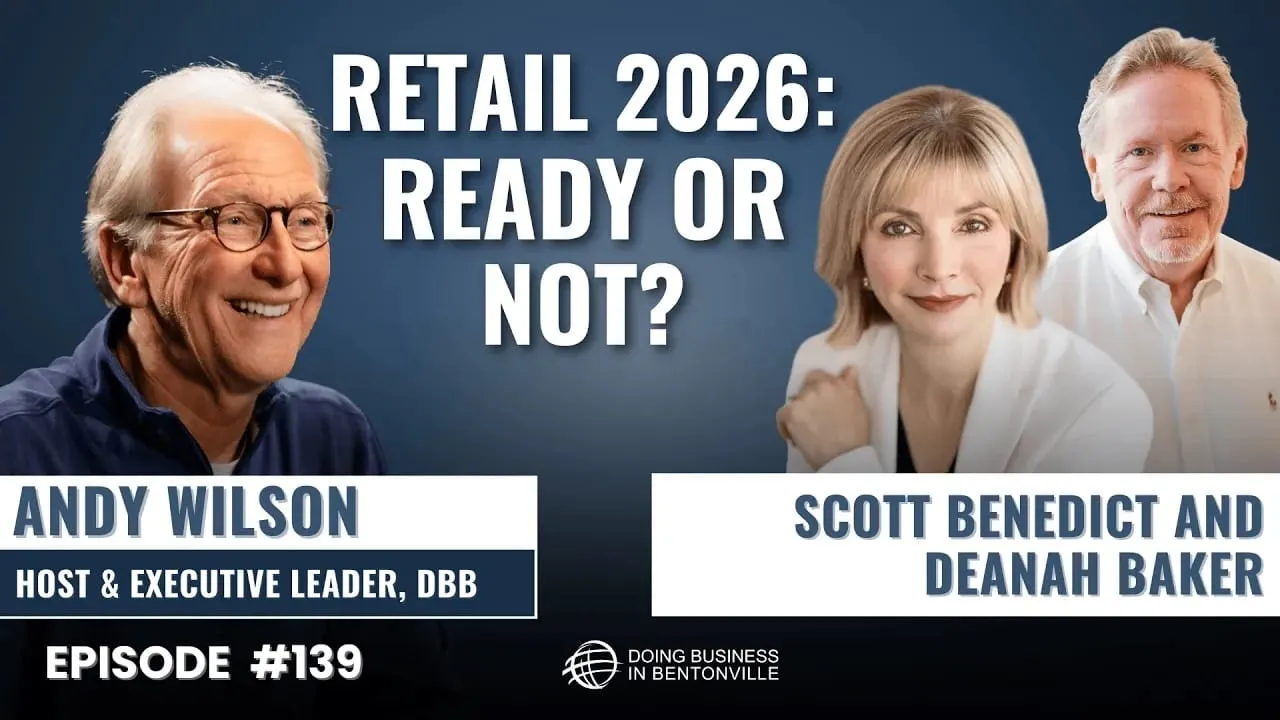
Blink and the shopper has already moved on. We sat down with fellow DBB hosts Deanah Baker and Scott Benedict to map the retail shifts that will define 2026, where AI turns shopping into solution-finding, value stretches beyond price, and health becomes the default filter for every aisle.
We start with the pace of change and why being late to a behavior shift is costly. Consumers are already using AI tools and shopping agents to assemble entire solutions: meals tailored to nutrition goals, outfits for specific events, or home projects within a budget. Scott breaks down how agentic commerce weighs price, speed, stock, reviews, and delivery windows with zero emotion, forcing brands and retailers to upgrade product detail pages, data quality, and last-mile execution. Deanah zooms in on the merchant’s craft, showing how AI can take on the heavy lifting, forecasting, enrichment, and routine analysis, so teams can focus on curation, brand DNA, and staying close to the customer.
Then we tackle value in a tougher economy. Private brands aren’t filler; they’re strategic engines that signal quality and put pressure on national brands to justify gaps. We explore how value shows up as speed, reliability, and breadth of choice, not just low prices, and why shoppers now mix luxury and private label within the same trip. Finally, we dig into the rise of health and wellness, from “food as medicine” to smarter labels and educational product pages that help customers compare protein, sugar, and sodium at a glance. Wellness now touches pantry, apparel, and home, and it’s powered by trusted content plus fast, predictable fulfillment.
If you lead merchandising, marketing, supply chain, or brand, this conversation offers a practical map: build agent-ready content, design true private brands, redefine value, and train teams to move with speed. Part two goes deeper by retailer: Amazon, Walmart, Target, Kroger, Aldi, and what these trends mean for each. Subscribe, share with a colleague, and tell us: which shift will you tackle first?
More About this Episode
Retail Trends 2026: AI, Value, and the New Rules of Winning in a Consumer-Driven Era
Retail has always been dynamic. But the speed of change we are witnessing today is fundamentally different. As we look toward 2026, one truth stands out: by the time a behavioral shift becomes obvious to everyone, it is already too late to catch up.
Infrastructure, technology platforms, fulfillment networks, loyalty ecosystems, and consumer data capabilities take years to build. No retailer can flip a switch and suddenly replicate Walmart’s fulfillment network or Amazon’s delivery infrastructure. The same applies to brands. If you are reacting instead of anticipating, you are behind.
So what are the defining retail trends shaping 2026? Based on industry conversations, executive insights, and the pace of recent developments, three forces rise to the top:
- AI and digital transformation
- Value and pricing strategy evolution
- Consumer health and wellness acceleration
Each is reshaping retail strategy. Together, they are redefining what it means to compete.
AI and Digital Transformation: The Consumer Is Moving Faster Than Retailers
Artificial intelligence is no longer theoretical. It is embedded in how consumers shop today. What is most striking is not just the technology itself, but the speed of consumer adoption.
During the most recent holiday season, shoppers used AI powered tools to discover products, compare alternatives, and solve specific problems. Many retailers assumed adoption would take years. Instead, consumers embraced these tools almost immediately.
Retail is no longer leading technological change. In many cases, it is chasing the customer.
The Rise of Agentic Commerce
One of the most disruptive developments is agentic commerce. Instead of searching for a specific product, consumers increasingly describe a problem or goal:
- “I need high protein snacks for a low sodium diet.”
- “Help me redesign a small home office.”
- “Find an outfit for a winter wedding.”
The AI agent evaluates product data, reviews, shipping speed, pricing, availability, and user generated content to recommend a solution.
This represents a dramatic shift from traditional product search. Retailers and brands can no longer rely solely on technical specifications or marketing language. AI systems are scanning:
- Ratings and reviews
- Delivery timelines
- Inventory availability
- Comparative pricing
- Feature relevance
These systems are unemotional. They reward completeness, accuracy, and clarity of information.
For brands, this means product detail pages are now strategic assets. For retailers, it means data integrity and fulfillment speed directly impact discoverability.
Merchandising in an AI Powered World
For merchants, AI presents both opportunity and challenge.
Historically, much of a merchant’s time was consumed by operational preparation: reconciling numbers, reviewing history, managing spreadsheets, preparing purchase plans. Only a fraction of time was spent curating assortments and deeply understanding the customer.
Over time, cross functional teams improved efficiency. But complexity also increased. Omnichannel retail doubled the workload. Digital and physical channels required simultaneous management.
If implemented well, AI can reverse this imbalance. Instead of spending 90 percent of time on preparation and 10 percent on customer curation, the model could shift. AI can handle the heavy analytical lifting, freeing merchants to focus on brand differentiation, assortment storytelling, customer insights and strategic category building.
The merchants who thrive in 2026 will not be replaced by AI. They will be amplified by it.
Value and Pricing Strategy: More Than Just Lower Prices
Value has become the defining consumer expectation across income levels. In inflationary environments, this is unsurprising. But what is notable is how broadly value is being redefined.
Value is no longer just price. It includes:
- Quality
- Convenience
- Speed
- Assortment breadth
- Delivery reliability
The Power of Private Brands
Private brands are playing a central role in the value equation. In many categories, private labels have evolved into private brands. The distinction matters.
Retailers increasingly invest in quality, packaging, benchmarking, and brand identity. These are not secondary options. They are strategic weapons.
Private brands allow retailers to:
- Deliver competitive price gaps
- Improve margin structure
- Pressure national brands to remain competitive
- Fill assortment gaps with targeted solutions
Consumers are comfortable mixing premium national brands with value focused private brands within the same basket. A shopper may splurge on luxury denim while choosing private label grocery staples. Value decisions are contextual and personal.
This selective prioritization underscores an important truth: consumers are not uniformly trading down. They are trading strategically.
Value Through Speed and Convenience
Speed is increasingly a component of value.
If a customer can place an order in the evening and receive it the next morning, that convenience carries value. If an out of stock item is fulfilled from a nearby location later that day, that operational excellence strengthens loyalty.
Retailers who define value solely as price are missing the broader opportunity. In 2026, value will be measured in friction reduction.
Consumer Health and Wellness: A Structural Shift
Health and wellness is no longer a niche trend. It is becoming a foundational consumer mindset.
Consumers are more informed than ever. They track fitness, monitor nutrition, research ingredients, and evaluate product claims. The concept that “food is medicine” is gaining traction. Wellness is increasingly viewed holistically.
Product Transparency and Education
This shift affects both product development and marketing.
Packaging now prominently highlights:
- Protein content
- Sugar free claims
- Sodium levels
- Functional benefits
But packaging is only part of the story. The digital product detail page has become an educational platform.
Consumers often research products online, even when purchasing in store. They evaluate:
- Ingredient lists
- Customer reviews
- Health certifications
- Comparative benefits
Retailers and brands must ensure health and wellness messaging is consistent across physical packaging, digital content, and in store signage.
The Ripple Effect of Lifestyle Shifts
Broader health trends are influencing entire categories. For example:
- Weight management medications are changing purchasing patterns.
- Functional foods and supplements are expanding.
- Apparel sizing and fit dynamics are shifting.
Health and wellness is not confined to grocery. It touches apparel, beauty, general merchandise, and even home categories.
Retailers that monitor these signals closely will adjust assortments proactively rather than reactively.
The Leadership Challenge: Training the Next Generation
While technology and consumer behavior dominate headlines, another critical trend is unfolding inside retail organizations: leadership transformation.
Who trains the next generation of merchants?
The core attributes of great merchants remain unchanged:
- Curiosity
- Customer advocacy
- Analytical thinking
- Brand building
- Decisiveness
AI does not eliminate these qualities. It heightens their importance.
The opportunity is to use AI to remove low value tasks and create more time for strategic thinking and coaching. Organizations must intentionally invest in training talent to think holistically, not just operationally.
At the same time, existing leaders face their own transformation.
Many grew up either in physical retail or digital retail. Today’s consumer does not distinguish between channels. Leadership must evolve to manage unified commerce models.
This transition may be uncomfortable. It requires letting go of legacy habits while embracing new tools. But avoiding that discomfort is not an option.
The retailers that thrive will develop leaders who can operate fluidly across physical and digital ecosystems.
2026: A Year of Separation
AI acceleration. Value redefinition. Health driven consumption. Leadership evolution.
These forces are converging rapidly.
The retailers and brands that invest now in infrastructure, data discipline, digital transformation, and talent development will widen the gap between themselves and slower competitors.
Those distracted by short term operational challenges may find it difficult to move forward later.
Retail has always rewarded speed. Today, speed must be paired with strategic foresight.
By the time a shift feels obvious, the advantage belongs to someone else.
The opportunity in 2026 is not just to react to change. It is to anticipate it, build for it, and lead through it.